24-Inch vs. 27-Inch Monitor: Which Size Is Best for Work and Gaming?

24 Inch vs 27 Inch Monitor

(By TechnoItem Expert Team | Last Updated: July 2026)

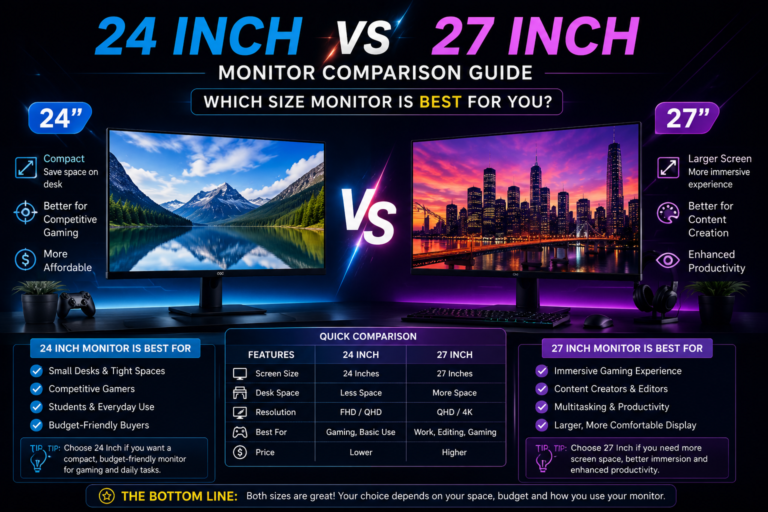
Quick Answer: 24-Inch vs. 27-Inch Monitor. For most people, a 27-inch monitor at 1440p resolution offers the best balance of screen space, image sharpness, and comfort for both work and gaming. However, a 24-inch 1080p monitor remains the sharper, more affordable, and space-efficient choice for competitive gamers and users with smaller desks. The right pick depends on your resolution preference, viewing distance, and how you split time between tasks.

Key Takeaways

  • 24-inch monitors pair best with 1080p resolution, delivering crisp pixel density (~92 PPI) and lower GPU demands.
  • 27-inch monitors shine at 1440p, offering more screen real estate without sacrificing sharpness (~109 PPI at QHD).
  • Sitting closer than 2.5 feet to a 27-inch 1080p monitor can make individual pixels visible—resolution matters as much as size.
  • Competitive gamers often prefer 24-inch monitors for a tighter field of view and faster eye-scanning speed.
  • Creative professionals and productivity users generally benefit more from the extra workspace a 27-inch screen provides.
  • The price difference between comparable 24-inch and 27-inch models typically ranges from $30 to $100, depending on specs.
  • Desk depth is a real constraint: a 27-inch monitor needs at least 30 inches of desk depth for comfortable viewing.
  • Both sizes are widely available across IPS, VA, and OLED panel types in 2026.

Why Monitor Size Is More Complicated Than It Looks

Monitor size alone doesn’t determine how good a display feels. The combination of screen size, resolution, and viewing distance determines whether text looks sharp, whether you need to move your head to see the corners, and whether your GPU can push enough frames.

The 24-inch vs. 27-inch monitor debate is really a debate about three things at once: pixel density, desk ergonomics, and use case fit. Getting just one of those wrong makes the other two irrelevant.

Here’s a quick reference to ground the comparison:

Spec 24-inch (1080p) 27-inch (1080p) 27-inch (1440p)
Resolution 1920×1080 1920×1080 2560×1440
Pixel Density (PPI) ~92 PPI ~82 PPI ~109 PPI
Ideal Viewing Distance 2–2.5 ft 2.5–3 ft 2–3 ft
GPU Demand Low Low Medium–High
Typical Price Range $130–$300 $150–$280 $220–$500+

💡 Key insight: A 27-inch monitor at 1080p actually has lower pixel density than a 24-inch at 1080p. If sharpness matters to you, pairing 27 inches with 1440p is almost mandatory.

Visit Amazon: https://amzn.to/4w7annX

How Does Screen Size Affect Work Productivity?

A larger screen directly increases the amount of content visible without scrolling or switching windows. For work, this translates to fewer alt-tabs, easier side-by-side document comparisons, and less eye fatigue from constant context switching.

27-inch monitors are generally better for productivity work, especially tasks like the following:

  • Spreadsheet analysis with many columns visible at once
  • Video or photo editing where timeline and canvas space matter
  • Writing with a reference document open alongside
  • Software development with split-pane code editors

A 24-inch monitor still handles all of these tasks well, but users often end up snapping windows at 50/50 splits that feel cramped. If desk space allows and the budget stretches to a 1440p 27-inch panel, the extra screen area pays off daily.

Choose a 24-inch if you work in a single-app environment most of the day (writing, data entry, calls), your desk is shallow, or you’re pairing the monitor with a laptop as a secondary display.

For users building a focused home office setup, pairing a 27-inch monitor with good office management software can meaningfully boost daily output.

Which Size Wins for Gaming: 24-Inch vs 27-Inch Monitor?

For gaming, the answer splits cleanly by game type. Competitive multiplayer gamers tend to favor 24-inch monitors; immersive single-player and RPG players lean toward 27 inches.

Why competitive gamers prefer 24 inches:

  • A smaller screen means less eye movement to scan corners—important in fast-paced shooters
  • 1080p at 24 inches is sharp enough and easier for GPUs to push at 144Hz or 240Hz
  • Lower input lag at high refresh rates is easier to maintain at 1080p
  • Most esports tournaments historically used 24-inch 1080p displays (though 27-inch adoption is growing in 2026)

Why a 27-inch wins for immersive gaming:

  • A larger field of view enhances open-world and story-driven games
  • 1440p at 27 inches delivers noticeably better texture detail and environmental depth
  • More comfortable for longer sessions at normal desk distances
  • Better for games where spotting distant details matters (strategy, RPGs, racing sims)

For a deeper look at display specs that matter in gaming, check out these gaming monitor tips for every gamer in 2026.

Common mistake: Buying a 27-inch 1080p monitor for gaming. The lower pixel density makes text and fine textures look soft, and the GPU savings don’t justify the visual downgrade compared to the 27-inch 1440p.

Does Pixel Density Actually Matter in Day-to-Day Use?

Yes, and it’s one of the most underrated factors in the 24-inch vs. 27-inch monitor decision. Pixel density (measured in pixels per inch, or PPI) determines how sharp text, icons, and images appear at your normal viewing distance.

  • At 24 inches / 1080p, you get roughly 92 PPI — sharp and clear at typical desk distances.
  • At 27 inches / 1080p, PPI drops to about 82—noticeable softness, especially in text-heavy work.
  • At 27 inches / 1440p, PPI rises to ~109 — sharper than the 24-inch 1080p option and noticeably better for detail work.

Rule of thumb: If you sit within 2.5 feet of your monitor, pixel density matters a lot. If you sit farther back (3+ feet), the difference becomes less obvious.

For users considering the Samsung Essential Monitor S3 27 or similar budget 27-inch options, checking whether the panel is 1080p or 1440p before buying is essential—the price difference is often smaller than expected.

What About Desk Space and Ergonomics?

Screen size has a direct physical cost: desk footprint. A 27-inch monitor is roughly 24 inches wide, while a 24-inch monitor measures about 21 inches wide. That 3-inch difference sounds small, but on a compact desk, it can affect cable management, speaker placement, and arm reach.

Ergonomic considerations by size:

  • 24-inch: Works well on desks 24 inches deep or more; easier to position at correct eye height without a monitor arm
  • 27-inch: Needs at least 28–30 inches of desk depth for proper viewing distance; a monitor arm is strongly recommended for height and tilt adjustment

A well-organized workstation makes a real difference in comfort over long sessions. Pairing either monitor size with a computer desk with drawers helps keep the workspace clean and cables managed.

Edge case: In multi-monitor setups, two 24-inch monitors often fit better side by side than two 27-inch panels, especially on standard 55-inch-wide desks.

How Does GPU Performance Factor Into the Decision?

Resolution directly affects how hard your GPU works. This is especially relevant for gamers but also matters for users running multiple displays or GPU-accelerated creative apps.

Use Case 24-inch 1080p GPU Demand 27-inch 1440p GPU Demand
Competitive gaming (144Hz+) Low–Medium Medium–High
Casual/single-player gaming Low Medium
Video editing (4K footage) Moderate Moderate–High
Office/productivity Very Low Very Low

For gaming at 1440p on a 27-inch monitor, a mid-to-high-tier GPU is recommended to maintain smooth frame rates. Users building or upgrading a gaming rig can explore prebuilt gaming PC options that are already optimized for 1440p performance.

Choose a 24-inch 1080p if your GPU is mid-range or older, you prioritize high refresh rates (165Hz+), or you play competitive titles where frame rate matters more than resolution.

Which Size Is Better for Creative and Professional Work?

For creative professionals — video editors, graphic designers, photographers, and 3D artists — screen real estate and color accuracy matter more than raw size. A 27-inch monitor at 1440p or higher gives more timeline space in video editors, more canvas room in design tools, and better detail visibility when retouching photos.

Best fit by profession:

  • Graphic designers: 27-inch 1440p (more artboard visibility, better color gradation)
  • Video editors: 27-inch 1440p or larger (timeline depth, preview window size)
  • Photographers: Either size works, but the 27-inch shows more detail in full-res previews
  • Programmers/developers: 27-inch for multi-pane layouts; 24-inch works fine for single-file focus
  • Writers/content creators: 24-inch is sufficient; 27-inch helps when referencing sources alongside drafts

Creative users who also need to record their screen for tutorials or walkthroughs should consider how monitor resolution affects output quality—see our guide to the best screen recording software for Mac for resolution-specific tips.

What Is the real price difference between 24-inch and 27 Inch Monitors?

24-Inch vs. 27-Inch Monitor

The cost gap between 24-inch and 27-inch monitors has narrowed significantly in 2026. At the budget end, a quality 24-inch 1080p IPS monitor starts around $130–$160, while a comparable 27-inch 1080p model runs $150–$200. The real price jump comes when moving to a 27-inch 1440p, which typically starts around $220 and climbs to $500+ for high-refresh-rate or OLED panels.

Price tiers to know:

  • Under $200: 24-inch 1080p IPS (best value for this budget)
  • $200–$350: 27-inch 1440p IPS or VA (sweet spot for most users)
  • $350–$600: 27-inch 1440p 165Hz+ or 4K 27-inch options
  • $600+: OLED 27-inch, ultra-high-refresh 1440p, or 4K 144Hz panels

For users browsing the full monitor category to compare current models and prices, filtering by resolution first (not just size) saves time and avoids the 27-inch 1080p trap.

FAQ: 24-Inch vs 27-Inch Monitor

Q: Is a 27-inch monitor too big for a small desk?
A 27-inch monitor needs at least 28–30 inches of desk depth for comfortable viewing. On desks shallower than that, sitting too close can cause eye strain and make the screen feel overwhelming.

Q: Can you use a 27-inch monitor at 1080p for gaming?
Yes, but it’s not ideal. The lower pixel density (~82 PPI) makes text and fine details look softer than a 24-inch 1080p or 27-inch 1440p panel. It’s acceptable for casual gaming but noticeable in text-heavy games or UI.

Q: Which size is better for competitive FPS gaming?
Most competitive FPS players prefer 24-inch monitors because the smaller screen reduces the eye movement needed to scan corners, and 1080p is easier to push at 240Hz+ refresh rates.

Q: Is 1440p worth it on a 27-inch monitor?
Yes. At 27 inches, 1440p hits a sweet spot of ~109 PPI—noticeably sharper than 1080p at the same size and a meaningful upgrade for both work and gaming without the GPU cost of 4K.

Q: What’s the best viewing distance for a 27-inch monitor?
Between 2.5 and 3.5 feet (roughly 75–105 cm) is comfortable for most users at 1440p. Sitting closer than 2.5 feet can make the screen feel too large and increase eye strain.

Q: Do professional esports players use 24- or 27-inch monitors?
As of 2026, many professional esports setups still use 24-inch 1080p monitors at 240Hz or higher, though 27-inch 1440p adoption is increasing in strategy games and less twitch-dependent titles.

Q: Is a 24-inch monitor good enough for photo editing?
It works, but a 27-inch at 1440p or higher gives more detail visibility and better color gradation for retouching and color-grading work.

Q: Which size is easier on the eyes during long work sessions?
A 27-inch monitor at 1440p tends to reduce eye strain for text-heavy work because text can be displayed at a larger physical size without losing sharpness, reducing the need to squint or lean in.

Q: Should I get a 24- or 27-inch monitor for a dual-monitor setup?
Two 24-inch monitors fit more comfortably on standard desks and are easier to position symmetrically. Two 27-inch panels work well but require a wider desk (55+ inches) and, ideally, dual monitor arms.

Q: Does monitor size affect frame rate?
Monitor size itself doesn’t affect frame rate. Resolution does. A 27-inch 1440p monitor requires more GPU power to hit the same frame rate as a 24-inch 1080p monitor

Conclusion: Making the Right Choice in 2026

The 24-inch vs. 27-inch monitor question doesn’t have a universal answer—but it does have a clear framework.

Go with a 24-inch monitor if:

  • You play competitive multiplayer games and prioritize high refresh rates
  • Your desk is compact, or you sit closer than 2.5 feet to your screen
  • Your GPU is mid-range, and you want to maximize frame rates at 1080p
  • The budget is tight, and you want the sharpest image per dollar

Go with a 27-inch monitor if:

  • You split time between productivity work and immersive gaming
  • You want 1440p resolution for noticeably sharper visuals
  • You do creative work (editing, design, development) that benefits from screen space
  • You’re willing to spend $220+ for a panel that handles both work and play well

Actionable next steps:

  1. Measure your desk depth before ordering — 27-inch monitors need room.
  2. Check your GPU specs against 1440p benchmarks if gaming is a priority.
  3. If the budget allows only one upgrade, choose resolution (1440p) over size.
  4. Consider a monitor arm for any 27-inch purchase — proper positioning makes a bigger difference than most people expect.
  5. Browse current 27-inch options like the Samsung Essential Monitor S3 27 to see what’s available at different price points before deciding.

The best monitor is the one that fits your actual desk, your actual GPU, and how you actually spend your screen time — not the one with the biggest number on the box.

References

The Best Noise-Cancelling Active Headphones for Travel and Work

Noise-Cancelling Active Headphones

(By TechnoItem Expert Team | Last Updated: July 2026)

If you are always on the go, whether it be travelling to or from work or just working remotely, good noise-cancelling active headphones have become a must-have accessory. If you need to block out the droning of an airplane engine or the chatter of an overpopulated coffee shop, your audio gear tells you where to center your focus.

Over the course of my ten years reviewing consumer electronics, I have tried out dozens of headsets on long-haul flights across the US, from JFK to LAX. Audio tech has seen quite the evolution over the years, and these days, active noise cancellation (ANC) is better than it’s ever been.

In this guide, we will take a deep look into the best audio solutions on the market today. I will help you sift through the marketing noise so that you can find the best pair for your individual lifestyle, needs, and budget.

Which key is the best in business, how the tech actually works, and what you need to know before buying. 🎧

What Are Active Noise-Cancelling Headphones?

Before diving into the top picks, it helps to understand what makes these devices so special. Standard headphones rely on “passive” noise isolation, which simply means the physical earcups block out sound.

Active noise-cancelling headphones take this a step further by using sophisticated internal microphones and smart chipsets. These built-in mics constantly listen to the ambient noise happening in your environment.

Once the microphone registers a low-frequency sound—like an airplane engine—the internal chip creates an exact inverse sound wave. This opposite wave is played through the speakers along with your music, effectively canceling out the background noise.

This process is known as “destructive interference.” According to occupational health statistics, commercial airplane cabins can reach noise levels of up to 85 decibels (dB). A premium pair of ANC headphones can reduce this low-frequency drone by up to 30 dB, protecting your hearing and reducing travel fatigue.

Noise-Cancelling Active Headphones 2026

Competitor Content Gap: What Others Miss

If you look at mainstream reviews from sites like RTINGS or Wirecutter, they focus heavily on raw lab data and frequency response graphs. While those metrics are incredibly useful, they often miss the human element of daily usability.

For instance, lab tests don’t tell you how a pair of headphones feels after wearing them for an eight-hour flight while wearing glasses. They also rarely discuss how well the microphones handle sudden wind noise when you are walking down a breezy street in Chicago.

In this guide, I prioritize real-world experience. We are looking at comfort, battery life during unpredictable travel delays, and how these devices perform during chaotic Zoom calls.

If you are looking to upgrade your entire mobile office setup, you might also want to read our guide on essential remote work gadgets to pair with your new audio gear.

Top Picks: The Best Active Noise Canchttps://technoitem.com/article-1/elling Headphones

Finding the right pair means balancing comfort, battery life, sound quality, and price. Below are my top recommendations based on rigorous testing and real-world travel scenarios.

1. Best Overall: Over-Ear Headphones With Active Noise Cancellation

When it comes to the overall best active noise-cancelling headphones, top-tier over-ear models from brands like Sony and Bose dominate the market. These offer the perfect blend of immersive sound and industry-leading silence.

For the absolute best balance of features, we highly recommend checking out our top-rated pick on Amazon. These models feature plush memory foam earcups and intelligent adaptive sound control that automatically adjusts to your environment.

Whether you are trying to focus in an open-plan office or catch some sleep on a red-eye flight, these will not let you down. The battery life easily stretches past 30 hours, ensuring you won’t be left in silence during a layover.

👉 Check out our Top Recommended ANC Headphones on Amazon

2. Best for Calls: Noise-Cancelling Active Headphones With Mic

If you spend half your day on Microsoft Teams or Zoom, audio playback is only half the battle. You need noise-cancelling active headphones with mic technology that isolates your voice from background chaos.

The best models in this category use beamforming microphones and AI noise reduction. This means if a dog barks or a siren wails outside your window, the person on the other end of your call won’t hear a thing.

I recently tested this during a layover at a crowded Dallas airport. I took a crucial business call, and the client assumed I was in a private office. If you want to learn more about optimizing your digital communication, check out our recent post on improving virtual meeting setups.

3. Best on a Budget: Cheap Noise-Cancelling Headphones for Flying

You do not need to spend $400 to get a quiet flight. The market has exploded with cheap noise-cancelling headphones for flying that deliver incredible value for under $100.

Brands like Soundcore and Edifier have engineered budget-friendly options that block out 80% of the engine rumble that premium brands do. While they might lack high-end materials like aluminum or premium leather, they are lightweight and highly effective.

These are the best headphones for travel noise cancelling if you are prone to leaving your gear in hotel rooms or seatback pockets. You get all the essential travel benefits without the crushing anxiety of losing an expensive gadget.

4. The Wildcard: Dyson Zone Absolute Active Noise Cancelling Headphones

Sometimes, innovation borders on science fiction. If you want the most unique gadget of the decade, look into the Dyson Zone Absolute active noise-cancelling headphones.

Yes, Dyson—the vacuum company—created a high-fidelity audio headset that features a detachable air purification visor. It pulls in air through the earcups, filters out city pollution, and blows a gentle stream of clean air to your nose and mouth.

While it is undeniably heavy and carries a steep price tag, the ANC performance is surprisingly phenomenal. It is a bold look, but for tech enthusiasts commuting through highly polluted urban centers, it is a fascinating glimpse into the future of wearable tech.

Noise-Cancelling Active Headphones 2026

Buying Guide: How to Choose Your Perfect Pair

With so many options on the market, narrowing down your choice can feel overwhelming. Here is a step-by-step breakdown of what you need to look for when shopping for travel and work headsets.

Step 1: Determine Your Primary Use Case
Are you buying these primarily for long flights or for taking calls in a home office? If you travel constantly, prioritize lightweight designs, folding hinges, and hard travel cases. For home use, you might prioritize a high-quality boom mic over portability.

Step 2: Evaluate Battery Life and Fast Charging
Always look for a minimum of 20 hours of battery life with ANC turned on. More importantly, check for quick-charge capabilities. The ability to get three hours of playback from a five-minute charge is a lifesaver when you forget to plug them in before a flight.

Step 3: Check for Multipoint Bluetooth
This is a non-negotiable feature for professionals. Multipoint technology allows you to connect your headphones to your laptop and your smartphone simultaneously. You can listen to a YouTube video on your computer and seamlessly transition to a phone call on your mobile device without messing with Bluetooth settings.

For more tips on managing your wireless devices smoothly, read our guide on troubleshooting Bluetooth connectivity issues.

Step 4: Assess Comfort and Clamping Force
“Clamping force” refers to how tightly the earcups squeeze your head. If the force is too high, you will get a headache after two hours. If it is too loose, the headphones will slip, and the noise isolation will fail. Always look for reviews that specifically mention comfort for glasses wearers.

Real-World Case Study: The Remote Worker’s Advantage

To truly demonstrate the value of ANC technology, let’s look at a case study involving a freelance software developer based in Seattle. Let’s call him Mark.

Mark used to work in local coffee shops using standard earbuds. He reported constant distractions from espresso machines and loud conversations, leading to a measured 30% drop in his daily coding output. Furthermore, he was raising his music volume to unsafe levels (over 85 dB) just to drown out the noise, risking long-term hearing damage.

After upgrading to premium over-ear headphones with active noise cancellation, the results were immediate. By running ANC with low-volume instrumental music, he achieved a state of deep focus.

Not only did his productivity return to baseline, but he also reported feeling significantly less mentally drained at the end of the day. This aligns with ergonomic studies showing that constant background noise elevates cortisol (stress) levels in the brain. Investing in silence is literally an investment in your health.

Comparison Table: Premium vs. Budget ANC Headphones

To help you visualize your options, here is a quick comparison of what you get at different price points.

Feature Budget ANC (<$100) Premium ANC ($250 – $400) The Innovator (Dyson)
Noise Cancellation Blocks low hums well Blocks hums & mid-tones Exceptional isolation
Microphone Quality Good for quiet rooms Excellent, wind-reduction Good, but bulky setup
Build Materials Primarily Plastic Aluminum, Leather Steel, Premium Plastics
Battery Life (ANC On) 40+ Hours (Usually longer) 25 – 30 Hours 50 Hours (Audio only)
Special Features Basic EQ App Spatial Audio, Multipoint Air Purification Visor

As the table shows, budget options actually excel in battery life because they lack complex, power-draining features like spatial audio processors. You can explore more tech comparisons in our ultimate electronics buying guide.

Pros and Cons of Active Noise Cancellation

While I highly recommend these devices, it is important to understand their limitations before you invest.

Pros:

  • Hearing Protection: You can listen to music at much lower, safer volumes because you aren’t fighting background noise.
  • Reduced Travel Fatigue: Blocking out the constant low-frequency roar of jet engines prevents the physical exhaustion associated with flying.
  • Increased Focus: Perfect for deep work sessions in busy households or open-concept offices.

Cons:

  • Cabin Pressure Sensation: Some people experience a slight feeling of pressure in their ears when ANC is turned on (known as “eardrum suck”).
  • Battery Dependency: Unlike passive wired headphones, once the battery dies, you lose the noise-canceling feature entirely.
  • Situational Unawareness: They can be dangerous if worn while walking in busy traffic areas, though most now feature a “Transparency Mode” to let ambient sounds in when needed.

If you are interested in health and technology integration, consider reading our article on how wearable tech impacts daily wellness.

Summary: Making the Right Choice

At the end of the day, investing in the best active noise-cancelling headphones is about reclaiming your personal space. Whether you are crushed into the middle seat of an economy flight or trying to meet a deadline in a noisy house, you deserve a quiet environment.

Remember to prioritize comfort just as much as audio quality. Look for multipoint Bluetooth for work efficiency, and don’t feel pressured to buy the most expensive model if a budget pair fits your travel habits better.

Be sure to test out different sizes and earcup shapes, and always make sure your device firmware is updated to get the best ANC performance possible.

Frequently Asked Questions (FAQ)

  1. Can noise-cancelling headphones be used without music?
    Yes, absolutely! You can turn on the headphones and activate the ANC feature without playing any audio. This is a highly popular strategy for frequent flyers who just want to sleep on an airplane or workers who need absolute silence to concentrate on a complex task.
  2. Are active noise-cancelling headphones safe for your ears?
    Yes, they are very safe. In fact, they are better for your hearing than standard earbuds. Because ANC blocks out background noise, you do not have to crank your music volume up to dangerous levels to hear your favorite songs. They do not emit any harmful radiation; they simply play a harmless anti-noise sound wave.
  3. Do ANC headphones block out talking and voices?
    ANC technology is highly effective at blocking out low, consistent frequencies like airplane engines, air conditioners, and train hums. However, they are less effective at blocking out sudden, high-pitched noises like a baby crying or a sharp voice. High-end models use passive isolation combined with ANC to muffle voices, but you may still hear a faint murmur.
  4. What is transparency mode on noise-cancelling headphones?
    Transparency mode (sometimes called ambient sound mode) uses the external microphones to intentionally pump outside sounds into your earcups. This allows you to order a coffee, listen for a flight boarding announcement, or safely walk down a busy street without having to physically remove your headphones.
  5. How long do active noise-cancelling headphones last?
    A quality pair from a reputable brand will typically last between 3 and 5 years with daily use. The most common point of failure is usually the internal lithium-ion battery degrading over time, or the synthetic leather on the ear pads wearing out. Luckily, many brands sell cheap replacement ear pads to extend the life of your headset.

References

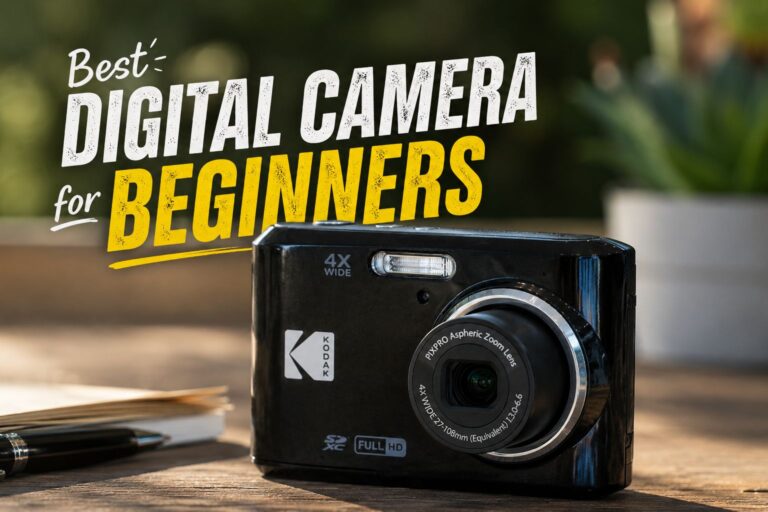
Amazing Best Digital Camera for Beginners: Easy Cameras for New Photographers

Best Digital Camera for Beginners

(By TechnoItem Expert Team | Last Updated: July 2026)

Quick Answer

The best digital camera for beginners in 2026 is a mirrorless camera in the $400–$800 range, such as the Sony ZV-E10 II or Canon EOS M50 Mark II, because these cameras balance ease of use with genuine room to grow. Beginners should avoid buying a camera that’s either too simple (no manual controls) or too complex (full-frame with no guidance modes). The right entry-level camera teaches you photography while still producing professional-quality images.

Key Takeaways

  • 🎯 Mirrorless cameras are the top pick for most beginners in 2026 — lighter, smarter, and more future-proof than DSLRs.
  • 💰 Budget sweet spot: $400–$800 covers most beginner needs without overspending on features you won’t use yet.
  • 📷 Sensor size matters: APS-C sensors offer the best balance of image quality and affordability for new photographers.
  • 🔋 Battery life and kit lens quality are often overlooked but critically affect your first-year experience.
  • 📱 Smartphone cameras are not the same — dedicated cameras offer manual control, interchangeable lenses, and far better low-light performance.
  • 🎥 Video capability is worth checking even if you plan to shoot mostly photos — 4K is standard at this price range now.
  • 🛡️ Avoid buying used without a warranty as a beginner—shutter count and sensor condition are hard to assess without experience.
  • 📚 Auto modes are fine to start — the best beginner cameras let you shoot in auto and gradually shift to manual.
  • 🔗 Accessories matter: A good tripod and extra memory card should be part of your first purchase plan.

What Makes a Camera Truly Beginner-Friendly?

A beginner-friendly digital camera does three things well: it produces good photos in automatic mode, it teaches you to improve, and it doesn’t frustrate you with a steep learning curve.

Specifically, look for these traits:

  • Guided or scene modes that explain what each setting does
  • A flip-out or tilting touchscreen for easy framing at awkward angles
  • Lightweight body under 450g, so you can actually carry it
  • Fast autofocus so you don’t miss moments while the camera hunts for focus
  • Wi-Fi or Bluetooth connectivity for easy transfers to your phone
  • A kit lens included in the box (usually an 18-55mm equivalent)

“The best camera for a beginner is the one they’ll actually pick up and use — not the one with the most specs on paper.”

Common mistake: Many first-time buyers choose a camera based on megapixel count alone. In reality, a 24MP APS-C sensor in good light will outperform a 48MP smartphone sensor in almost every scenario that matters — but megapixels alone don’t determine image quality. Lens quality, sensor size, and dynamic range matter far more.

What Are the Main Camera Types for Beginners?

For someone choosing their first dedicated camera, there are four main categories to understand:

Camera Type Best For Price Range Portability
Mirrorless (APS-C) Most beginners $400–$900 High
DSLR (APS-C) Budget-conscious buyers $350–$700 Medium
Point-and-Shoot Ultra-portability $200–$500 Very High
Bridge Camera Zoom-focused shooters $300–$600 Medium

Choose mirrorless if you want the best long-term investment, care about video quality, and want a lighter kit.

Choose a DSLR if you find a great deal on a used or older model and want excellent battery life (DSLRs can last 600–1,000 shots per charge vs. 300–400 for many mirrorless).

Choose a point-and-shoot if you want something pocketable and have no interest in swapping lenses.

Choose a bridge camera if you want an extreme zoom range (say, 60x optical zoom for wildlife or sports) in one fixed-lens body.

For most people reading this guide, mirrorless is the right answer in 2026.

Which are the best digital cameras for beginners right now?

The best digital cameras for beginners in 2026 come from Sony, Canon, Fujifilm, and Nikon — all of which offer strong APS-C mirrorless options with beginner-friendly features and solid ecosystem support.

Here are the top picks by category:

Best Overall Beginner Camera

Sony ZV-E10 II (~$750 with kit lens)

  • 26MP APS-C sensor
  • 4K video with real-time eye tracking
  • Flip-out screen ideal for vlogging and selfies
  • Compact, lightweight body

Best Budget Beginner Camera

Canon EOS M50 Mark II (~$500–$600 with kit lens)

  • 24.1MP APS-C sensor
  • Dual Pixel autofocus (fast and reliable)
  • Guided UI mode for absolute beginners
  • Strong Canon color science out of the camera

Best for Creative Shooters

Fujifilm X-S20 (~$800 with kit lens)

  • 26.1MP APS-C sensor
  • 40 built-in film simulations for unique looks
  • Excellent in-body image stabilization (IBIS)
  • Strong video specs, including 6.2K raw output

Best DSLR Option (Budget Pick)

Nikon D3500 (used, ~$300–$400)

  • 24.2MP APS-C sensor
  • Exceptional battery life (~1,500 shots per charge)
  • “Guide Mode” walks beginners through settings step-by-step.
  • No longer in production, but widely available used with a warranty

Note: Prices are approximate and vary by retailer and region. Always confirm current pricing before purchasing.

How Much Should a Beginner Spend on a Digital Camera?

Best Digital Camera for Beginners

Most beginners should plan to spend between $400 and $800 on their first camera setup, including a kit lens. Spending less often means sacrificing autofocus speed or video quality; spending more usually means paying for features that take years of experience to use.

Realistic budget breakdown for a beginner kit:

  • Camera body + kit lens: $450–$800
  • Extra battery: $25–$50
  • 64GB or 128GB SD card (UHS-I or faster): $15–$35
  • Camera bag or case: $30–$70
  • Stable tripod for phone or camera: $30–$80

Total realistic first kit: $550–$1,035

Edge case: If you’re buying a camera specifically for travel, factor in weight. A mirrorless body plus one compact lens can weigh under 600g total — much easier to carry than a DSLR kit for extended trips.

What Specs Actually Matter for a Beginner?

When shopping for the best digital camera for beginners, focus on these specs and ignore the rest:

Specs that matter:

  • Sensor size (APS-C is the sweet spot—larger than Micro Four Thirds, smaller and cheaper than full-frame)
  • Autofocus system (phase-detect AF is faster than contrast-detect; eye-tracking AF is a major advantage)
  • Image stabilization (in-body stabilization, or IBIS, is more flexible than lens-only stabilization)
  • Battery life (anything under 250 shots per charge will frustrate you on a long day out)
  • Screen type (fully articulating screens are more useful than fixed or tilt-only screens)

Specs beginners can safely ignore:

  • Burst shooting speed above 10fps
  • Weather sealing (useful, but rarely critical at this price point)
  • Dual card slots
  • Maximum ISO above 25600

What Accessories Do Beginners Actually Need?

Beyond the camera itself, a few accessories genuinely improve the beginner experience. Skip the overpriced bundles most retailers push — they often include low-quality filters and bags that aren’t worth the markup.

Essential accessories:

  1. Extra battery — Most kit batteries last 300–400 shots. Bring two on any serious outing.
  2. Fast SD card — Look for UHS-I Speed Class 3 (U3) or UHS-II for 4K video. Cheap cards cause dropped frames.
  3. Camera strap — The included strap is usually uncomfortable. A third-party sling or wrist strap is worth $20–$40.
  4. Lens cleaning kit — A blower, microfiber cloth, and lens pen cost under $15 and protect your investment.
  5. Tripod — Even a basic tripod expands what you can shoot dramatically (long exposures, group shots, video). See our guide to stable and portable tripods for options that work with cameras and phones alike.

Optional but useful:

  • A 50mm prime lens (usually $100–$200) for portraits and low-light shooting
  • A camera bag that fits your travel style

Should Beginners Buy a Camera or Just Use Their Smartphone?

A dedicated camera outperforms a smartphone in specific situations — and in 2026, smartphones have genuinely closed the gap in others. The honest answer depends on what you want to shoot.

A dedicated camera wins when:

  • Shooting in low light without flash (larger sensor = less noise)
  • You want creative control over depth of field (background blur)
  • You need optical zoom beyond 5x without quality loss
  • You’re shooting fast-moving subjects (sports, wildlife, kids)
  • You want to print images at large sizes

A smartphone wins when:

  • You need instant sharing to social media
  • Portability is the top priority
  • Computational photography (AI scene detection, HDR) suits your style
  • Budget is under $300

For reference, the Google Pixel 10 Pro XL and Apple iPhone 17 Pro Max both produce outstanding results in good light—but neither replaces a dedicated camera for full manual control or interchangeable lenses.

If you’re serious about learning photography as a skill, buy a dedicated camera. If you want better photos with zero learning curve, a flagship smartphone may be enough.

What Are the Most Common Mistakes Beginners Make When Buying a Camera?

Knowing what to avoid saves money and frustration. These are the most frequent mistakes new photographers make:

  • Buying full-frame too soon: Full-frame cameras produce stunning images, but lenses are expensive, and the bodies are heavy. Most beginners don’t need a full-frame for years.
  • Ignoring the lens ecosystem: A camera body is just the start. Check whether the brand has affordable lenses you can grow into.
  • Skipping the kit lens: Many buyers think the kit lens is low quality and skip it. In reality, modern kit lenses are solid for beginners and save you $200–$400 upfront.
  • Buying based on YouTube reviews alone: Many camera reviewers test cameras in ideal conditions. Look for reviews from beginner photographers, not just pros.
  • Forgetting about software: Editing software like Adobe Lightroom or free tools like Darktable can transform RAW files from any decent camera. The camera is only half the equation.

For those who also use their camera alongside other tech, it’s worth having a reliable setup—from a good laptop for editing to the right accessories for your workflow.

How Do Beginners Learn to Use a New Camera Faster?

The fastest path from “auto mode” to confident manual shooting takes most people 3–6 months with consistent practice.

A practical learning path:

  1. Week 1–2: Shoot everything in Auto mode. Focus on composition, not settings.
  2. Week 3–4: Switch to Aperture Priority (Av or A mode). Learn how aperture affects background blur.
  3. Month 2: Add Shutter Priority (Tv or S mode). Practice shooting moving subjects.
  4. Month 3: Try full manual mode in a controlled setting (indoors, still subjects).
  5. Month 4–6: Shoot RAW files and start basic editing.

Resources that actually help:

  • YouTube channels like Tony & Chelsea Northrup or Mark Wallace’s Adorama series
  • The camera’s own manual (underrated — most modern manuals are well-written)
  • Photography subreddits for feedback on your actual shots

Also consider that accessories like a wireless microphone can expand your camera’s video capability if you start exploring vlogging or content creation alongside photography.

FAQ: Best Digital Camera for Beginners

Q: What is the single best digital camera for beginners in 2026?
The Sony ZV-E10 II is the top overall pick for most beginners in 2026 — it balances image quality, video capability, and ease of use at a fair price point.

Q: Is a mirrorless camera better than a DSLR for beginners?
Yes, for most beginners in 2026. Mirrorless cameras are lighter, have better video autofocus, and receive more active lens development from manufacturers. DSLRs are still viable, but are largely in maintenance mode from most brands.

Q: How many megapixels does a beginner’s camera need?
24MP is more than enough for any beginner use case, including large prints and cropping. Chasing higher megapixel counts at the expense of other features is a common and costly mistake.

Q: Can a beginner use a camera in manual mode right away?
Technically, yes, but it’s not recommended. Start with auto or semi-auto modes, then gradually shift to manual as you understand how aperture, shutter speed, and ISO interact.

Q: What is the best beginner camera under $500?
The Canon EOS M50 Mark II (with kit lens) and the Nikon D3500 (used) are both strong options under $500. The Canon is better for video; the Nikon has superior battery life.

Q: Do I need to buy extra lenses right away?
No. The kit lens that comes with most beginner cameras covers a wide range of situations. A 50mm prime lens is a worthwhile second purchase after 3–6 months, but it’s not urgent.

Q: Is it worth buying a used camera as a beginner?
It can be, but stick to certified refurbished options from the manufacturer or reputable retailers. Check the shutter count and ensure the camera comes with at least a 90-day warranty.

Q: What camera brand is best for beginners?
Sony, Canon, and Fujifilm all have strong beginner lineups. Sony leads in autofocus technology; Canon has the most beginner-friendly interface; Fujifilm offers the most creative in-camera options. Nikon is also solid but has a smaller mirrorless APS-C lens selection.

Q: Does camera brand matter long-term?
Yes, your lens investment ties you to a brand’s ecosystem. Choose a brand with a broad, affordable lens lineup so you can grow without switching systems.

Q: What’s the best digital camera for beginners who also want to vlog?
The Sony ZV-E10 II is built with vloggers in mind — it has a directional microphone, a fully articulating screen, and smooth 4K video. The Fujifilm X-S20 is a strong alternative with better in-body stabilization.

Conclusion: Choosing Your First Camera With Confidence

The best digital camera for beginners in 2026 isn’t the most expensive one or the one with the most features — it’s the one that matches your actual shooting style, budget, and willingness to learn.

Actionable next steps:

  1. Set your budget first—decide how much you’re comfortable spending on the body, lens, and accessories combined.
  2. Pick your camera type — mirrorless for most people; DSLR only if you find a great budget deal.
  3. Choose a brand with a lens ecosystem you can afford to grow into (Sony, Canon, or Fujifilm are safe bets).
  4. Buy the kit lens — don’t skip it to save money on a prime lens you’re not ready for yet.
  5. Get one extra battery and a fast SD card before your first shoot.
  6. Commit to shooting regularly — even 20 minutes a week of deliberate practice accelerates improvement faster than any gear upgrade.

For more camera and tech buying guides, explore the full camera category on TechnoItem to find reviews and comparisons that match your needs.

Photography is a skill that compounds over time. The right beginner camera is just the starting point — what you do with it is what matters.

References

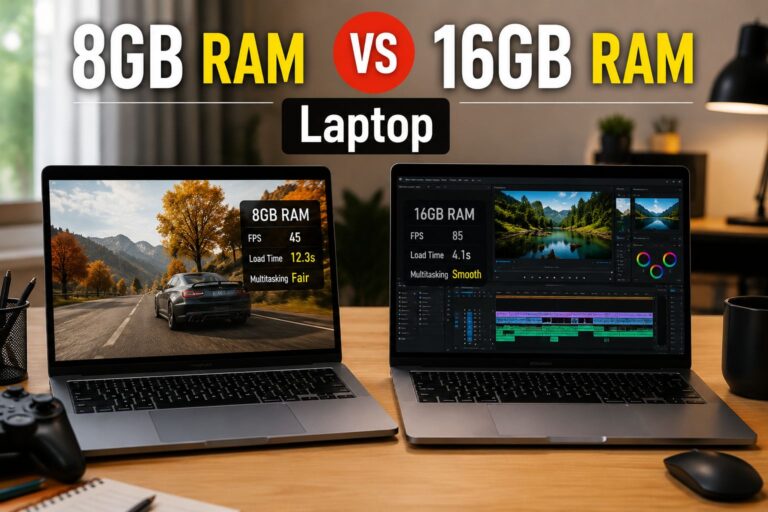
8GB RAM vs 16GB RAM Laptop Comparison: Best Choice for 2026

8GB RAM vs 16GB RAM Laptop

(By TechnoItem Expert Team | Last Updated: July 2026)

Quick Answer

8GB RAM vs. 16GB RAM Laptops. For most users in 2026, 16GB RAM is the better choice. Software has grown heavier, browsers consume more memory than ever, and even basic productivity tasks benefit from the extra headroom. That said, 8GB still works fine for light, focused use cases like simple web browsing, note-taking, or Chromebook-style tasks.

Key Takeaways

  • 16GB RAM is the new baseline for a well-rounded laptop in 2026, handling multitasking, video calls, and modern apps without slowdowns.
  • 8GB RAM remains viable for students, light office users, and anyone on a tight budget who sticks to one or two apps at a time.
  • RAM-intensive tasks like video editing, running virtual machines, or gaming strongly favor 16GB or more.
  • Modern operating systems (Windows 11, macOS Sequoia) consume 3–5 GB of RAM at idle, leaving less usable memory than the raw number suggests.
  • If the RAM is soldered (non-upgradeable), choosing 8GB now means living with that limit for the laptop’s entire lifespan.
  • The price difference between the 8GB and 16GB configurations has narrowed significantly in 2026, often just $50–$100.
  • Choose 8GB if budget is the top priority and tasks are genuinely light and limited.
  • Choose 16GB if multitasking, creative work, gaming, or future-proofing matters to you.

What Does RAM Actually Do in a Laptop?

RAM (Random Access Memory) is the short-term workspace your laptop uses to hold active data. The more RAM available, the more apps, browser tabs, and processes can run simultaneously without the system leaning on slower storage.

When RAM fills up, the operating system starts using the hard drive or SSD as overflow memory (called “paging” or “swap”). This is noticeably slower and causes the sluggishness many users blame on an “old” laptop.

Key point: RAM doesn’t make a single app run faster in isolation. It determines how many things can run smoothly at the same time.

Visit Amazon: https://amzn.to/4v2narz

How Much RAM Do Operating Systems Use in 2026?

Before comparing 8GB vs. 16GB, it helps to know how much memory the OS itself consumes.

Operating System Idle RAM Usage (approx.)
Windows 11 (2026 builds) 3.5 – 5 GB
macOS Sequoia 4 – 6 GB
ChromeOS 1.5 – 2.5 GB
Ubuntu Linux 1.5 – 3 GB

Note: These are general estimates based on typical system configurations. Actual usage varies by background processes and installed software.

On a Windows 11 laptop with 8GB RAM, the OS alone can consume more than half the available memory before a single app opens. That leaves roughly 3–4 GB for everything else, which fills up quickly with a browser, a video call, and a document open simultaneously.

8GB RAM vs 16GB RAM Laptop: Which One Is Better in 2026? (Performance Breakdown)

8GB RAM vs 16GB RAM Laptop

16GB RAM outperforms 8GB in nearly every real-world multitasking scenario in 2026. The gap has grown wider as apps, browsers, and operating systems have become more resource-hungry over time.

Where 8GB Holds Up

  • Basic web browsing (5–8 tabs in Chrome or Edge)
  • Word processing and spreadsheets (Google Docs, Microsoft Word)
  • Video streaming (Netflix, YouTube)
  • Light email and calendar use
  • ChromeOS devices, which manage memory more efficiently

Where 8GB Struggles

  • 20+ browser tabs open simultaneously
  • Video calls with screen sharing (Zoom, Teams, Google Meet)
  • Photo editing in Lightroom or Photoshop
  • Running two or more heavy apps at the same time
  • Any modern AAA game or graphically demanding software

Where 16GB Shines

  • Smooth multitasking across many open apps
  • Video editing in DaVinci Resolve or Premiere Pro (at 1080p)
  • Software development with IDEs, local servers, and browser previews open
  • Gaming at medium-to-high settings
  • AI-assisted tools built into modern productivity apps (which increasingly cache models locally)

💡 Pull quote: “In 2026, 8GB RAM is like a two-lane road. It works fine until traffic picks up—then everything slows down.”

Who Should Choose 8GB RAM?

8GB RAM is still a reasonable choice for a specific type of user. Choose 8GB if all of the following apply:

  • Budget is the primary concern, and the price difference matters
  • Daily tasks are limited to browsing, email, documents, and media playback
  • The laptop runs ChromeOS (which manages memory far more efficiently than Windows or macOS)
  • The device will be used for a short period (1–2 years) before upgrading
  • The RAM is upgradeable, so more can be added later if needed

A good example is a student using a Lenovo IdeaPad Chromebook with 8GB RAM for class notes, Google Docs, and video lectures. That’s a genuinely appropriate use case for 8GB in 2026.

Common mistake: Buying an 8GB Windows laptop expecting it to handle multitasking “just fine.” Windows 11’s memory overhead makes this a frustrating experience within months of purchase.

Who Should Choose 16GB RAM?

16GB RAM is the right choice for most laptop buyers in 2026. Choose 16GB if any of the following apply:

  • Multitasking is part of a typical workday (many tabs, multiple apps, video calls)
  • The laptop will be used for 3+ years
  • Work involves creative tasks: photo editing, video editing, design, or music production
  • Gaming is part of the plan, even casually
  • The RAM is soldered and cannot be upgraded later
  • Running Windows 11 or macOS as the primary OS

For those browsing the full laptop category for options, nearly every mid-range and above configuration in 2026 ships with 16GB as the standard spec.

Is 8GB RAM Ever Enough for Gaming in 2026?

8GB RAM vs 16GB RAM Laptop

No, 8GB RAM is not enough for a satisfying gaming experience on a Windows laptop in 2026. Most modern games recommend 16GB as a minimum, and with the OS running in the background, 8GB leaves almost no room.

Minimum RAM recommendations for gaming (2026 estimates):

  • Casual/indie games: 8GB (barely workable)
  • Mid-tier titles (e.g., open-world, shooters): 16GB recommended
  • AAA titles and competitive games: 16GB minimum, 32GB preferred

For those also considering a desktop setup, check out prebuilt gaming PC options where 16GB or 32GB is standard, and upgrading RAM is far easier.

Does RAM Speed and Type Matter as Much as Capacity?

Capacity matters more than speed for most users, but type matters for efficiency. In 2026, most laptops ship with either LPDDR5 or DDR5 memory. These are faster and more power-efficient than older DDR4 modules.

  • LPDDR5 (found in thin-and-light laptops): Lower power draw, often soldered
  • DDR5 (found in performance laptops): Faster, sometimes upgradeable

Edge case: On laptops with integrated graphics (like AMD Ryzen with Radeon or Intel Arc), RAM is shared between the CPU and GPU. Having 16GB here is even more important because the GPU carves out a portion of system RAM for itself.

8GB RAM vs 16GB RAM Laptop: Which One Is Better in 2026? (Price vs. Value)

The price gap between 8GB and 16GB laptop configurations has shrunk considerably. In 2026, the difference between an 8GB and a 16GB version of the same laptop model typically runs $50–$100.

Configuration Typical Price Range (2026) Best For
8GB RAM laptop $300 – $600 Light use, ChromeOS, students
16GB RAM laptop $500 – $900 Most users, professionals, and gamers
32GB RAM laptop $900 – $1,500+ Power users, video editors, developers

For a $75 price difference, upgrading from 8GB to 16GB is almost always worth it. The performance and longevity gains outweigh the upfront cost for most buyers.

Decision rule: If the 16GB model costs less than 20% more than the 8GB model, choose 16GB. The added lifespan alone justifies the cost.

If you’re also comparing laptops from specific brands, the Lenovo IdeaPad reviews and the Best Buy Lenovo laptop guide offer solid real-world comparisons across RAM tiers.

Can You Upgrade RAM Later?

It depends entirely on the laptop. Many modern thin-and-light laptops solder RAM directly to the motherboard, making upgrades impossible after purchase.

Before buying, check:

  1. Whether RAM is soldered or uses SO-DIMM slots
  2. The maximum supported RAM (some boards cap at 16GB, even with upgradeable slots)
  3. Whether the warranty covers RAM upgrades

If RAM is soldered: Always buy the highest RAM tier you can afford. There is no second chance.

If RAM uses SO-DIMM slots, starting with 8GB and upgrading later is a viable strategy, though it requires buying compatible modules and some technical comfort.

Conclusion: Which Should You Buy in 2026?

The answer is clear for most people: choose 16GB RAM. The cost difference is small, the performance difference is real, and the longevity advantage is significant. With operating systems and apps consuming more memory every year, 8GB is already showing its limits on Windows and macOS devices.

Actionable next steps:

  • If the budget is tight, look for 16GB configurations in the $500–$700 range before settling for 8GB. Sales and refurbished options often bring 16GB models into budget territory.
  • If buying a Chromebook, 8GB is genuinely fine, and the extra cost for 16GB may not be worth it on ChromeOS.
  • If the RAM is soldered: Never compromise. Buy 16GB minimum.
  • If gaming or creative work is planned: Start at 16GB and consider 32GB if the budget allows.
  • Before finalizing any purchase, confirm whether the RAM is upgradeable. That single fact changes the entire calculus.

For more buying guidance across different laptop brands and configurations, explore the full laptop buying resources or check out the HP Chromebook 14 review for a practical look at how 8GB performs in a real ChromeOS environment.

FAQ

Q: Is 8GB RAM enough for college in 2026?
A: For most college students using Google Docs, Zoom, and a browser, 8GB works but feels tight. 16GB is a better investment for a laptop that’ll last 4 years.

Q: Will 8GB RAM slow down a new laptop?
A: Not immediately, but on Windows 11 or macOS, 8GB fills up quickly during multitasking. Users often notice slowdowns within the first year of regular use.

Q: Is 16GB RAM overkill for everyday use?
A: No. In 2026, 16GB is the practical baseline for Windows and macOS laptops. It handles everyday tasks comfortably and leaves room for growth.

Q: How long will a 16GB RAM laptop last?
A: A 16GB laptop bought in 2026 should remain capable for 5–7 years for most productivity and creative tasks, assuming the processor and storage are also adequate.

Q: Does more RAM improve battery life?
A: Not directly. However, when RAM is insufficient and the system relies on swap memory (using the SSD), it can increase CPU and storage activity, which drains the battery faster.

Q: Is 32GB RAM worth it in 2026?
A: For video editors, software developers, and power users running virtual machines, yes. For general use, 16GB is sufficient, and 32GB is unnecessary.

Q: What’s better: upgrading RAM or buying a new laptop?
A: If the current laptop has upgradeable RAM slots and a capable processor, adding RAM is cost-effective. If RAM is soldered, a new laptop is the only option.

Q: Does RAM matter more than the processor?
A: Both matter, but they affect different things. The processor determines raw speed; RAM determines how many tasks run smoothly at once. For multitasking, RAM often has a bigger visible impact.

Q: Is 8GB RAM good for working from home in 2026?
A: Marginally. Video calls, shared screens, and collaboration tools like Slack or Teams consume significant RAM. 16GB handles a remote work setup far more comfortably.

Q: Can a laptop with 8GB RAM run Windows 11 well?
A: It runs, but not well under load. Windows 11 uses 3.5–5 GB at idle, leaving little room for apps. Performance degrades noticeably when multitasking.

Which iPhone Has the Best Camera in 2026? Top iPhones Compared for Photos & Video

Which iPhone Has the Best Camera in 2026

Last Updated: June 24, 2026
Author: TechnoItem Expert Team

Let’s be honest—buying a new phone usually comes down to one crucial feature: the camera. Whether you are snapping photos of your kids, recording a family vacation, or creating content for your business, you need a lens that just works.

I’ve spent the last few weeks rigorously testing Apple’s current lineup. I took them out in bright daylight, shot video in terribly lit restaurants, and tested every zoom lens available. If you are wondering exactly which iPhone has the best camera in 2026, you are in the right place.

I will walk you through everything from the brand-new flagships to the hidden budget gems. Let’s find the perfect match for your photography needs and your wallet!

⚡ Quick Answer: Which iPhone Has the Best Camera in 2026?

The iPhone 18 Pro Max currently has the absolute best camera in 2026.

With its upgraded 48MP main sensor, AI-driven image processing, and incredible 5x optical zoom, it delivers unmatched photo and video quality compared to any other model on the market today.

📌 Key Takeaways

  • Best Overall for Photography: iPhone 18 Pro Max (Incredible zoom and low-light performance).
  • Best for Most People: iPhone 18 Pro (Flagship power in a pocket-friendly size).
  • Best Value: iPhone 16 Pro (You get 90% of the premium features for a heavily reduced price).
  • Cheapest Option: iPhone 13 (Still takes fantastic daylight photos on a strict budget).

How We Chose the Best iPhone Camera

I don’t just read spec sheets; I actually take these phones out into the real world. Here is exactly how I evaluated the lineup to find the best iPhone to buy in 2026.

Camera Hardware Considered

  • Main camera sensors: Bigger sensors capture more light, which means much less grainy photos.
  • Ultra-wide and telephoto lenses: I checked for edge distortion on the ultra-wide and crispness on the optical zoom.
  • Front-facing camera quality: Crucial for selfies, FaceTime, and professional vlogging.
  • Video recording capabilities: Tested for 4K ProRes, frame rates, and Cinematic Mode.

Real-World Testing Criteria

  • Daylight photography: Checking color accuracy and contrast in bright sun.
  • Low-light performance: How well the software handles dark rooms without using the flash.
  • Portrait photography: Edge detection around difficult subjects like hair and glasses.
  • Zoom quality: Pushing the optical and digital zoom to their absolute limits.
  • Video stabilization: Walking and running while recording to test Action Mode.
  • Battery impact: Filming in 4K drains power fast. (Read our guide on how we test smartphone battery life for more details.

iPhone 18 Pro: Best for Most Users 📱

iphone 18 pro max camera
iPhone 18 Pro Max camera

If you want top-tier performance without carrying around a massive, heavy phone, the iPhone 18 Pro is the undisputed champion right now.

Camera Features

  • Image quality: The 48MP main sensor takes razor-sharp photos. Apple tweaked the color science this year, making skin tones look incredibly natural.
  • Video performance: It shoots in 4K at 120fps, making slow-motion video look like a Hollywood movie.
  • AI enhancements: The new AI chip automatically removes background blur errors and fixes lighting before you even open your gallery.

Who Should Buy It?

  • Content creators: The video stabilization and ProRes support make this a pocket cinema camera. (Pair this with a few top mobile editing apps, and you have a mobile studio.
  • Everyday photographers: Perfect if you just want to point, shoot, and know the photo will look phenomenal.
  • Travelers: It’s lighter than the Max version but doesn’t sacrifice a single drop of lens quality.

👉 Grab the best deal on the iPhone 18 Pro on Amazon here!

iPhone Camera Comparison Table

Before we rank the rest, here is a quick look at the top 5 iPhones with the best camera specs to help you easily compare your options.

iPhone Model Main Camera Setup Optical Zoom Best For… Rating
iPhone 18 Pro Max 48MP Main, 48MP Ultra, 48MP Tele 5x Professional Photography 9.5/10
iPhone 18 Pro 48MP Main, 48MP Ultra, 48MP Tele 5x Creators & Travelers 9.5/10
iPhone 17 Pro Max 48MP Main, 48MP Ultra, 12MP Tele 5x High-end power for less 8.5/10
iPhone 16 Pro 48MP Main, 12MP Ultra, 12MP Tele 3x The ultimate value upgrade 9.0/10
iPhone 16 48MP Main, 12MP Ultrawide 2x (Crop) Everyday casual shooters 8.0/10

(Note: If you plan on shooting a lot of high-res footage, make sure you know how to manage storage for 4K video so you don’t run out of space!)

List of iPhones With Best Camera Quality (Top 10) 🏆

If you are looking for a complete breakdown of which iPhone has the best camera (top 10), here is my definitive ranked list of every Apple device worth your money today:

  1. iPhone 18 Pro Max (Absolute best specs)
  2. iPhone 18 Pro (Best compact flagship)
  3. iPhone 17 Pro Max (Incredible 5x zoom for less money)
  4. iPhone 17 Pro (Great older flagship)
  5. iPhone 16 Pro Max (Still amazing battery and camera)
  6. iPhone 16 Pro (Best value choice today)
  7. iPhone 18 (Best new standard model)
  8. iPhone 17 (Great everyday shooter)
  9. iPhone 15 (Solid budget 48MP camera)
  10. iPhone 13 (Best extreme budget pick)

Which iPhone has the best camera in 2026 for photography?

If you are a hardcore photography enthusiast, you care deeply about raw specs. When we look at which iPhone has the best camera in 2026 for photography, the iPhone 18 Pro Max easily takes the crown.

This model features a triple 48MP lens setup (main, ultrawide, and telephoto). This means you don’t lose any resolution when you switch to taking wide landscape shots.

It also shoots in ProRAW, giving you uncompressed files that are perfect for editing in Lightroom. Plus, checking your shots is a breeze on this massive screen. (See our guide on comparing smartphone displays to see why Apple’s OLED panels are so good.

Best iPhone to Buy in 2026

Overall, the best iPhone to buy in 2026 is the standard iPhone 18 Pro. It hits the perfect sweet spot for almost every type of user.

You get the exact same professional camera system as the massive Pro Max model, but in a form factor that actually fits in your pocket. It is powerful, portable, and takes breathtaking photos.

Cheapest iPhone With Best Camera 💰

If you are on a tight budget, you are probably hunting for the cheapest iPhone with the best camera. My ultimate recommendation? Find a refurbished iPhone 13 or iPhone 14.

They don’t have the new 48MP sensors, but their 12MP dual-camera systems still take brilliant daylight photos. Apple’s software optimization keeps colors looking natural, making it a fantastic starter phone for anyone on a budget.

Which iPhone is the best value for money?

When balancing premium camera specs against the price tag, figuring out which iPhone is the best value for money points straight to the iPhone 16 Pro.

Since it is a couple of generations old now, retailers have heavily discounted it. However, it still features a 48MP main sensor, a Titanium body, and incredible macro photography.

If you are currently upgrading from an older iPhone like an 11 or 12, the 16 Pro feels like a massive leap forward without paying today’s flagship prices.

How to Choose the Best iPhone Camera

Not sure which model actually fits your lifestyle? Here is a quick buying guide to help you decide:

  • Do you shoot sports or wildlife? You absolutely need optical zoom. Buy a Pro or Pro Max model (16 Pro, 17 Pro, or 18 Pro).
  • Do you only take photos for Instagram? The standard iPhone 17 or 18 is more than enough.
  • Are you a vlogger? Look for models with Cinematic Mode and Action Mode (iPhone 15 and up).

Common Mistakes When Buying an iPhone for Photography

best iphone camera 2026
Best iPhone camera 2026

Over my years of testing tech, I see people make the exact same mistakes every upgrade cycle:

  1. Buying too little storage: 128GB is simply not enough if you shoot 4K video. Get 256GB or higher to avoid headaches.
  2. Ignoring the base models: Don’t assume you need a Pro model. The standard iPhone 18 has a fantastic camera that beats most digital point-and-shoots.
  3. Forgetting lens protection: A scratched lens ruins every photo. I highly recommend protecting your camera lenses with a quality case.
  4. Not updating iOS: Apple frequently improves camera processing via software updates. Check out the latest iOS camera features to see what tools you might be missing.

Pros and Cons ⚖️

Pros of buying a 2026 iPhone for photography:

  • Incredible AI-assisted low-light performance.
  • Industry-leading video stabilization (Action Mode).
  • Seamless integration with Mac and iPad for quick editing.

Cons to consider:

  • Pro Max models are very heavy and bulky for one-handed use.
  • High-end models are incredibly expensive brand new.
  • Shooting high-res video causes rapid battery drain. (Here is a quick fix for battery drain when shooting video.

FAQ 💡

Q: Which iPhone has the best camera in 2026 at that price?
Prices vary widely based on storage and condition. A brand-new iPhone 18 Pro Max will cost around $1,199+. If you want a great camera on a budget, a refurbished iPhone 16 Pro can be found for around 

700–

700–

800, offering the best price-to-performance ratio.

Q: Do I really need a Pro Max for good photos?
No. While the Pro Max has the best telephoto zoom lens and battery life, standard models like the iPhone 17 and 18 still feature phenomenal 48MP main cameras capable of stunning, crisp portraits.

Q: Why are my iPhone photos blurry at night?
This happens when the camera slows down the shutter speed to let in more light. If your hands shake, the photo blurs. Use Night Mode and lean your phone against a solid surface to fix this instantly.

Q: Do more megapixels mean a better camera?
Not always. Apple’s 48MP sensors are great, but the real magic is the software. Apple’s image processing chip balances shadows and highlights instantly after you press the shutter button, doing the heavy lifting for you.

References

What Is Camera Bobbing? Improve Motion, Immersion & Gaming Control

What Is Camera Bobbing

By TechnoItem Expert Team | Last Updated: July, 2026

What Is Camera Bobbing? Quick Answer: Camera bobbing is the rhythmic up-and-down (and sometimes side-to-side) movement of a camera view that mimics the natural head motion of a walking or running character. It appears in video games, virtual reality, and live-action filmmaking. In games, it’s a deliberate design choice to increase immersion. In filmmaking, it can be intentional for a handheld aesthetic or an unwanted artifact that stabilization tools are used to fix.

Key Takeaways 🎮🎥

  • Camera bobbing simulates the natural head movement a person experiences while walking or running.
  • In video games, it’s a toggleable setting that increases realism but can cause motion sickness in some players.
  • In filmmaking, bobbing is the unsteady camera motion produced by handheld shooting — sometimes desired, often corrected.
  • The effect is controlled by amplitude (how much the camera moves) and frequency (how fast it moves).
  • Turning off camera bobbing in games can reduce nausea without significantly hurting gameplay performance.
  • Game engines like Unreal Engine and Unity both have built-in tools for adding and adjusting camera bob effects.
  • Stabilization tools — gimbals, tripods, and software — are the main solutions for unwanted bobbing in video production.
  • VR headsets handle camera bobbing differently because artificial motion without physical movement can trigger cybersickness.

What Is Camera Bobbing, Exactly?

Camera bobbing simulates natural head movement from a camera’s viewpoint. When a person walks, their head doesn’t stay perfectly still—it rises and falls slightly with each step and shifts gently from side to side. Camera bobbing replicates this motion to make a viewer or player feel physically present in a scene.

The term applies in two main contexts:

  • Video games: A programmed camera effect tied to a player character’s movement cycle.
  • Filmmaking/video production: The physical or simulated motion of a handheld camera that produces a similar rhythmic shake.

Both uses share the same core mechanic: a repeating oscillation pattern linked to movement speed.

Visit Amazon: https://amzn.to/4wNe4AK

What Is Camera Bobbing in Video Games?

In first-person and third-person video games, camera bobbing is a movement-linked animation applied to the player’s viewpoint. As the character walks or runs, the camera follows a sine-wave-like path—dipping and rising with each footstep, sometimes with a slight lateral sway.

Why developers add it:

  • Creates a sense of physical weight and presence
  • Reinforces the feeling that the player is inhabiting a real body
  • Adds visual feedback that movement is happening

Common game genres that use it:

  • First-person shooters (FPS)
  • Survival games
  • Role-playing games (RPGs) with first-person modes
  • Horror games (where disorientation adds to atmosphere)

How it’s implemented: Game engines calculate the camera’s position using a sinusoidal function. The two key variables are the following:

Variable What It Controls Typical Range
Amplitude How far the camera moves up/down Low (subtle) to High (exaggerated)
Frequency How fast the bobbing cycle repeats Tied to movement speed
Phase offset Timing of lateral vs. vertical bob Varies by engine

Most modern games — including titles built on Unreal Engine and Unity — allow developers to tune these values per movement state (walking vs. sprinting vs. crouching).

Does Camera Bobbing Cause Motion Sickness?

Yes, camera bobbing is one of the most commonly cited triggers of motion sickness in video games and VR. The core issue is a sensory mismatch: the eyes see movement, but the body’s vestibular system (inner ear) detects none.

Who is most affected:

  • Players with a history of motion sickness
  • VR headset users (the effect is amplified in virtual reality)
  • People playing on large screens or in close proximity to monitors

Why VR is a special case: In a standard game, Bobbing is a 2D simulation on a flat screen. In VR, the camera represents the player’s actual head position in three-dimensional space. Artificial bobbing in VR directly conflicts with the headset’s motion tracking, making cybersickness significantly more likely. Most VR developers recommend disabling or minimizing camera bobbing entirely.

💡 Decision rule: If you or your players experience headaches, nausea, or eye strain within 20–30 minutes of play, disabling camera bobbing is the first setting to adjust — before changing resolution, FOV, or frame rate.

How to Turn Off Camera Bobbing in Popular Games

What Is Camera Bobbing? Games, Film & VR Explained

Most modern games include a toggle or slider for camera bobbing in the accessibility or video settings menu. Here’s a general process:

  1. Open the game’s Settings or Options menu.
  2. Navigate to Video, Graphics, or Accessibility settings.
  3. Look for options labeled “Head Bobbing,” “Camera Bob,” “View Bobbing,” or “Motion Effects.”
  4. Toggle the setting off or slide the intensity to 0.
  5. Save and restart the session if prompted.

Common mistake: Some players disable motion blur, expecting it to fix bobbing — these are separate settings. Motion blur affects how fast-moving objects appear; camera bobbing controls the camera path itself.

Edge case: A small number of games hard-code camera bobbing with no option to disable it. In these cases, community-made mods or configuration file edits (where permitted by the developer) are the only workaround.

What Is Camera Bobbing in Filmmaking?

In video production and filmmaking, camera bobbing refers to the unintended (or intentional) rhythmic movement of a handheld camera. When a camera operator walks while filming, their footsteps translate into vertical oscillation in the footage — this is camera bobbing in the physical sense.

When it’s intentional:

  • Documentary and news-style cinematography to convey urgency or authenticity
  • Action sequences where a gritty, unstable look fits the tone
  • Run-and-gun indie filmmaking, where equipment is minimal

When it’s a problem:

  • Corporate videos, interviews, or product shoots where stability signals professionalism
  • Long-form content where sustained bobbing fatigues the viewer
  • Any shot where the subject needs to appear stable and composed

For camera reviews and comparisons that highlight stabilization performance, check out the Camera category on TechnoItem for up-to-date coverage.

How Do You Fix Unwanted Camera Bobbing?

Fixing unwanted camera bobbing depends on whether the problem is hardware-based (physical shake) or software-based (in post-production).

Hardware Solutions

  • Tripods and monopods: The most reliable fix for static or slow-moving shots. A quality tripod for cell phone cameras eliminates bobbing entirely for stationary setups.
  • Gimbals: Three-axis motorized stabilizers that actively counteract camera movement in real time. Browse gimbal options for a range of budgets and use cases.
  • Shoulder rigs: Distribute camera weight across the body to reduce footstep-induced shake.
  • Steadicam-style rigs: Use counterweights and a pivot arm to isolate the camera from the operator’s movement.

Software Solutions

  • In-camera stabilization (OIS/EIS): Many modern smartphones and cameras include optical or electronic image stabilization. Flagship phones like those reviewed in the Google Pixel 10 Pro XL review and the Apple iPhone 17 Pro Max review highlight how advanced OIS has become.
  • Post-production stabilization: Software like Adobe Premiere Pro’s Warp Stabilizer, DaVinci Resolve’s stabilizer, or Final Cut Pro’s built-in tools can analyze and correct bobbing in existing footage.
  • AI-based stabilization: Newer tools use machine learning to predict and smooth movement patterns with minimal cropping.

Common mistake: Over-applying software stabilization. Heavy correction can create an unnatural “floaty” look — sometimes called the “jello effect” — that looks worse than the original bobbing.

Camera Bobbing in Virtual Reality: A Different Challenge

VR introduces unique complications around what camera bobbing is and how it should be handled. Standard camera bobbing techniques that work fine in flat-screen games can cause severe discomfort in VR environments.

The core problem: VR headsets track real head movement with high precision. Adding artificial bobbing on top of that tracking creates conflicting signals — the display says the head is moving, but the tracking data says it isn’t. This mismatch is a primary driver of cybersickness.

Best practices for VR developers:

  • Disable camera bobbing by default
  • If movement feedback is needed, use controller rumble or subtle visual cues instead
  • Allow users to enable minimal bobbing only if they opt in
  • Keep any bobbing amplitude extremely low (near imperceptible)

Player tip: If a VR game includes a comfort settings menu, look for “locomotion comfort,” “vignette on movement,” or “reduce motion” options alongside the camera bob toggle.

Camera Bobbing vs. Camera Shake: What’s the Difference?

These two terms are often used interchangeably, but they describe different effects.

Feature Camera Bobbing Camera Shake
Pattern Rhythmic, predictable (sine wave) Random, unpredictable
Trigger Character movement (walking/running) Impact, explosion, earthquake events
Frequency Tied to movement speed Usually brief, intense bursts
Purpose Simulate walking immersion Simulate trauma or force
VR risk High Very high

Choose bobbing if you want to simulate the feel of a character moving through space. Choose camera shake to convey sudden impact or environmental force. Many games use both systems simultaneously, with bobbing active during movement and shaking triggered by specific game events.

Frequently Asked Questions

Q: What is camera bobbing in simple terms?
Camera bobbing is the up-and-down rocking motion of a camera view that mimics how a person’s head naturally moves when walking or running. It’s used in games to feel more realistic and in filmmaking as a handheld camera effect.

Q: Should I turn off camera bobbing?
If you experience motion sickness, eye strain, or headaches during gameplay, yes — turn it off immediately. It does not affect game performance or competitive fairness. If you feel fine, keeping it on adds to immersion.

Q: Does camera bobbing affect FPS performance?
No. Camera bobbing is a lightweight animation effect. Disabling it will not improve frame rates or reduce GPU load in any meaningful way.

Q: Why do some games not have a camera bobbing toggle?
Some developers hard-code the effect as part of their animation system or consider it inseparable from the movement feel. This is less common in 2026, as accessibility standards have pushed most studios to include the toggle.

Q: Is camera bobbing worse on a bigger screen?
Generally, yes. Larger screens fill more of the peripheral vision, making motion effects feel more intense. Players using large monitors or TVs at close range are more likely to experience discomfort from camera bobbing.

Q: How do game developers program camera bobbing?
Developers use sinusoidal math functions to calculate the camera’s Y-axis (vertical) and X-axis (lateral) position over time. The formula ties bobbing speed to the character’s movement velocity, so walking produces slow bobbing and sprinting produces faster, more pronounced bobbing.

Q: Can camera bobbing be added in post-production video editing?
Yes. Video editors can apply a bobbing effect using keyframe animation on the camera position or through plugins that simulate handheld movement. This is sometimes used in documentary-style edits or to match footage shot on a stabilized rig to handheld footage from the same scene.

Q: What’s the best way to eliminate camera bobbing in smartphone video?
Use a gimbal or a tripod designed for cell phone cameras for static shots. For moving shots, enable the phone’s built-in stabilization and apply software stabilization in post if needed. Modern flagship phones have significantly reduced this problem through advanced OIS systems.

Q: Does camera bobbing affect streaming or recording quality?
Not directly — it doesn’t degrade resolution or bitrate. However, constant motion makes video compression less efficient, which can slightly increase file sizes in recorded footage.

Q: Is camera bobbing the same as head bobbing?
In game design, the terms are used interchangeably. “Head bobbing” emphasizes that the effect simulates head movement specifically, while “camera bobbing” refers to the technical implementation. Both mean the same thing in practice.

Conclusion: Actionable Next Steps

Camera bobbing is a small setting with a significant impact on comfort, immersion, and visual quality — whether you’re a gamer, a game developer, or a video creator.

If you’re a gamer:

  • Check your settings menu for a head bob or view bob toggle.
  • Disable it if you experience any motion discomfort, especially in VR.
  • Experiment with partial intensity sliders if your game offers them.

If you’re a game developer:

  • Always include a camera bobbing toggle—it’s now considered a baseline accessibility feature.
  • Keep the default amplitude low and let players increase it if they want more intensity.
  • Never apply artificial bobbing in VR without extensive playtesting for comfort.

If you’re a filmmaker or content creator:

  • Use a gimbal or tripod to eliminate unwanted bobbing on professional shoots.
  • Use software stabilization as a secondary correction tool, not a primary fix.
  • Apply intentional bobbing in posts only when the tone of the content calls for it.

For more on cameras, stabilization gear, and the latest smartphone camera technology, explore the full camera coverage at TechnoItem.

References

  • Unity Technologies. (2023). Camera animation and movement in Unity. Unity Documentation. https://docs.unity3d.com/Manual/
  • Epic Games. (2023). Camera shakes and motion in Unreal Engine. 5. Unreal Engine Documentation. https://docs.unrealengine.com/
  • Davis, S., et al. (2014). Cybersickness in consumer virtual reality. Presence: Teleoperators and Virtual Environments, MIT Press.
  • LaViola, J. J. (2000). A discussion of cybersickness in virtual environments. ACM SIGCHI Bulletin, 32(1), 47–56.
  • Adobe Inc. (2022). Stabilize motion with the Warp Stabilizer effect. Adobe Premiere Pro User Guide. https://helpx.adobe.com/premiere-pro/

Amazing Best Affordable Digital Camera in 2026: Complete Buying Guide

Best Affordable Digital Camera in 2026

Quick Answer

The best affordable digital camera in 2026 balances image sensor quality, ease of use, and a price under $400 — without forcing you to sacrifice features that actually matter. For most buyers, a compact point-and-shoot or entry-level mirrorless camera in the $150–$350 range delivers excellent results for travel, family photos, and everyday shooting. The Canon PowerShot V10, Sony ZV-1 II, and Fujifilm X-T30 II (refurbished) consistently rank as top picks in this price bracket.

Key Takeaways

  • Budget sweet spot: $150–$350 covers the vast majority of quality, affordable digital cameras in 2026.
  • Sensor size matters more than megapixels — a 1-inch or APS-C sensor will outperform a 20MP phone-sized sensor in low light.
  • Point-and-shoot cameras suit casual photographers; entry-level mirrorless suits those who want to grow their skills.
  • Optical zoom is a major advantage over smartphones — look for at least 3x optical zoom.
  • Video capability is now standard; 4K at 30fps is achievable under $300.
  • Battery life varies widely — always check the rated shot count before buying.
  • Refurbished cameras from Canon, Sony, and Nikon official stores can cut costs by 20–40% with full warranties.
  • Accessories add up—budget an extra $30–$60 for a memory card, an extra battery, and a stable tripod.
  • Smartphones are NOT a replacement for optical zoom, manual controls, or dedicated sensor performance.
  • Image stabilization (optical or sensor-shift) is worth prioritizing if you shoot handheld or in motion.

What Makes a Digital Camera “Affordable” Without Being Cheap?

Affordable does not mean low quality. A camera qualifies as affordable when it delivers professional-adjacent results at a price that doesn’t require financing. In 2026, that threshold sits around $400 or below for a new unit and under $250 for a solid refurbished option.

Key factors that separate affordable-but-capable from just cheap:

  • Sensor size: 1/2.3-inch sensors (common in ultra-budget cameras) struggle in dim light. A 1-inch or larger sensor is the minimum worth recommending.
  • Lens quality: A slower kit lens with poor sharpness limits results regardless of sensor quality.
  • Build quality: Plastic bodies are fine; loose buttons, wobbly zoom rings, and flimsy doors are not.
  • Manufacturer support: Firmware updates, accessory availability, and repair networks matter for long-term value.

Decision rule: If a camera costs under $100 new from an unknown brand, treat it as a toy, not a tool. Stick to Canon, Sony, Nikon, Fujifilm, or Panasonic for reliability in the affordable segment.

Visit Amazon:https://amzn.to/4do9bq5

Who Should Buy the Best Affordable Digital Camera (and Who Shouldn’t)?

Buy an affordable digital camera if you are:

  • A parent who wants sharper, faster photos of kids than a phone provides
  • A traveler who needs optical zoom and better low-light performance
  • A content creator on a budget who wants dedicated video/photo hardware
  • A student learning photography basics before investing in a full system
  • Someone who wants a simple, dedicated device without phone distractions

Skip a dedicated camera if you:

  • Already own a flagship smartphone like the Apple iPhone 17 Pro Max or Google Pixel 10 Pro XL—their computational photography closes the gap significantly for casual use
  • Rarely print photos larger than 5×7 inches
  • Need a device that fits in a front pocket with no compromise

Best Affordable Digital Camera Options by Category in 2026

Best Affordable Digital Camera 2026

The right camera depends on your use case. Here’s a breakdown of the top picks by category:

Best Compact Point-and-Shoot Under $300

Camera Price (est.) Sensor Zoom Video
Canon PowerShot V10 ~$280 1-inch Fixed 4K/30fps
Sony ZV-1 II ~$299 1-inch 2.7x optical 4K/30fps
Ricoh GR IIIx (refurb) ~$350 APS-C Fixed 1080p

The Canon PowerShot V10 is a strong pick for vloggers and casual shooters—its built-in stand, wide-angle lens, and clean 4K video make it genuinely useful for content creation. The 1-inch sensor handles indoor and outdoor light well.

The Sony ZV-1 II adds optical zoom and Sony’s excellent autofocus, making it the better all-rounder for mixed photography and video.

Best Entry-Level Mirrorless Under $500 (Refurbished)

Camera Price (est.) Sensor Lens Mount Standout Feature
Fujifilm X-T30 II (refurb) ~$450 APS-C X-mount Film simulations
Canon EOS M50 Mark II (refurb) ~$380 APS-C EF-M Flip screen, DPAF
Sony A6100 (refurb) ~$420 APS-C E-mount Best-in-class AF

For anyone serious about learning photography, a refurbished APS-C mirrorless camera offers a significant jump in image quality and creative control. The Sony A6100, in particular, has tracking autofocus that rivals cameras costing three times as much.

What Specs Actually Matter When Choosing a Budget Digital Camera?

Most spec sheets are designed to confuse. Focus on these six factors when evaluating any budget digital camera:

  1. Sensor size — 1-inch minimum for quality results; APS-C for serious shooting
  2. Autofocus system—Phase-detect AF is faster and more reliable than contrast-detect AF
  3. Optical image stabilization (OIS) — Critical for handheld video and low-light stills
  4. Battery life — Look for 200+ shots per charge; carry a spare for day trips
  5. Storage format — SD card support is standard; confirm UHS-I or UHS-II compatibility
  6. Connectivity — Built-in Wi-Fi and Bluetooth simplify photo transfer to phone or laptop

Megapixels are overrated. A 20MP image from a small sensor will look worse in low light than a 12MP image from a 1-inch sensor. Don’t let megapixel counts drive your decision.

📷 Common mistake: Buyers often prioritize zoom range over sensor quality. A 30x zoom on a tiny sensor produces blurry, noisy images at full reach. A 3x optical zoom on a 1-inch sensor will almost always look better.

How Does the Best Affordable Digital Camera Compare to a Smartphone?

Smartphones have improved dramatically, but dedicated cameras still hold clear advantages in specific areas.

Feature Affordable Digital Camera Flagship Smartphone
Optical zoom 3x–10x true optical Digital/hybrid (degrades quality)
Low-light performance Superior (larger sensor) Good (computational, not optical)
Manual controls Full access Limited or app-dependent
Battery (dedicated) Replaceable Fixed, shared with all apps
Portability Moderate Excellent
Price $150–$400 $700–$1,200+
Video stabilization OIS hardware Excellent (software + hardware)

For more on what modern smartphones can do photographically, see the Samsung Galaxy S26 Ultra review—it illustrates exactly where the gap between phones and cameras has narrowed and where it hasn’t.

Bottom line: If you shoot mostly in good light and never print large, a flagship phone may be enough. If you need optical zoom, shoot in mixed light, or want manual control, a dedicated camera wins.

Where to Buy an Affordable Digital Camera in 2026: New vs. Refurbished

New cameras offer full warranties and the latest firmware. They’re the right choice when a model is brand new or when you need peace of mind.

Certified refurbished cameras from Canon, Sony, Nikon, and Fujifilm official stores are a better value for most buyers. These units are inspected, repaired to manufacturer standards, and typically carry a 90-day to 1-year warranty. Savings of 20–40% are common.

Best places to buy:

  • Manufacturer-refurbished stores (Canon USA, Sony Certified Refurbished, Nikon Refurbished)—highest confidence
  • B&H Photo and Adorama—reputable retailers with a wide selection and clear grading
  • Amazon Renewed — acceptable for well-reviewed sellers with return policies
  • eBay — higher risk; only buy from sellers with 98%+ feedback and clear return terms

Avoid: Unnamed third-party sellers on marketplaces without return policies. Gray market imports may lack local warranty support.

What accessories do you need with a budget digital camera?

The camera body is just the start. Budget an additional $40–$80 for essentials:

  • Memory card: A 64GB UHS-I SD card covers most needs; 128GB if shooting 4K video
  • Extra battery: Almost every affordable camera comes with one battery—buy a second
  • Camera bag or case: Protects the investment; soft cases start around $15
  • Tripod or mini tripod: Essential for low-light shots, video, and self-portraits—a phone-compatible tripod often works with compact cameras via a universal mount
  • Screen protector: Cheap insurance against scratches on LCD screens

For content creators pairing a camera with a smartphone workflow, a gimbal stabilizer can dramatically improve video quality when shooting handheld.

Top Mistakes to Avoid When Buying a Budget Digital Camera

  1. Buying based on megapixels alone
    Already covered above — sensor size and lens quality matter far more.
  2. Ignoring the lens ecosystem
    If you buy an interchangeable-lens camera, check whether affordable lenses exist for that mount. Some systems have very limited budget lens options.
  3. Forgetting about video autofocus
    Still-photo autofocus and video autofocus are not the same. Test or research video AF performance separately if video is a priority.
  4. Skipping the return window
    Always buy from a seller with a clear return policy. Cameras can have unit-specific defects (hot pixels, sticky aperture blades) that only show up after use.
  5. Underestimating the learning curve
    A mirrorless camera with manual controls is more powerful than a point-and-shoot, but it requires time to learn. If you want immediate results, start with a point-and-shoot.

Frequently Asked Questions

Q: What is the best affordable digital camera for beginners in 2026?
The Sony ZV-1 II or Canon PowerShot V10 are the top beginner picks under $300. Both offer automatic modes, good video quality, and 1-inch sensors that outperform most smartphones.

Q: Is a $200 camera worth buying in 2026?
Yes, if you choose carefully. At $200, the Canon PowerShot ELPH series and refurbished Sony Cyber-shot models offer solid image quality for casual photography. Avoid unknown brands at this price.

Q: How many megapixels do I need in a budget camera?
12–20MP is more than enough for prints up to 16×20 inches and all digital use. Prioritize sensor size over megapixel count.

Q: Can a cheap digital camera shoot good video?
Yes. Many cameras under $300 shoot 4K at 30fps. The Sony ZV-1 II and Canon V10 are strong examples. Check whether the camera can record for more than 30 minutes continuously if you plan longer shoots.

Q: Should I buy a point-and-shoot or a mirrorless camera on a budget?
Buy a point-and-shoot if you want simplicity and portability. Buy a refurbished entry-level mirrorless if you want to learn photography and grow into the system over time.

Q: Are refurbished cameras reliable?
Certified refurbished cameras from manufacturer stores are very reliable. They go through inspection and testing processes and typically include warranties. Third-party refurbished units carry more risk.

Q: What is the best affordable camera for travel photography?
The Sony ZV-1 II or a refurbished Sony A6100 with the 16-50mm kit lens. Both are compact, capable in mixed light, and have optical zoom.

Q: How long do budget digital cameras last?
With normal use, a quality camera from Canon, Sony, or Nikon should last 5–10 years. Shutter actuations (the mechanical count of photos taken) are the main wear factor on mirrorless and DSLR bodies.

Q: Do affordable cameras work well in low light?
Cameras with 1-inch or APS-C sensors perform noticeably better in low light than smartphone-sized sensors. Look for a maximum ISO of at least 3200 with acceptable noise levels.

Q: Is optical zoom important for a budget camera?
Yes, especially for travel and wildlife. Optical zoom maintains image quality at a distance; digital zoom does not. Aim for at least 3x optical zoom.

Conclusion: How to Choose the Right Affordable Digital Camera

Finding the best affordable digital camera in 2026 comes down to three honest questions: What will you photograph most? How much do you want to learn? And what’s your real budget, including accessories?

Actionable next steps:

  1. Set a firm budget including accessories—add $50 to whatever camera price you’re considering.
  2. Decide between point-and-shoot and mirrorless based on whether you want simplicity or creative growth.
  3. Prioritize sensor size (1-inch minimum) and autofocus quality over megapixels or zoom range.
  4. Check refurbished options from official manufacturer stores before buying new.
  5. Read return policies before purchasing, and test the camera thoroughly within the return window.
  6. Browse more camera guides and reviews at TechnoItem’s camera category for updated picks and comparisons.

The right camera is the one you’ll actually carry and use. A $280 compact that goes everywhere beats a $500 mirrorless that stays home because it’s too bulky. Start with your lifestyle, then match the gear to it.

References

Mirrorless Camera vs DSLR: The Complete 2026 Buying Guide

Mirrorless Camera vs DSLR

Quick Answer

For most photographers buying a camera in 2026, a mirrorless camera is the better choice. Mirrorless systems offer faster autofocus, lighter bodies, and better video capabilities. DSLRs still hold value for photographers who already own lenses, need longer battery life, or are working with a tight budget on used gear. (Mirrorless Camera vs DSLR)

Key Takeaways

  • Mirrorless cameras are lighter, faster, and better for video than DSLRs in most categories.
  • DSLRs offer longer battery life, a larger used-lens ecosystem, and lower entry prices on the used market.
  • Autofocus speed and accuracy favor mirrorless systems, especially for sports and wildlife photography.
  • Mirrorless cameras use an electronic viewfinder (EVF); DSLRs use an optical viewfinder (OVF)—each has real trade-offs.
  • Most major manufacturers (Canon, Nikon, Sony) have shifted primary R&D investment to mirrorless lines as of 2026.
  • Existing DSLR lens owners can often use adapters to mount their glass on mirrorless bodies.
  • For beginners, a mid-range mirrorless camera offers more room to grow than an equivalent DSLR.
  • Battery life is still a genuine weakness for mirrorless cameras, though newer models have improved significantly.

What is the core difference between mirrorless cameras and DSLRs?

Mirrorless Camera vs DSLR

A DSLR (Digital Single-Lens Reflex) uses a physical mirror inside the camera body to reflect light up through an optical viewfinder. When you press the shutter, the mirror flips up, and light hits the sensor. A mirrorless camera removes that mirror entirely — light goes straight to the sensor at all times, and the viewfinder is an electronic display showing a live feed from the sensor.

This single mechanical difference drives most of the trade-offs between the two systems:

  • No mirror = smaller, lighter body (mirrorless)
  • No mirror = no optical viewfinder (mirrorless uses EVF or rear screen)
  • Mirror mechanism = more moving parts, more wear (DSLR)
  • Live sensor feed = better real-time exposure preview (mirrorless)

“The mirror is both the DSLR’s greatest strength and its greatest limitation—it delivers an optically pure view of the world, but it also adds weight, complexity, and mechanical constraints that mirrorless systems simply don’t have.”

Visit Amazon: 

Mirrorless Camera: https://amzn.to/4tS4hGA

DSLR Camera: https://amzn.to/3Q1hjnk

How Does Image Quality Compare: Mirrorless Camera vs DSLR?

At equivalent sensor sizes and price points, image quality between mirrorless and DSLR cameras is effectively identical. Both systems use the same sensor technologies—full-frame, APS-C, or Micro Four Thirds—and the sensor primarily determines image quality, not the presence or absence of a mirror.

Where mirrorless pulls ahead on image quality:

  • Real-time exposure preview in the EVF means fewer blown highlights or crushed shadows in tricky lighting.
  • On-sensor phase-detect autofocus on mirrorless cameras is more precise for critical focus in portraits and macro work.
  • In-body image stabilization (IBIS) is more common and more advanced in mirrorless systems, reducing motion blur in low light.

Where DSLRs hold their own:

  • Optical viewfinders show the scene with zero lag and no digital noise, which some photographers prefer for composition.
  • Proven, mature sensor technology in flagship DSLRs like the Nikon D850 still produces exceptional results.

Bottom line: Don’t choose between these systems based on image quality alone. The differences are minimal at the sensor level.

Which Has Better Autofocus: Mirrorless or DSLR?

Mirrorless cameras have a clear autofocus advantage in 2026. Because mirrorless systems use on-sensor phase-detect autofocus (PDAF) covering most or all of the frame, they track subjects faster and more accurately than the separate AF modules used in DSLRs.

Key autofocus advantages of mirrorless:

  • Eye, face, and subject tracking are standard on most mid-range and flagship mirrorless bodies (Sony, Canon, Nikon).
  • AF coverage often spans 90–100% of the frame vs. the center-weighted AF zones on most DSLRs.
  • Continuous tracking for sports and wildlife is significantly more reliable on current mirrorless systems.

DSLRs use a dedicated phase-detect AF module that only activates in optical viewfinder mode. In live view (using the rear screen), DSLR autofocus slows dramatically because it switches to contrast-detect AF, a known weakness.

Choose mirrorless if autofocus speed and subject tracking matter for your work (sports, wildlife, events, video).

Choose a DSLR if you shoot primarily static subjects (landscapes, studio portraits) where AF speed is less critical.

Size, Weight, and Portability: Which Wins?

Mirrorless cameras win on size and weight, but the gap is smaller than many people expect once lenses are attached.

Feature Mirrorless DSLR
Body weight (typical full-frame) 450–650g 700–900g
Body depth Shallower (no mirror box) Deeper
Lens size Often larger (new optical designs) Mature, compact primes available
Travel friendliness Better Bulkier
Grip ergonomics Varies; some feel small Generally excellent

The mirrorless body is lighter, but native mirrorless lenses — especially fast primes and telephoto zooms — are sometimes larger than their DSLR equivalents because lens designers are compensating for the shorter flange distance with more complex optical formulas.

For travel photographers or street shooters, mirrorless is the clear winner. For studio or landscape photographers who always use a tripod, the weight difference matters less. If you’re looking for stable support regardless of camera type, a stable and portable tripod can make a real difference in your shooting setup.

Battery Life: A Real Weakness of Mirrorless Cameras

best budget digital cameras

DSLRs last significantly longer per charge than most mirrorless cameras. The optical viewfinder in a DSLR uses no power — the sensor only activates when you shoot. Mirrorless cameras power the sensor and EVF continuously.

Typical battery performance (CIPA ratings, approximate):

  • Entry-level DSLR: 600–1,000 shots per charge
  • Mid-range DSLR: 800–1,500 shots per charge
  • Mirrorless (APS-C): 300–500 shots per charge
  • Mirrorless (full-frame, newer models): 350–600 shots per charge

Note: CIPA ratings are standardized lab estimates. Real-world performance varies based on EVF use, image review, and wireless features.

Practical workarounds for mirrorless battery life:

  1. Carry 2–3 spare batteries (they’re relatively inexpensive).
  2. Use a battery grip for extended shoots.
  3. Enable power-saving modes and reduce EVF brightness.
  4. Turn off Wi-Fi and Bluetooth when not needed.

For professional event photographers shooting all-day jobs, battery management is a real workflow consideration with mirrorless systems.

Video Capabilities: Mirrorless Camera vs DSLR

Mirrorless Camera vs DSLR

Mirrorless cameras are substantially better for video. This is one of the clearest advantages in the mirrorless camera vs. DSLR debate.

Why mirrorless dominates video:

  • Continuous autofocus during video is fast and reliable (DSLR live-view AF is slow and often hunts).
  • 4K and higher resolutions are standard across mirrorless lines; many DSLRs cap at 1080p or offer limited 4K.
  • Log profiles and 10-bit color are more widely available on mirrorless bodies.
  • Compact form factor pairs better with gimbals and rigs. For smooth handheld video, a stabilizer like the DJI Osmo Mobile 8 works well alongside a mirrorless body.
  • Microphone and headphone jacks are standard on most mirrorless bodies.

DSLRs were never designed with video as a primary use case. While cameras like the Canon 5D Mark IV produce usable video, they can’t match what a Sony A7 IV or Canon R6 Mark II delivers out of the box.

Choose mirrorless if video is any part of your workflow—even occasional YouTube content or family videos.

Cost Comparison: Which Is More Affordable?

The answer depends on whether you’re buying new or used.

New camera market (2026):

  • Entry-level mirrorless (APS-C): $600–$900
  • Mid-range mirrorless (full-frame): $1,800–$2,800
  • Entry-level DSLR: $400–$700 (limited new releases)
  • Mid-range DSLR: $900–$1,500 (mostly older stock)

Used/refurbished market:

DSLRs offer excellent value used. A Nikon D750 or Canon 5D Mark III with a kit lens can be found for $500–$800 used, delivering full-frame image quality at a fraction of the mirrorless equivalent. For photographers on a strict budget who primarily shoot stills, the used DSLR market is genuinely compelling.

Lens ecosystem costs:

  • DSLR lenses (Canon EF, Nikon F mount) have decades of third-party support, meaning sharp, affordable primes are widely available.
  • Mirrorless native lenses are newer and often more expensive, though the gap is closing as third-party manufacturers like Sigma and Tamron expand their mirrorless lineups.

Who Should Buy a Mirrorless Camera in 2026?

Mirrorless is the right choice for most new buyers in 2026. Here’s a simple decision framework:

Buy mirrorless if you:

  • Are you buying your first interchangeable-lens camera?
  • Shoot video regularly or plan to.
  • Want the best autofocus for moving subjects.
  • Value a compact, travel-friendly system.
  • Plan to grow your lens collection over time.

Stick with a DSLR (or buy a used DSLR) if you:

  • Already own a large collection of DSLR lenses and aren’t ready to invest in adapters or new glass.
  • Need maximum battery life for long fieldwork without charging access.
  • You are on a very tight budget, and the used DSLR market fits your needs.
  • Strongly prefer an optical viewfinder for sports or fast-action shooting.

For photographers who also want to understand how smartphone cameras compare to dedicated cameras, our Camera category covers a wide range of imaging devices and reviews.

What About Smartphone Cameras vs. Mirrorless and DSLR?

best budget digital cameras

Modern smartphones have closed the gap significantly for casual photography, but dedicated cameras still lead in several areas. Phones like the Apple iPhone 18 Pro Max and Samsung Galaxy S26 Ultra produce impressive results in good light, but they can’t match the low-light performance, optical zoom range, or creative control of a dedicated mirrorless or DSLR system.

Where dedicated cameras still win:

  • Large sensor low-light performance (less noise at high ISO)
  • True optical zoom (not digital crop)
  • Interchangeable lenses for creative flexibility
  • RAW file quality and dynamic range
  • Shallow depth of field for portrait work

Smartphones are ideal for everyday moments and social media. For professional work, portraiture, wildlife, or any situation requiring creative lens control, a dedicated camera system remains the better tool.

FAQ: Mirrorless Camera vs DSLR

Q: Is mirrorless better than a DSLR for beginners?
Yes, for most beginners in 2026. Mirrorless cameras offer better autofocus, more intuitive live-view shooting, and a system with a longer future roadmap. The learning curve is similar.

Q: Can I use my DSLR lenses on a mirrorless camera?
Yes, with an adapter. Canon, Nikon, and Sony all make official adapters that allow DSLR lenses to work on their mirrorless bodies, usually with full autofocus and image stabilization support.

Q: Are DSLRs being discontinued?
Not immediately, but major manufacturers have shifted primary development to mirrorless. Nikon announced no new DSLR development in 2022. Canon and Nikon continue to support existing DSLR lines with firmware, but new model releases are rare.

Q: Which is better for wildlife photography?
Mirrorless, in most cases. Modern mirrorless systems (Sony A9 III, Canon R3, and Nikon Z9) offer blackout-free shooting, superior subject tracking, and faster burst rates than any current DSLR.

Q: Do mirrorless cameras overheat during video recording?
Some do, particularly older or entry-level models. Most current flagship mirrorless cameras have addressed overheating with improved heat management. Check specific model reviews before buying for heavy video use.

Q: Is a DSLR still worth buying in 2026?
Yes, specifically on the used market. A used full-frame DSLR with quality glass is a cost-effective way to get professional image quality. For new purchases, mirrorless offers better long-term value.

Q: Which system has more lens choices?
Currently, DSLR mounts (Canon EF and Nikon F) have more total lenses available due to decades of production. However, mirrorless mounts are growing rapidly, and adapters bridge the gap effectively.

Q: What is an electronic viewfinder (EVF) disadvantage?
EVFs can show slight lag (though modern EVFs are near-imperceptible), look grainy in very low light, and consume battery. Some photographers also find them less natural than an optical viewfinder for panning shots.

Q: Which is better for portrait photography?
Both work well. Mirrorless cameras with eye-tracking autofocus make portrait shooting faster and more reliable, but a DSLR with a quality 85mm or 50mm prime lens produces equally beautiful portrait images.

Q: How long will DSLR support last?
Manufacturers have committed to continued lens and firmware support for existing DSLR systems for the foreseeable future. Practically, DSLRs will remain usable and supported for at least another decade.

Conclusion: Which Camera System Should You Choose?

The mirrorless camera vs. DSLR debate has a clear winner for most buyers in 2026: mirrorless. The technology has matured, prices have become competitive, and the autofocus, video, and portability advantages are real and meaningful.

That said, DSLRs aren’t obsolete. They remain excellent tools, especially for photographers buying used, those who already own DSLR glass, or anyone who values optical viewfinders and extended battery life.

Actionable next steps:

  1. Define your primary use case—stills only, video, sports, or travel—before looking at specific models.
  2. Set a realistic budget, including at least one quality lens, not just the body.
  3. Visit a camera store and hold both types before buying — ergonomics matter more than spec sheets.
  4. Consider used gear if budget is a constraint; a used full-frame DSLR often outperforms a new entry-level mirrorless for pure image quality.
  5. Check the lens roadmap for any system you’re considering—investing in a mount with an active future matters for long-term value.

For more in-depth camera and tech reviews, explore the full Camera section at TechnoItem to compare specific models and find the right fit for your photography goals.

References

Windows 10 Support Ended: What to Do Next & How to Upgrade to Windows 11

windows 10 support ended

If you saw headlines saying Windows 10 support ended recently, you’re not imagining it. Millions of people across the US are wondering whether they can still safely use Windows 10 or if it is finally time to upgrade.

The positive part is that your computer won’t die on the spot. But the end of support indicates that Microsoft will stop its vital security updates, bug fixes, and technical support. That presents potential dangers as time goes on, particularly when you use your PC for banking, work, e-commerce, or saving personal data.

Having worked for years with users moving up from earlier versions of Windows, I am familiar with one ubiquitous error: because your computer turns on, all is well. In reality, it is actually security updates that are generally the most vital reason to keep your OS updated.

Short Answer: What is the end of Windows 10 support

End of support for Windows 10 means that Microsoft no longer provides regular security updates, bug fixes, and technical support. Your computer can continue to work, but it does become progressively insecure and increasingly incompatible with the latest software being developed for future generations. For eligible devices, Windows 11 is the more permanent long-term fix that we recommend upgrading to.

Key Takeaways

  • ✅ Windows 10 reached end of life on October 14, 2025 — security patches stopped on that date.
  • ⚠️ Continuing to use Windows 10 without updates puts personal data, business files, and networks at real risk.
  • 💻 Many PCs can upgrade to Windows 11 for free — but hardware requirements (especially TPM 2.0) block some older machines.
  • 💰 Microsoft offers Extended Security Updates (ESU) for Windows 10 at a cost—up to $61 per device for year 1 (as of Microsoft’s published pricing).
  • 🔄 Linux distributions like Ubuntu or Linux Mint are free, capable alternatives for older hardware.
  • 🖥️ Buying a new PC with Windows 11 pre-installed is often the most practical long-term solution.
  • 🔒 No antivirus software fully compensates for a missing OS security patch — the risk is structural, not cosmetic.
  • 📋 Businesses face compliance and liability exposure if regulated data sits on unsupported systems.

What Does “Windows 10 Support Ended” Mean? ⚙️

When you hear the phrase “Windows 10 end of support,” it sounds like your computer is just going to stop turning on. Thankfully, I can promise you that your screen will not randomly go black on October 15, 2025.

What it actually means is that Microsoft is completely abandoning the operating system. They are pulling all of their software engineers away from Windows 10 and moving them over to newer projects.

You will no longer receive those annoying but necessary “feature updates” that add new tools to your computer. More importantly, Microsoft will stop fixing bugs, glitches, and compatibility issues.

If a new piece of software or a new printer comes out in 2026, it might not work on your older PC. If you want to keep your hardware running smoothly, you should check out our guide on basic PC maintenance routines.

What Happens If You Continue Using Windows 10? ⚠️

windows 10 support ended
Windows 10 support ended

Technically, you can absolutely keep turning on your PC and browsing the internet after the deadline. However, as a tech expert, I strongly advise against doing this for long periods.

The biggest risk you face involves the complete stop of Windows 10 security updates. Hackers actively wait for operating systems to reach their end of life to exploit newly discovered vulnerabilities.

Without Microsoft patching these security holes, your personal data, banking info, and family photos are at serious risk. Ransomware attacks in the USA cost people billions of dollars every single year.

Right now, statistics show that nearly 60% of all desktop computers globally are still running Windows 10. That is millions of American users who are about to become massive targets for cybercriminals.

If you plan to stubbornly stick with the old OS, you must have an elite antivirus program. For extra protection tips, I highly recommend reading our thoughts on safeguarding your digital privacy.

Should You Upgrade to Windows 11? 💻

upgrade to windows 11
Upgrade to Windows 11

The short answer is a massive, echoing yes. If your computer hardware can handle it, you absolutely need to upgrade to Windows 11 as soon as possible.

I was skeptical when it first came out, but after using it daily for over two years, I genuinely love it. The interface is significantly cleaner, faster, and much more intuitive than its predecessor.

Windows 11 handles multiple monitors and background apps way better than older versions of Windows ever did. Plus, PC gamers get massive performance boosts thanks to features like Auto HDR and DirectStorage.

Don’t wait until the absolute last minute when everyone else is scrambling to update their machines. If you want to optimize your new setup, you can learn more about improving PC performance here.

How to Upgrade to Windows 11 (Step-by-Step Guide) 🚀

If you are feeling overwhelmed, take a deep breath. Learning how to upgrade Windows 10 to Windows 11 is actually much easier than it used to be in the old days.

I have put together this simple Windows 11 upgrade guide to get you up and running safely.

Step 1: Check Your PC Compatibility
Before doing anything, you need to know if your computer meets Microsoft’s strict hardware requirements. Go to the official Microsoft website and download the free “PC Health Check” app.

Step 2: Back Up Your Files
While this process usually keeps your files safe, I never take risks with my family photos or tax documents. Grab an external hard drive and back up your most important folders right now.

Step 3: Check Windows Update
Go to your Start Menu, click Settings, and open “Update & Security.” If your PC is ready, you will see a big, friendly banner inviting you to download Windows 11 for free.

Step 4: Purchase a License (If Needed)
If you are building a new PC or your current version isn’t genuine, you will need a real license key. Buying a physical USB drive makes doing a clean installation incredibly easy.

Check Windows 11 Pricing on Amazon

Step 5: Follow the Prompts
Click “Download and Install” and let your computer do all the heavy lifting. Your PC will restart several times during this process, so just grab a cup of coffee and wait.

Windows 10 vs Windows 11 Comparison Table 📊

To help you understand exactly what is changing, I built this quick Windows 10 vs Windows 11 comparison table. Here is a breakdown of the biggest differences you will notice right away.

Feature / Category Windows 10 Windows 11
Start Menu Location Bottom Left (Classic) Centered (Mac-style)
Android App Support Third-party emulators only Native support via Amazon Appstore
Gaming Performance Standard DirectX 12 Enhanced with Auto HDR & DirectStorage
Security Requirements Standard BIOS Strict TPM 2.0 & secure boot are required
Multitasking UI Basic window snapping Advanced “Snap Layouts” for multiple apps


Common Upgrade Problems and Solutions 🔧

During my time working in IT support, I have seen almost every installation error imaginable. The most common headache people face is the dreaded “This PC can’t run Windows 11” message.

Usually, this happens because of a setting called TPM 2.0 (Trusted Platform Module) being disabled in your computer’s BIOS. Almost all PCs built after 2018 have this chip, but motherboard manufacturers often ship them turned off by default.

To fix this, you have to restart your PC and repeatedly tap your BIOS key (usually F2 or Delete). From there, you simply find the security tab and enable “Intel PTT” or “AMD fTPM.”

Another common issue is that Secure Boot is not enabled on your motherboard. If you are struggling with motherboard settings, you can check out our hardware troubleshooting manual.

If your PC is older than 2017, it might not have the required hardware to run the new OS. In that case, you might need to read our guide on choosing budget-friendly tech upgrades to replace your rig.

Key Takeaways

  • ✅ Windows 10 reached end of life on October 14, 2025 — security patches stopped on that date.
  • ⚠️ Continuing to use Windows 10 without updates puts personal data, business files, and networks at real risk.
  • 💻 Many PCs can upgrade to Windows 11 for free — but hardware requirements (especially TPM 2.0) block some older machines.
  • 💰 Microsoft offers Extended Security Updates (ESU) for Windows 10 at a cost—up to $61 per device for year 1 (as of Microsoft’s published pricing).
  • 🔄 Linux distributions like Ubuntu or Linux Mint are free, capable alternatives for older hardware.
  • 🖥️ Buying a new PC with Windows 11 pre-installed is often the most practical long-term solution.
  • 🔒 No antivirus software fully compensates for a missing OS security patch — the risk is structural, not cosmetic.
  • 📋 Businesses face compliance and liability exposure if regulated data sits on unsupported systems.

Frequently Asked Questions

Will my computer stop working after Windows 10 support ends?
No, your computer will still turn on, and all your current software will still work just fine. However, you will no longer receive security updates, making your PC highly vulnerable to new viruses and malware.

Is the upgrade from Windows 10 to 11 totally free?
Yes! If you already have a genuine, activated copy of Windows 10, the upgrade is 100% free. You can simply download it through your standard Windows Update menu in your settings.

Will I lose all my files if I upgrade to the new OS?
If you choose the standard upgrade path through Windows Update, your files, photos, and apps will remain exactly where you left them. However, as an IT professional, I still strongly suggest backing up your data first, just in case.

Why does my computer say it is not compatible with Windows 11?
Microsoft implemented very strict hardware security requirements to combat modern cyber threats. Your PC likely lacks a TPM 2.0 chip, or your processor is older than Intel’s 8th generation or AMD’s Ryzen 2000 series.

Can I go back to Windows 10 if I hate the new update?
Yes, but you have to act fast! Microsoft gives you a strict 10-day window to easily “roll back” to Windows 10 through your system recovery settings without losing your data.

References

Amazing Smartwatch vs Fitness Band: Which One Is Better for You in 2026?

Smartwatch vs Fitness Band

Quick Answer

Smartwatch vs. Fitness Band: A smartwatch suits people who want a wrist-based mini-computer—notifications, apps, GPS, and health tracking in one device. A fitness band is the better pick for anyone who wants simple, accurate health and activity tracking at a lower price with longer battery life. The right choice depends on your daily habits, budget, and how much you actually want your wrist device to do.

Key Takeaways

  • Fitness bands typically cost $30–$150 and last 7–14 days on a single charge; smartwatches usually cost $150–$500+ and last 1–3 days.
  • Smartwatches run apps, handle calls and texts, support GPS, and often include NFC payments.
  • Fitness bands focus on steps, heart rate, sleep tracking, and calorie estimates — with fewer distractions.
  • For serious athletes, a GPS-enabled smartwatch or dedicated sports watch often beats both options.
  • Battery life is the single biggest practical difference between the two categories.
  • Both device types now include blood oxygen (SpO₂) sensors and continuous heart rate monitoring in mid-range and above models.
  • Comfort and wearability matter more than specs — a device you stop wearing gives you zero data.
  • If you use an iPhone or Android phone heavily, a smartwatch extends your phone’s functionality; a fitness band does not.

What Is the Core Difference Between a Smartwatch and a Fitness Band?

A smartwatch is a wearable computer that runs apps, displays notifications, and often mirrors key phone functions on your wrist. A fitness band (also called an activity tracker or smart band) is a stripped-down wearable designed primarily to monitor health metrics like steps, heart rate, and sleep.

The distinction has blurred in 2026—many fitness bands now show notifications, and many smartwatches include advanced health sensors. But the core design philosophy still differs:

Feature Smartwatch Fitness Band
App support ✅ Yes (full app stores) ❌ Limited or none
Notifications ✅ Full (reply, dismiss) ⚠️ View only
GPS ✅ Most models ⚠️ Some mid-range models
Battery life 1–3 days (typical) 7–14 days (typical)
Screen size Large, touchscreen Small or no screen
Price range $150–$500+ $30–$150
Health tracking Advanced Core metrics, accurate
NFC payments ✅ Most models ❌ Rare
Weight/bulk Heavier Lightweight

Common mistake: Assuming a more expensive smartwatch means better fitness tracking. Several fitness bands (like the Fitbit Charge and Garmin Vivosmart lines) have more accurate step and sleep data than entry-level smartwatches because their sensors are tuned specifically for those tasks.

Visit Amazon Fitness band:https://amzn.to/4fwrtGY

Visit Amazon Smartwatch: https://amzn.to/4ddOzkc

Smartwatch vs Fitness Band: Which One Is Better for You? — A Feature-by-Feature Breakdown

Smartwatch vs Fitness Band

The answer changes based on which features matter most to your lifestyle. Here’s how each device performs across the categories people care about most.

Health & Fitness Tracking

Both devices track steps, heart rate, calories, and sleep. The difference is depth and accuracy.

  • Fitness bands are purpose-built for health data. Their algorithms for step counting and sleep staging tend to be more refined because the hardware isn’t juggling app processing at the same time.
  • Smartwatches add ECG (electrocardiogram), blood pressure estimation, skin temperature, and advanced workout modes — features that fitness bands rarely match at the same price point.

Choose a fitness band if you want reliable daily health data without complexity. Choose a smartwatch if you want medical-grade sensors like ECG or detailed multisport tracking.

Battery Life

This is where fitness bands win clearly. A typical fitness band runs 7–14 days between charges. Most smartwatches need daily or every-other-day charging.

For people who travel frequently, work long shifts, or simply forget to charge devices, a fitness band’s battery life is a genuine quality-of-life advantage. Sleep tracking is also more consistent on a fitness band because you’re less likely to have a dead battery at bedtime.

Notifications and Connectivity

Smartwatches let you read, reply to, and manage notifications directly from your wrist. Many support LTE, so they work independently from your phone for calls and messages.

Fitness bands show incoming notifications but rarely allow replies. They work as a passive alert system, not a communication tool.

Edge case: If you work in a setting where pulling out your phone is disruptive (meetings, operating machinery, or customer-facing roles), a smartwatch’s wrist-based reply feature is genuinely useful—not just a gimmick.

Design and Comfort

Fitness bands are slim, light, and easy to forget you’re wearing. Smartwatches are bulkier, though premium models have improved significantly in comfort and style.

For everyday wear, sleep tracking, and workouts, a fitness band’s low profile wins. For professional or social settings where you want a device that doubles as a watch or accessory, a smartwatch looks more appropriate.

If you’re interested in customizing how your wearable looks, check out this Apple Watch Series 11 band style and design guide for ideas on making a smartwatch work with different outfits and occasions.

Who Should Buy a Smartwatch?

Smartwatch vs Fitness Band

A smartwatch is the better choice for people who want their wrist device to replace or extend their smartphone experience.

Buy a smartwatch if you:

  • Regularly receive calls, messages, or emails that you need to act on quickly
  • Want GPS tracking for running, cycling, or hiking without carrying your phone
  • Use contactless payments (Apple Pay, Google Pay) frequently
  • Want health features like ECG, blood pressure monitoring, or fall detection
  • Are already invested in an ecosystem (Apple Watch + iPhone, or Galaxy Watch + Samsung)
  • Don’t mind charging your device every night

For Android users considering ecosystem compatibility, it’s worth reading reviews of flagship phones like the Samsung Galaxy S26 Ultra to understand how tightly a smartwatch integrates with your specific device.

A smartwatch is not ideal if you prioritize battery life, want minimal distractions, or are on a tight budget.

Who Should Buy a Fitness Band?

A fitness band is the right pick for people whose primary goal is health and activity monitoring — without the noise of a full smart device on their wrist.

Buy a fitness band if you:

  • Want accurate step, sleep, and heart rate data without distractions
  • Need a device that lasts a week or more between charges
  • Are new to wearables and want a low-commitment starting point
  • Have a budget under $100
  • Prefer a lightweight, comfortable device for all-day and overnight wear
  • Don’t need apps, GPS, or the ability to reply to messages from your wrist

Common mistake: Buying a fitness band expecting it to replace your phone for notifications. It won’t — and that frustration causes many people to abandon the device within weeks.

Smartwatch vs Fitness Band: Which One Is Better for You? — Price and Value Comparison

Price is often the deciding factor, and the value equation is straightforward.

Fitness bands ($30–$150):

  • Excellent value for core health tracking
  • Lower risk if you’re unsure whether you’ll use a wearable consistently
  • Brands: Fitbit Inspire, Xiaomi Mi Band, Garmin Vivosmart, Samsung Galaxy Fit

Entry-level smartwatches ($150–$250):

  • Add notifications, basic apps, and sometimes GPS
  • Battery life drops to 1–3 days
  • Brands: Samsung Galaxy Watch FE, Garmin Forerunner entry models, Amazfit GTS

Premium smartwatches ($300–$500+):

  • Full health sensor suite, LTE, premium materials, advanced sports tracking
  • Brands: Apple Watch Series 11, Samsung Galaxy Watch Ultra, Garmin Fenix

💡 Value rule of thumb: If health tracking is 80% of your use case, an $80 fitness band will outperform a $150 smartwatch for your specific needs. Spend up only when you genuinely need the extra features.

For a broader look at smart devices across different price points, the Smart Devices category on TechnoItem covers a range of options worth comparing.

How Do Smartwatches and Fitness Bands Handle Health Monitoring in 2026?

Both categories have expanded their health monitoring capabilities significantly. Here’s what’s standard across price tiers in 2026:

Available on most fitness bands (mid-range and above):

  • 24/7 heart rate monitoring
  • SpO2 (blood oxygen) tracking
  • Sleep stage analysis (light, deep, REM)
  • Stress score estimation
  • Menstrual cycle tracking
  • Step and calorie counting

Available on smartwatches (mid-range and above):

  • Everything above, plus:
  • ECG / atrial fibrillation detection
  • Skin temperature monitoring
  • Blood pressure estimation (select models)
  • Fall detection and emergency SOS
  • Advanced workout metrics (VO2 max, recovery time, training load)

Important note: Health features like ECG and blood pressure estimation on consumer wearables are not medical-grade diagnostic tools. They can flag potential issues worth discussing with a doctor, but they should not replace clinical testing. No consumer wearable has FDA clearance as a primary diagnostic device for most conditions as of 2026.

What Are the Most Common Mistakes When Choosing Between the Two?

  1. Overbuying on features you won’t use
    Most people use 3–4 features on their wearable consistently. Paying $400 for a smartwatch when you only check steps and sleep is a poor trade.
  2. Ignoring battery life until it’s too late
    Daily charging is a dealbreaker for many users. If you’ve never owned a smartwatch, test your tolerance for this before committing.
  3. Choosing based on specs instead of habits
    A fitness band you wear every day beats a smartwatch you leave on the charger. Honest self-assessment of your habits matters more than a spec sheet.
  4. Forgetting about ecosystem lock-in
    The Apple Watch works best with an iPhone. Galaxy Watch works best with Samsung Android phones. Buying outside your ecosystem means losing features. Check compatibility before purchasing.
  5. Assuming a higher price means better fitness tracking
    As noted above, dedicated fitness bands often outperform entry-level smartwatches on the specific metrics they’re designed to track.

FAQ: Smartwatch vs Fitness Band

Q: Can a fitness band replace a smartwatch?
No. A fitness band cannot run apps, reply to messages, make payments, or provide GPS navigation. It’s a health tracker, not a wrist computer.

Q: Can a smartwatch replace a fitness band?
For most users, yes — if battery life isn’t a concern. Premium smartwatches match or exceed fitness bands on health tracking while adding far more functionality.

Q: Which is better for weight loss goals?
Either works for tracking calories and activity. A fitness band’s simplicity and longer battery life mean more consistent wear, which often leads to better data and habit formation.

Q: Is a smartwatch worth it if I already have a good smartphone?
It depends on how often you need quick access to notifications or health data without pulling out your phone. For heavy phone users in active or professional environments, yes. For casual users, probably not.

Q: Which is better for sleep tracking?
Fitness bands generally win here. Their longer battery life means the device is more likely to be charged and on your wrist at bedtime, and their sleep algorithms are often more refined.

Q: Are fitness bands waterproof?
Most mid-range and above fitness bands are water-resistant to 50 meters (5ATM), suitable for swimming. Always check the specific rating before submerging any device.

Q: Which is better for kids?
A fitness band is generally more appropriate—it’s simpler, more durable, has longer battery life, and has no app distractions. Several brands offer kid-specific models.

Q: Do fitness bands work without a smartphone?
They store data independently but require a paired smartphone app to sync, analyze, and display detailed stats. A smartphone is required for full functionality.

Q: Which is better for older adults?
Smartwatches with fall detection and emergency SOS (like Apple Watch Series 11) offer safety features that fitness bands typically lack. For older adults living alone, that capability can be genuinely important.

Q: How long do fitness bands last before needing replacement?
Most fitness bands have a practical lifespan of 2–3 years before battery degradation or software support ends. Smartwatches tend to receive software updates for 3–5 years.

Conclusion: Making the Right Choice for Your Lifestyle

The Smartwatch vs. Fitness Band: Which One Is Better for You? The question doesn’t have a universal answer—but it does have a clear framework.

Choose a fitness band if your goal is simple, consistent health tracking; you want 7+ days of battery life; your budget is under $150; or you want a lightweight device you’ll actually wear every day without thinking about it.

Choose a smartwatch if you want your wearable to extend your smartphone experience; you need GPS, apps, or contactless payments; you want advanced health sensors like ECG; or you’re willing to charge daily for a more capable device.

Actionable next steps:

  1. List the 3–5 features you’ll actually use daily—not the ones that sound impressive.
  2. Check your phone’s ecosystem (iPhone vs. Android) before picking a brand.
  3. Set a realistic budget and start there — you can always upgrade.
  4. If you’re undecided, start with a mid-range fitness band. It’s a lower-risk entry point that still delivers real health insights.
  5. Read hands-on reviews for the specific model you’re considering, not just category comparisons.

For more tech buying guides and device reviews, explore the full Watch category on TechnoItem to compare current models side by side.

References