Best Digital Budget Camera: Top Picks & Buying Guide for 2026

best digital budget camera

(By TechnoItem Expert Team | Last Updated: July 2026)

Quick Answer: The best digital budget camera in 2026 delivers sharp image quality, reliable autofocus, and practical features for under $300. Top contenders include the Canon PowerShot ELPH 360 HS, Sony Cyber-shot DSC-W800, and Kodak PIXPRO FZ55—each offering strong value for beginners, travelers, and casual photographers who want better results than a smartphone without a steep price tag.

🔑 Key Takeaways

  • Budget digital cameras typically range from $50 to $300, with the sweet spot for quality landing between $100 and $200.
  • Sensor size matters more than megapixel count — a larger sensor captures more light and produces cleaner images.
  • Optical zoom beats digital zoom every time; look for at least 5x optical zoom for versatile shooting.
  • Image stabilization (OIS) is critical for handheld shots, especially in low light or at long zoom ranges.
  • For video, aim for at least 1080p/30fps recording capability; some budget models now offer 4K.
  • Battery life varies widely—check shots-per-charge ratings before buying, especially for travel use.
  • A budget camera still outperforms most mid-range smartphones in optical zoom, dedicated controls, and battery life.
  • Always factor in the cost of a memory card and carrying case — these are rarely included.

What Makes a Camera the Best Digital Budget Camera?

The best digital budget camera balances image quality, ease of use, and durability at a price that doesn’t require a serious financial commitment. It’s not about finding the cheapest option—it’s about finding the most capable camera for the money.

Key criteria to evaluate:

  • Sensor size: 1/2.3-inch sensors are standard at this price range; larger sensors (1/1.7-inch or bigger) appear in higher-end budget models and produce noticeably better low-light shots.
  • Megapixels: 16–20MP is plenty for prints up to 16×20 inches and social media sharing. Don’t chase higher numbers at the expense of other features.
  • Optical zoom range: A 5x–10x optical zoom covers most everyday needs. Superzoom budget cameras (30x+) exist but often sacrifice image quality.
  • Autofocus speed: Faster AF means fewer missed moments, especially with kids or pets.
  • Build quality: Plastic bodies are expected at this price, but look for solid construction and a comfortable grip.
  • Connectivity: Wi-Fi and Bluetooth for wireless photo transfer are increasingly common even in budget models.

Choose a budget camera over a smartphone if you need optical zoom beyond 3x, want a dedicated device with longer battery life, or prefer physical controls for manual adjustments.

Visit Amazon: https://amzn.to/4uQdIYs

Who Should Buy a Budget Digital Camera in 2026?

Budget digital cameras are ideal for specific types of users, not everyone. They’re a strong fit for:

  • Beginners and kids learning photography basics without risking an expensive device
  • Casual travelers who want better zoom and battery life than a phone provides
  • Parents capturing school events, sports days, and family gatherings
  • Vloggers and content creators on a tight budget who need a dedicated camera
  • Backup camera users who want a second device for outdoor activities

Who should skip a budget camera: Professional photographers, serious hobbyists wanting interchangeable lenses, or anyone who needs 4K video as a primary feature. In those cases, a mirrorless entry-level camera (starting around $400–$500) or a capable smartphone like the Google Pixel 9a with Gemini may serve better.

Top Picks: Best Digital Budget Camera Options in 2026

These cameras represent the strongest value across different use cases. Prices are approximate retail estimates as of mid-2026.

Camera Price Range Zoom Video Best For
Canon PowerShot ELPH 360 HS ~$150 12x optical 1080p All-around beginner
Sony Cyber-shot DSC-W800 ~$70 5x optical 720p Ultra-budget, simple use
Kodak PIXPRO FZ55 ~$80 5x optical 1080p Value + 1080p video
Nikon COOLPIX B500 ~$200 40x optical 1080p Superzoom on a budget
Canon PowerShot SX530 HS ~$250 50x optical 1080p Travel + wildlife
Fujifilm FinePix XP140 ~$170 5x optical 4K Waterproof + 4K video

Quick decision rules:

  • Choose the Sony DSC-W800 if the budget is under $80 and simplicity is the priority.
  • Choose the Kodak PIXPRO FZ55 if 1080p video at the lowest possible price is the goal.
  • Choose the Canon ELPH 360 HS for the best all-around balance of features and image quality under $200.
  • Choose the Nikon COOLPIX B500 if the zoom range is the top priority for sports or wildlife.
  • Choose the Fujifilm XP140 for outdoor adventures where water, dust, or drops are a real risk.

How Does a Budget Digital Camera Compare to a Smartphone Camera?

best digital budget camera

Budget cameras and modern smartphones each have genuine strengths. Neither is universally better.

Where budget cameras win:

  • Optical zoom (smartphones cap out at 3x–5x optical; budget cameras offer 5x–50x)
  • Dedicated battery life (200–300 shots per charge vs. draining a phone battery)
  • Physical shutter button and zoom controls for easier one-handed shooting
  • Longer reach for wildlife, sports, and events

Where smartphones win:

  • Computational photography (AI scene detection, portrait mode, night mode)
  • Convenience — always in your pocket
  • Instant sharing via apps
  • Video stabilization is often superior on flagship phones

For example, the Samsung Galaxy A16 4G LTE with its 50MP camera produces excellent results for everyday shots and social media. But it can’t match a 40x optical zoom camera for distance shooting.

Common mistake: Assuming more megapixels on a budget camera means better photos than a smartphone. A 48MP sensor on a phone with advanced processing often beats a 20MP budget camera sensor in low light.

What Features to Prioritize When Buying the Best Digital Budget Camera

Not all specs matter equally. Here’s a practical priority order for budget camera shoppers:

  1. Optical zoom range — Decide how much reach you need before anything else.
  2. Image stabilization — Optical IS (OIS) is far better than digital IS; check the spec sheet carefully.
  3. Low-light performance — Look for cameras with wider apertures (f/2.8 or lower) or larger sensors.
  4. Battery life — Aim for at least 200 shots per charge; carry a spare battery for travel.
  5. Video resolution — 1080p/30fps is the minimum acceptable standard in 2026; 4K is a bonus.
  6. Wi-Fi/Bluetooth — Wireless transfer saves time and makes sharing photos far easier.
  7. Size and weight — Compact point-and-shoot cameras are more likely to be carried regularly.

Edge case: If shooting in extreme conditions (beach, rain, snow), waterproofing becomes the top priority, even above zoom range. The Fujifilm XP140 is waterproof to 65 feet and shockproof to 5.8 feet — rare at this price point.

For photographers who want to stabilize their shots further, pairing a budget camera with a stable and portable tripod (many work with compact cameras via a standard ¼-inch thread) makes a real difference for landscapes and long exposures.

How Much Should You Spend on a Budget Digital Camera?

The right budget depends on what the camera needs to do.

  • Under $80: Basic point-and-shoot with 5x zoom and 720p–1080p video. Acceptable for casual family photos and simple travel shots. Limited low-light performance.
  • $80–$150: Noticeably better image quality, 10x–12x optical zoom, 1080p video, and often Wi-Fi connectivity. This is the sweet spot for most buyers.
  • $150–$300: Better sensors, faster autofocus, 4K video in some models, and more durable builds. Worth spending if photography is a regular hobby.

Above $300, you’re entering entry-level mirrorless or DSLR territory, which offers interchangeable lenses and significantly better image quality—but also more complexity and cost.

💡 Pro tip: Buying a refurbished or certified renewed camera from a reputable seller can get you a $250 camera for $130–$160. Check manufacturer-certified programs and major retailers for warranty-backed renewed options.

What Are the Most Common Mistakes When Buying a Budget Camera?

Avoiding these mistakes saves money and frustration:

  • Prioritizing megapixels over sensor size. A 20MP 1/2.3-inch sensor will underperform a 12MP 1-inch sensor in almost every real-world situation.
  • Ignoring digital zoom vs. optical zoom. Digital zoom is just cropping — it degrades image quality. Always check the optical zoom spec.
  • Forgetting accessories in the budget. A 32GB or 64GB memory card ($8–$15) and a carrying case ($10–$20) are near-essential add-ons.
  • Skipping battery life research. Some budget cameras only last 150 shots per charge — a serious problem for a full day of travel.
  • Buying based on brand alone. Lesser-known brands like Kodak PIXPRO and Panasonic Lumix offer genuinely competitive specs at budget prices.

Are Budget Cameras Good for video in 2026?

Most budget digital cameras now record 1080p video, and a growing number offer 4K. For casual video—family events, travel vlogs, and short social clips—a budget camera handles the job well.

Limitations to know:

  • Autofocus during video recording is slower and less reliable than on dedicated video cameras or flagship smartphones.
  • Built-in microphones on budget cameras are generally poor; external mic support is rare at this price.
  • Rolling shutter (the “jello effect” when panning quickly) is common on small-sensor budget cameras.

For anyone serious about video content creation, pairing a budget camera with a wireless microphone like the Mini Mic Pro dramatically improves audio quality—the biggest weakness of budget camera video.

Also worth considering: a gimbal stabilizer can compensate for shaky handheld footage, which is a common issue with budget camera video due to limited OIS systems.

Frequently Asked Questions

Q: What is the best digital budget camera for beginners in 2026?
The Canon PowerShot ELPH 360 HS is the top all-around pick for beginners. It offers 12x optical zoom, 1080p video, Wi-Fi, and a straightforward interface at around $150.

Q: Can a budget camera take professional-looking photos?
Yes, with good lighting and composition. Budget cameras have real limitations in low light and fast-action shooting, but in daylight conditions, results can look excellent — especially when printed or shared digitally.

Q: Is a budget camera better than a phone camera?
For optical zoom, dedicated battery life, and physical controls, yes. For low-light photography, AI processing, and convenience, a modern smartphone often wins.

Q: What memory card do I need for a budget digital camera?
Most budget cameras use SD cards. A Class 10 or UHS-I-rated card with 32 GB or 64 GB capacity is sufficient for most users. For 4K video recording, use a UHS-I or UHS-II card rated at 30MB/s or faster.

Q: Do budget cameras have image stabilization?
Some do, some don’t. Always check the spec sheet for “Optical Image Stabilization” (OIS). Digital IS is available on more models but is far less effective.

Q: How long do budget cameras last?
With reasonable care, a budget camera typically lasts 3–5 years. The most common failure points are the zoom mechanism and battery capacity degradation over time.

Q: Are waterproof budget cameras worth it?
Yes, if shooting near water, in rain, or during outdoor activities. The Fujifilm XP140 is the most recommended waterproof option under $200.

Q: What’s the difference between a point-and-shoot and a DSLR?
A point-and-shoot (compact camera) has a fixed lens, is smaller, and is easier to use. A DSLR has interchangeable lenses, a larger sensor, and more manual control—but costs significantly more.

Q: Can I use a budget camera for YouTube or social media content?
Yes, for basic content. The image quality at 1080p is acceptable for YouTube. Adding an external mic and good lighting makes a significant difference to production quality.

Q: What brand makes the most reliable budget cameras?
Canon, Sony, and Nikon consistently produce reliable budget cameras with good after-sales support. Kodak PIXPRO and Panasonic Lumix also offer competitive options at lower price points.

Conclusion: Choosing the Right Budget Camera for Your Needs

The best digital budget camera in 2026 isn’t a single model — it’s the one that matches specific shooting needs, zoom requirements, and budget constraints. For most buyers, spending between $100 and $200 delivers the best balance of image quality, features, and durability.

Actionable next steps:

  1. Define your primary use case — travel, family events, wildlife, or video — before comparing models.
  2. Set a firm budget, including accessories (memory card, case, and spare battery).
  3. Compare optical zoom and image stabilization specs as your first filter.
  4. Read sample photo galleries from real users on photography forums before purchasing.
  5. Consider certified renewed models for better specs at lower prices.
  6. Check the camera category in TechnoItem’s camera section for updated reviews and comparisons.

For those whose needs eventually outgrow a compact camera, exploring capable smartphones with advanced camera systems—like the Google Pixel 10 Pro XL—offers a natural upgrade path without committing to a full camera system.

A budget camera won’t replace professional gear, but it absolutely delivers photos and videos worth keeping — and that’s the point.

References

  • Canon USA. (2022). PowerShot ELPH 360 HS Specifications. canon.com
  • Sony Electronics. (2021). Cyber-shot DSC-W800 Product Page: sony.com
  • Fujifilm. (2019). FinePix XP140 Specifications. fujifilm.com
  • Nikon. (2016). COOLPIX B500 Product Page. nikonusa.com
  • Kodak PIXPRO. (2022). FZ55 Digital Camera Specifications. kodakpixpro.com
  • Digital Photography Review (DPReview). (2023). Budget Camera Buying Guide. dpreview.com

Meta Title: Best Digital Budget Camera: Top Picks & Guide 2026

Meta Description: Find the best digital budget camera in 2026. Compare top picks under $300, key specs to check, and expert buying tips for beginners and travelers.

Tags: best digital budget camera, budget camera 2026, point and shoot camera, cheap digital camera, beginner camera guide, compact camera buying guide, best camera under $200, optical zoom camera, travel camera, Canon PowerShot, Sony Cyber-shot, budget photography

Amazing EVIL Camera vs DSLR: Which Camera Is Better for Photography in 2026?

EVIL Camera vs DSLR

(By TechnoItem Expert Team | Last Updated: July 2026)

Quick Answer: An EVIL camera (Electronic Viewfinder, Interchangeable Lens)—also called a mirrorless camera—uses an electronic viewfinder and no mirror mechanism, making it lighter and more compact than a DSLR. DSLRs use an optical viewfinder and a reflex mirror, offering longer battery life and a wider selection of native lenses. For most new photographers in 2026, a mirrorless (EVIL) camera is the better long-term investment. DSLRs still make sense for shooters who already own glass or need maximum battery endurance in the field. (EVIL Camera vs DSLR)

Key Takeaways

  • EVIL stands for “Electronic Viewfinder Interchangeable Lens”—it’s the technical term for mirrorless cameras.
  • Mirrorless cameras are generally lighter, more compact, and better suited for video than DSLRs.
  • DSLRs offer optical viewfinders, longer battery life per charge, and a massive back-catalog of affordable native lenses.
  • Major manufacturers (Canon, Nikon, Sony) have shifted R&D focus almost entirely to mirrorless systems as of 2026.
  • Image quality at equivalent sensor sizes is comparable between both systems — sensor size matters more than camera type.
  • Budget matters: entry-level DSLRs can still undercut mirrorless cameras at the same image quality tier.
  • Autofocus speed and subject tracking favor modern mirrorless cameras by a clear margin.
  • Choosing between an EVIL camera and a DSLR ultimately comes down to your shooting style, budget, and existing gear.

What Is an EVIL Camera, and How Does It Differ from a DSLR?

An EVIL camera is a mirrorless interchangeable-lens camera that replaces the optical viewfinder and reflex mirror of a DSLR with an electronic viewfinder (EVF) and direct sensor readout. The result is a physically smaller body with fewer moving parts.

A DSLR (Digital Single-Lens Reflex) works by bouncing light from the lens up through a mirror into an optical viewfinder. When you press the shutter, the mirror flips up, the shutter opens, and light hits the sensor. This mechanism adds bulk but gives a true optical view of the scene.

Key structural differences at a glance:

Feature EVIL / Mirrorless DSLR
Viewfinder type Electronic (EVF) Optical (OVF)
Mirror mechanism None Yes
Body size/weight Smaller, lighter Larger, heavier
Battery life (typical) 300–500 shots/charge 600–1,200 shots/charge
Video capability Excellent Good to moderate
AF speed (2026) Very fast (phase + AI) Fast (phase detect)
Native lens selection Growing rapidly Extensive (decades of glass)
New model releases Active Slowing significantly


Visit Amazon:

1:https://amzn.to/4e2eviY

2:https://amzn.to/4wUfdXd

Why the EVIL Camera vs DSLR Debate Still Matters in 2026

mirrorless vs DSLR
Mirrorless vs. DSLR

Some photographers assume this debate is settled — and in terms of manufacturer investment, it largely is. Canon released its last major DSLR body update in 2022, and Nikon has publicly committed its future to the Z-mount mirrorless system. Sony stopped producing new DSLR bodies years ago.

But the debate still matters for buyers because

  • Millions of used DSLRs are available at steep discounts, making them compelling entry points.
  • Existing lens ecosystems mean many working photographers have thousands of dollars in DSLR glass.
  • Battery life and ruggedness remain genuine DSLR advantages in specific field conditions.
  • Beginners searching for “evil camera vs. DSLR” are often choosing their first serious camera system—a decision that shapes their gear investment for years.

💡 The real question isn’t which technology is “better” — it’s which system fits your shooting habits, budget, and growth path.


Image Quality: Does the Camera Type Actually Matter?

For image quality, the camera type (mirrorless vs DSLR) is largely irrelevant. Sensor size and quality determine dynamic range, low-light performance, and resolution — not whether a mirror is present.

A full-frame mirrorless camera and a full-frame DSLR with the same generation sensor will produce nearly identical raw files. The meaningful comparisons are the following:

  • Full-frame vs. APS-C vs. Micro Four Thirds—sensor size differences create real IQ gaps.
  • Sensor generation — a newer APS-C mirrorless sensor can outperform an older full-frame DSLR sensor.
  • Lens quality — a sharp prime on either system beats a mediocre zoom on either system.

Choose based on sensor size and lens quality, not mirror presence.

Autofocus: Where Mirrorless Cameras Pull Ahead

Modern mirrorless cameras have a clear autofocus advantage over DSLRs, particularly for moving subjects. This is one area where the evil camera vs. DSLR comparison has a definitive answer for most use cases.

DSLRs use a dedicated phase-detection AF module in the mirror box, which is fast but limited to the center of the frame. Mirrorless cameras embed phase-detection pixels across the entire sensor and layer AI subject recognition on top, enabling eye, face, animal, and vehicle tracking across the full frame.

Where this matters most:

  • 📸 Sports and wildlife photography
  • 👶 Children and unpredictable subjects
  • 🎬 Video with continuous subject tracking
  • 🐦 Birds in flight (a classic AF stress test)

For static subjects—landscapes, architecture, and studio portraits—DSLR autofocus is perfectly adequate.

Video Performance: A Clear Win for Mirrorless

If video is part of your workflow, mirrorless cameras are the stronger choice. DSLRs typically use sensor crop during video recording and often lack features like in-body image stabilization (IBIS), log profiles, and 4K at higher frame rates.

Mirrorless cameras in 2026 commonly offer:

  • 4K at 60fps or higher
  • 6K and 8K options on higher-end bodies
  • In-body image stabilization (IBIS)
  • Clean HDMI output for external recorders
  • Log color profiles for post-production grading

For vloggers, filmmakers, or hybrid photo-video shooters, the mirrorless advantage here is significant. If you’re pairing your camera with a smartphone gimbal like the DJI Osmo Mobile 8 for run-and-gun shooting, a lighter mirrorless body also balances better on a gimbal.

Size, Weight, and Portability: The Practical Reality

EVIL cameras are generally smaller and lighter than DSLRs, but the gap narrows with larger lenses. A compact mirrorless body paired with a large telephoto lens is no lighter than a DSLR with an equivalent lens.

Where the size advantage is real:

  • Street photography with a small prime lens
  • Travel photography where bag space is limited
  • Daily carry where you want a capable camera without a large bag

Where the size advantage shrinks:

  • Wildlife or sports shooting with 400mm+ telephoto lenses
  • Studio work where portability doesn’t matter
  • Shooters who prefer a larger grip for ergonomic comfort

If portability is a priority and you’re also comparing your camera to a capable smartphone, it’s worth checking out the Samsung Galaxy S26 Ultra or the Google Pixel 10 Pro XL—flagship phones that can complement or even replace a dedicated camera for casual shooting.

Battery Life: The DSLR’s Lasting Advantage

DSLRs consistently outperform mirrorless cameras on battery life. The optical viewfinder uses no power, and the mirror mechanism only activates at the moment of capture. A mid-range DSLR can deliver 800–1,200 shots per charge. Most mirrorless cameras manage 300–500 shots under CIPA test conditions.

Practical workarounds for mirrorless shooters:

  • Carry two or three spare batteries (they’re small and relatively inexpensive)
  • Use a battery grip for extended shooting sessions
  • Turn off the EVF when reviewing shots on the rear screen
  • Use power-saving modes during idle periods

For travel photographers or photojournalists in remote locations without reliable charging access, this is a genuine consideration — not just a spec sheet footnote.

You can also pair your camera with a stable cell phone tripod to extend shooting sessions without holding the camera, which conserves battery on both mirrorless and DSLR bodies.

Cost Comparison: What Does Each System Actually Cost?

Entry-level pricing in 2026 (approximate USD):

System Entry Body Mid-Range Body Kit Lens (18-55mm equiv.)
DSLR (new) $400–$600 $900–$1,400 $100–$200
DSLR (used/refurbished) $150–$350 $400–$700 $50–$150
Mirrorless (new) $600–$900 $1,200–$2,000 $200–$400
Mirrorless (used) $350–$600 $700–$1,200 $150–$300

The budget reality: A used DSLR kit can get a beginner shooting with excellent image quality for under $400. An equivalent mirrorless setup costs more, though prices have dropped as the market matures.

Choose a DSLR if: You’re on a tight budget, you’re buying used, or you already own compatible lenses.

Choose mirrorless if you’re investing in a long-term system, you shoot video, or you want the latest autofocus technology.

For a broader look at camera and electronics options, the Camera category at TechnoItem covers a range of imaging gear across budgets.

Who Should Choose an EVIL Camera vs. a DSLR?

DSLR vs mirrorless 2026

This is the most practical question in the entire EVIL camera vs. DSLR comparison. Here’s a direct decision framework:

Choose a mirrorless (EVIL) camera if you:

  • Are you buying your first serious camera with no existing lens investment
  • Shoot video regularly or plan to
  • Want the best autofocus for fast-moving subjects
  • Prioritize a compact, travel-friendly system
  • Are investing for the next 5–10 years (manufacturer support favors mirrorless)

Choose a DSLR if you:

  • Already own a collection of DSLR lenses (Canon EF, Nikon F, etc.)
  • Need maximum battery life for extended fieldwork
  • Are on a tight budget and want the best image quality per dollar
  • Prefer an optical viewfinder for its natural, lag-free view
  • Are you buying used and want the widest selection of affordable bodies

Common mistake: Buying a mirrorless body and then adapting all your old DSLR lenses. Adapted lenses often lose autofocus speed advantages, which defeats a key reason to go mirrorless. If you’re switching systems, plan to gradually replace lenses with native mirrorless glass.

FAQ: EVIL Camera vs DSLR

Q: Is “EVIL camera” just another name for mirrorless?
Yes. EVIL (Electronic Viewfinder, Interchangeable Lens) is the technical term for what most people call a mirrorless camera. The terms are interchangeable.

Q: Are DSLRs becoming obsolete?
Not immediately. DSLRs still produce excellent images and will continue to work indefinitely. However, manufacturers have largely stopped developing new DSLR models, so the technology is no longer advancing. Used DSLRs remain excellent value buys.

Q: Can I use my DSLR lenses on a mirrorless camera?
Usually, yes, with an adapter. Canon RF, Nikon Z, and Sony E-mount bodies all have manufacturer-made adapters for their legacy DSLR lenses. Autofocus performance varies by lens and adapter combination.

Q: Which is better for portrait photography?
Both systems produce excellent portraits. The mirrorless advantage in eye-tracking autofocus is genuinely useful for portraits, especially with moving subjects or children.

Q: Which is better for wildlife photography?
Modern mirrorless cameras have surpassed DSLRs for wildlife, particularly for bird-in-flight tracking. The Sony A9 series, Canon R3, and Nikon Z9 set a new standard that DSLR AF systems can’t match.

Q: Do mirrorless cameras have a shutter lag problem?
Early mirrorless cameras had noticeable EVF lag. Current-generation bodies (2023 onward) have EVF lag measured in milliseconds — imperceptible in normal shooting. This is no longer a meaningful concern.

Q: Is the electronic viewfinder (EVF) worse than an optical viewfinder?
It depends on preference. EVFs show exposure preview, focus peaking, and live histograms—genuinely useful information. Optical viewfinders offer a natural, lag-free view with no battery drain. Many photographers who switch to mirrorless prefer the EVF after a short adjustment period.

Q: What about weather sealing?
Both systems offer weather-sealed bodies at mid-to-high price points. Weather sealing is a feature of specific models, not an inherent advantage of either system.

Q: Is a mirrorless camera good for beginners?
Yes. Entry-level mirrorless cameras are no harder to use than DSLRs. The learning curve is the same; the technology is just different under the hood.

Q: Will DSLR lenses hold their value?
Canon EF and Nikon F lenses remain widely used and hold reasonable resale value, especially quality L-series and prime lenses. Demand is softening as more photographers move to mirrorless, but quality glass retains value better than bodies.

Conclusion: Making the Right Choice in 2026

The evil camera vs. DSLR debate has a practical answer for most photographers in 2026: mirrorless is the better long-term investment for anyone starting fresh or upgrading without a legacy lens collection. The autofocus advantages, video capabilities, and manufacturer support all point in the same direction.

That said, DSLRs aren’t dead — they’re just mature. A well-chosen used DSLR kit remains one of the best ways to get serious image quality on a limited budget, and existing DSLR users with quality lenses have no urgent reason to switch.

Actionable next steps:

  1. Audit your current gear. If you own quality DSLR lenses, calculate the cost of replacing them before switching systems.
  2. Define your primary use case. Video and fast-action shooting favor mirrorless. Budget-conscious stills shooting may still favor a used DSLR.
  3. Rent before you buy. Many camera rental services let you test a mirrorless body for a weekend—worth doing before a $1,000+ commitment.
  4. Buy the lens, not the body. Whichever system you choose, invest in quality glass. Bodies get upgraded; good lenses last decades.
  5. Check the used market. Both systems have a strong market. A one-generation-old mirrorless body at a 40% discount often beats buying new.

For more camera and tech gear coverage, explore the full Camera section at TechnoItem to compare options across categories and budgets.

References

  • Canon Inc.—EOS R System product announcements and development roadmaps. canon.com
  • Nikon Corporation — Z-mount system development statements. nikonusa.com
  • Sony Electronics—Alpha mirrorless system product line documentation. sony.com
  • CIPA (Camera & Imaging Products Association) — Battery life testing standards and shot count methodology. cipa.jp
  • Digital Photography Review (DPReview) — Mirrorless vs DSLR autofocus comparisons, 2022–2024. dpreview.com

Amazing Top Inexpensive Digital Cameras: Best Budget Picks for Stunning Photos in 2026

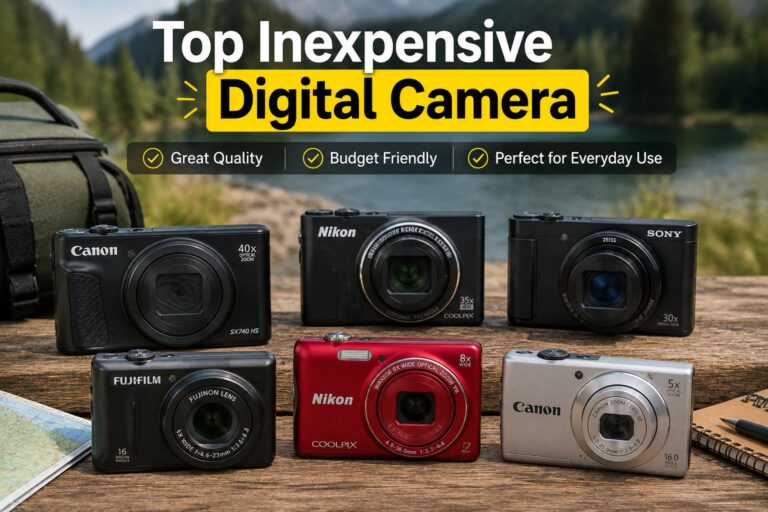
Top Inexpensive Digital Cameras

By TechnoItem Expert Team | Last Updated: July 24, 2026

Quick Answer

The top inexpensive digital cameras in 2026 sit in the $100–$350 price range and deliver genuinely good image quality for everyday photography, travel, and content creation. Brands like Canon, Sony, Nikon, and Kodak all offer solid budget options with features that would have cost twice as much five years ago. For most casual photographers, a budget point-and-shoot or entry-level mirrorless camera is all they’ll ever need.

Key Takeaways

  • Budget digital cameras ($100–$350) now offer 20MP+ sensors, optical zoom, and 4K video in many cases.
  • Canon PowerShot, Sony Cyber-shot, and Nikon Coolpix are the most reliable budget camera lines in 2026.
  • A dedicated camera still outperforms most smartphones in optical zoom, low-light performance, and battery life for long shooting sessions.
  • Point-and-shoot cameras are best for beginners and travelers; entry-level DSLRs and mirrorless cameras suit those who want to grow their skills.
  • Always check sensor size, optical zoom range, and battery life before buying—these three specs matter most at the budget level.
  • Memory cards, cases, and a stable tripod add value without breaking the budget.
  • Refurbished cameras from certified sellers can cut costs by 30–50% with minimal risk.
  • Smartphone cameras (like those on the Google Pixel 10 Pro XL) are a legitimate alternative but lack optical zoom depth and manual controls.

What Makes a Digital Camera “Inexpensive” in 2026?

A digital camera is generally considered inexpensive when it costs under $350. At this price point, buyers can find capable point-and-shoot cameras, entry-level mirrorless models, and older DSLR bodies that still perform well.

The $100–$200 range covers basic compact cameras ideal for casual use. The $200–$350 range unlocks better sensors, faster autofocus, and more manual control. Anything above $350 starts entering mid-range territory, where features like interchangeable lenses and larger sensors become standard.

Budget doesn’t mean bad. Many professional photographers keep a compact budget camera as a backup or travel body precisely because modern inexpensive cameras punch well above their price tag.

Key price tiers to know:

Price Range What You Get
Under $100 Basic point-and-shoot, fixed lens, 720p–1080p video
$100–$200 20MP+, optical zoom, 1080p–4K video, Wi-Fi connectivity
$200–$350 Larger sensors, faster AF, manual modes, better low-light
$350+ (mid-range) Interchangeable lenses, APS-C sensors, and advanced controls


Visit Amazon:https://amzn.to/4fnYYvh

Who Are the Top Inexpensive Digital Cameras Actually For?

Budget cameras are the right choice for specific types of users. They’re not for everyone, and knowing whether you fit the profile saves time and money.

Choose a budget digital camera if you are

  • A beginner photographer learning composition and exposure basics
  • A traveler who wants a lightweight, durable camera without worrying about theft or damage
  • A parent or family photographer capturing everyday moments without complex settings
  • A content creator who needs a dedicated camera for YouTube vlogs or social media
  • A student studying photography or visual media on a tight budget

A budget camera may not be enough if you:

  • Shoot professional events, weddings, or commercial work
  • Need fast burst shooting for sports or wildlife
  • Require interchangeable lenses for creative flexibility
  • Work in very low-light conditions regularly

If you fall into that second group, consider stretching the budget to $500+ or exploring a used mid-range body. For smartphone comparisons, the Samsung Galaxy A16 with its 50MP camera is worth a look as a hybrid option.

Top Inexpensive Digital Cameras Worth Buying in 2026

Top Inexpensive Digital Cameras

These are the most consistently recommended budget cameras across photography communities, retailer reviews, and hands-on testing in 2026. Prices reflect approximate retail at the time of publication.

🏆 Best Overall: Canon PowerShot ELPH 360 HS (~$150)

  • 12x optical zoom, 20.2MP sensor
  • Wi-Fi and NFC for easy sharing
  • Slim, pocket-friendly design
  • Great for travel and everyday shooting

📸 Best for Video: Sony Cyber-shot DSC-W800 (~$100)

  • 20.1 MP, 5x optical zoom
  • Simple controls, excellent color accuracy
  • Ideal for beginners who want reliable stills and 720p video
  • Lightweight at under 120g

🎥 Best for Vloggers: Canon PowerShot G7 X Mark II (~$320)

  • 1-inch sensor (significantly larger than most budget cameras)
  • 4.2x optical zoom, flip-up screen for selfies
  • 1080p video at 60fps
  • Popular with YouTube creators for a reason

🔍 Best Zoom: Nikon Coolpix B500 (~$200)

  • 40x optical zoom—best in class at this price
  • 16MP, Bluetooth, built-in Wi-Fi
  • Excellent for wildlife, sports, and events where you can’t get close

💰 Best Under $100: Kodak PIXPRO FZ45 (~$75)

  • 16MP, 4x optical zoom
  • Simple interface, good for kids or casual users
  • AA battery compatible — no proprietary charger needed

🔄 Best Refurbished Value: Sony Cyber-shot DSC-RX100 (Refurbished, ~$200)

  • Originally a $700+ camera, now available certified refurbished
  • 1-inch sensor, 10x optical zoom, exceptional image quality
  • Best image-per-dollar ratio in 2026 for budget shoppers

How Do Budget Cameras Compare to Smartphone Cameras?

Top Inexpensive Digital Cameras

Budget digital cameras beat smartphones in three specific areas: optical zoom, battery endurance, and physical controls. Smartphones win on convenience, software processing, and connectivity.

Feature Budget Camera Mid-Range Smartphone
Optical Zoom 5x–40x 3x–10x (most models)
Low-Light Moderate Good (AI-enhanced)
Battery Life 200–350 shots All-day (multi-use)
Manual Controls Full Limited
Portability Good Excellent
Sharing Speed Moderate (Wi-Fi) Instant

For most casual users, a smartphone like the Google Pixel 9a handles daily photography well. But for travel photography, wildlife, or situations where you want a dedicated device, a budget camera still makes sense.

What Specs Matter Most When Buying an Inexpensive Digital Camera?

Three specs separate a good budget camera from a frustrating one: sensor size, optical zoom, and battery life. Everything else is secondary.

  1. Sensor Size
    Larger sensors capture more light and produce better images, especially indoors or at dusk. A 1/2.3-inch sensor is standard at the budget level. A 1-inch sensor (found in the Sony RX100 line) is noticeably better and worth paying for if available.
  2. Optical Zoom (not digital zoom)
    Digital zoom is just cropping — it degrades image quality. Optical zoom uses actual glass elements and preserves sharpness. Look for at least 5x optical zoom for versatility.
  3. Battery Life
    Budget cameras often use small batteries. Check the CIPA rating (shots per charge). Anything under 180 shots per charge will frustrate you on a full day of shooting. Carry a spare battery if possible.

Other specs worth checking:

  • Image stabilization (OIS beats digital stabilization)
  • Video resolution (1080p minimum; 4K is a bonus)
  • Wi-Fi or Bluetooth for easy transfers
  • Weight and build quality for travel durability

For accessories that extend your shooting capability, a portable tripod pairs well with any budget camera for stable shots and long exposures.

Where to Buy Top Inexpensive Digital Cameras for the Best Price

The best prices on budget cameras come from a mix of sources, and knowing where to look saves real money.

Best places to buy in 2026:

  • Amazon — Competitive pricing, easy returns, frequent deals on Canon and Sony models
  • B&H Photo—Reliable for camera-specific purchases, often has open-box deals
  • Best Buy — Good for in-store testing before buying; price-match guarantee
  • eBay (certified refurbished) — Strong option for getting premium cameras at budget prices
  • Manufacturer websites — Canon, Sony, and Nikon all run periodic direct sales

Common mistake: Buying from unknown third-party sellers without checking return policies. Always confirm the seller’s rating and return window before purchasing a camera online.

For more tech buying guides and reviews, the Camera category at TechnoItem covers a wide range of options across price points.

What Accessories Should You Buy With a Budget Camera?

A budget camera performs better with a few low-cost accessories. None of these is required, but each one solves a real problem.

  • Extra battery (~$15–$25): Most budget cameras ship with one battery. A spare eliminates the fear of running out mid-shoot.
  • Class 10 or UHS-I SD card (~$10–$20): Slow cards cause lag between shots. A fast card fixes this immediately.
  • Camera case or bag (~$15–$30): Protects the investment and makes carrying easier.
  • Tripod or mini tripod (~$20–$40): Essential for low-light shots, group photos, and video. See options at TechnoItem’s tripod guide.
  • Screen protector (~$5–$10): Budget cameras often have plastic LCD screens that scratch easily.

Total accessory budget: $65–$125 covers everything needed to shoot confidently from day one.

Are Refurbished Budget Cameras Worth Buying?

Certified refurbished cameras from reputable sellers are worth buying in most cases. They typically cost 30–50% less than new, come with a warranty, and have been tested and repaired to manufacturer standards.

Choose refurbished if:

  • The camera is certified by the manufacturer or a verified retailer (not just “seller refurbished”)
  • It includes at least a 90-day warranty
  • You’re targeting a premium model (like Sony RX100) that’s outside your new-camera budget

Avoid refurbished if:

  • There’s no return policy or warranty
  • The listing doesn’t specify what was repaired or tested
  • The price is only 10–15% less than new—the risk isn’t worth the small saving

FAQ: Top Inexpensive Digital Cameras

Q: What is the best budget digital camera under $150 in 2026?
The Canon PowerShot ELPH 360 HS ($150) and Sony Cyber-shot DSC-W800 ($100) are the top picks. Both offer reliable image quality, optical zoom, and easy controls for beginners.

Q: Is a $100 camera worth buying, or should I just use my phone?
A $100 camera is worth buying if you need optical zoom, a dedicated shooting device, or longer battery life. For casual daily photos, a modern smartphone is equally capable or better.

Q: What’s the difference between optical zoom and digital zoom?
Optical zoom uses physical lens movement to magnify the subject without losing quality. Digital zoom simply crops the image, which reduces sharpness. Always prioritize optical zoom when comparing cameras.

Q: How many megapixels do I actually need?
For most uses, including 8×10 prints and social media, 16–20MP is more than enough. Megapixel count matters less than sensor size and lens quality at the budget level.

Q: Can budget cameras shoot good video?
Yes. Most cameras in the $150–$350 range shoot 1080p at 30fps or higher. Some, like the Canon G7 X Mark II, shoot 1080p at 60fps. True 4K is rare under $200 but available in some models.

Q: Do budget cameras work well in low light?
Budget cameras with small sensors (1/2.3-inch) struggle in low light compared to smartphones with AI processing. Cameras with 1-inch sensors (like the Sony RX100 series) perform noticeably better indoors and at night.

Q: What brand makes the most reliable budget cameras?
Canon and Sony consistently receive the highest reliability ratings in the budget camera segment. Nikon is also strong, particularly for zoom-range options.

Q: Should I buy a point-and-shoot or a used DSLR on a budget?
A point-and-shoot is better for portability and simplicity. A used DSLR gives more creative control and better image quality but is bulkier and requires learning more settings. Choose based on how serious you are about photography.

Q: Is Wi-Fi important in a budget camera?
Wi-Fi makes transferring photos to a phone or laptop much faster and easier. It’s a useful feature, especially for content creators. Most cameras above $150 now include it.

Q: What memory card should I buy for a budget camera?
A SanDisk or Lexar Class 10 or UHS-I SD card with at least 32GB storage is the standard recommendation. It ensures fast write speeds and enough space for a full day of shooting.

Conclusion: How to Choose the Right Budget Camera

The top inexpensive digital cameras in 2026 offer real value for photographers at every skill level. The decision comes down to three questions: How much do you want to spend? How important is zoom range? And will you grow into manual controls?

Actionable next steps:

  1. Set a firm budget before browsing—$100, $200, or $350 each unlocks a different tier of quality.
  2. Prioritize optical zoom and sensor size over megapixel count when comparing models.
  3. Check battery life ratings (CIPA standard) and budget for a spare battery.
  4. Consider certified refurbished if you want a premium model at a budget price.
  5. Add a fast SD card and a basic tripod to your order — these two accessories make an immediate difference in usability.
  6. Compare with smartphone options if portability is your top priority — devices like the Motorola Moto G 2026 offer strong cameras at competitive prices.

For more camera reviews, comparisons, and tech buying guides, browse the full Camera section at TechnoItem.

References

Amazing Best Digital Camera for Beginners: Easy Cameras for New Photographers

Best Digital Camera for Beginners

(By TechnoItem Expert Team | Last Updated: July 2026)

Quick Answer

The best digital camera for beginners in 2026 is a mirrorless camera in the $400–$800 range, such as the Sony ZV-E10 II or Canon EOS M50 Mark II, because these cameras balance ease of use with genuine room to grow. Beginners should avoid buying a camera that’s either too simple (no manual controls) or too complex (full-frame with no guidance modes). The right entry-level camera teaches you photography while still producing professional-quality images.

Key Takeaways

  • 🎯 Mirrorless cameras are the top pick for most beginners in 2026 — lighter, smarter, and more future-proof than DSLRs.
  • 💰 Budget sweet spot: $400–$800 covers most beginner needs without overspending on features you won’t use yet.
  • 📷 Sensor size matters: APS-C sensors offer the best balance of image quality and affordability for new photographers.
  • 🔋 Battery life and kit lens quality are often overlooked but critically affect your first-year experience.
  • 📱 Smartphone cameras are not the same — dedicated cameras offer manual control, interchangeable lenses, and far better low-light performance.
  • 🎥 Video capability is worth checking even if you plan to shoot mostly photos — 4K is standard at this price range now.
  • 🛡️ Avoid buying used without a warranty as a beginner—shutter count and sensor condition are hard to assess without experience.
  • 📚 Auto modes are fine to start — the best beginner cameras let you shoot in auto and gradually shift to manual.
  • 🔗 Accessories matter: A good tripod and extra memory card should be part of your first purchase plan.

What Makes a Camera Truly Beginner-Friendly?

A beginner-friendly digital camera does three things well: it produces good photos in automatic mode, it teaches you to improve, and it doesn’t frustrate you with a steep learning curve.

Specifically, look for these traits:

  • Guided or scene modes that explain what each setting does
  • A flip-out or tilting touchscreen for easy framing at awkward angles
  • Lightweight body under 450g, so you can actually carry it
  • Fast autofocus so you don’t miss moments while the camera hunts for focus
  • Wi-Fi or Bluetooth connectivity for easy transfers to your phone
  • A kit lens included in the box (usually an 18-55mm equivalent)

“The best camera for a beginner is the one they’ll actually pick up and use — not the one with the most specs on paper.”

Common mistake: Many first-time buyers choose a camera based on megapixel count alone. In reality, a 24MP APS-C sensor in good light will outperform a 48MP smartphone sensor in almost every scenario that matters — but megapixels alone don’t determine image quality. Lens quality, sensor size, and dynamic range matter far more.

What Are the Main Camera Types for Beginners?

For someone choosing their first dedicated camera, there are four main categories to understand:

Camera Type Best For Price Range Portability
Mirrorless (APS-C) Most beginners $400–$900 High
DSLR (APS-C) Budget-conscious buyers $350–$700 Medium
Point-and-Shoot Ultra-portability $200–$500 Very High
Bridge Camera Zoom-focused shooters $300–$600 Medium

Choose mirrorless if you want the best long-term investment, care about video quality, and want a lighter kit.

Choose a DSLR if you find a great deal on a used or older model and want excellent battery life (DSLRs can last 600–1,000 shots per charge vs. 300–400 for many mirrorless).

Choose a point-and-shoot if you want something pocketable and have no interest in swapping lenses.

Choose a bridge camera if you want an extreme zoom range (say, 60x optical zoom for wildlife or sports) in one fixed-lens body.

For most people reading this guide, mirrorless is the right answer in 2026.

Which are the best digital cameras for beginners right now?

The best digital cameras for beginners in 2026 come from Sony, Canon, Fujifilm, and Nikon — all of which offer strong APS-C mirrorless options with beginner-friendly features and solid ecosystem support.

Here are the top picks by category:

Best Overall Beginner Camera

Sony ZV-E10 II (~$750 with kit lens)

  • 26MP APS-C sensor
  • 4K video with real-time eye tracking
  • Flip-out screen ideal for vlogging and selfies
  • Compact, lightweight body

Best Budget Beginner Camera

Canon EOS M50 Mark II (~$500–$600 with kit lens)

  • 24.1MP APS-C sensor
  • Dual Pixel autofocus (fast and reliable)
  • Guided UI mode for absolute beginners
  • Strong Canon color science out of the camera

Best for Creative Shooters

Fujifilm X-S20 (~$800 with kit lens)

  • 26.1MP APS-C sensor
  • 40 built-in film simulations for unique looks
  • Excellent in-body image stabilization (IBIS)
  • Strong video specs, including 6.2K raw output

Best DSLR Option (Budget Pick)

Nikon D3500 (used, ~$300–$400)

  • 24.2MP APS-C sensor
  • Exceptional battery life (~1,500 shots per charge)
  • “Guide Mode” walks beginners through settings step-by-step.
  • No longer in production, but widely available used with a warranty

Note: Prices are approximate and vary by retailer and region. Always confirm current pricing before purchasing.

How Much Should a Beginner Spend on a Digital Camera?

Best Digital Camera for Beginners

Most beginners should plan to spend between $400 and $800 on their first camera setup, including a kit lens. Spending less often means sacrificing autofocus speed or video quality; spending more usually means paying for features that take years of experience to use.

Realistic budget breakdown for a beginner kit:

  • Camera body + kit lens: $450–$800
  • Extra battery: $25–$50
  • 64GB or 128GB SD card (UHS-I or faster): $15–$35
  • Camera bag or case: $30–$70
  • Stable tripod for phone or camera: $30–$80

Total realistic first kit: $550–$1,035

Edge case: If you’re buying a camera specifically for travel, factor in weight. A mirrorless body plus one compact lens can weigh under 600g total — much easier to carry than a DSLR kit for extended trips.

What Specs Actually Matter for a Beginner?

When shopping for the best digital camera for beginners, focus on these specs and ignore the rest:

Specs that matter:

  • Sensor size (APS-C is the sweet spot—larger than Micro Four Thirds, smaller and cheaper than full-frame)
  • Autofocus system (phase-detect AF is faster than contrast-detect; eye-tracking AF is a major advantage)
  • Image stabilization (in-body stabilization, or IBIS, is more flexible than lens-only stabilization)
  • Battery life (anything under 250 shots per charge will frustrate you on a long day out)
  • Screen type (fully articulating screens are more useful than fixed or tilt-only screens)

Specs beginners can safely ignore:

  • Burst shooting speed above 10fps
  • Weather sealing (useful, but rarely critical at this price point)
  • Dual card slots
  • Maximum ISO above 25600

What Accessories Do Beginners Actually Need?

Beyond the camera itself, a few accessories genuinely improve the beginner experience. Skip the overpriced bundles most retailers push — they often include low-quality filters and bags that aren’t worth the markup.

Essential accessories:

  1. Extra battery — Most kit batteries last 300–400 shots. Bring two on any serious outing.
  2. Fast SD card — Look for UHS-I Speed Class 3 (U3) or UHS-II for 4K video. Cheap cards cause dropped frames.
  3. Camera strap — The included strap is usually uncomfortable. A third-party sling or wrist strap is worth $20–$40.
  4. Lens cleaning kit — A blower, microfiber cloth, and lens pen cost under $15 and protect your investment.
  5. Tripod — Even a basic tripod expands what you can shoot dramatically (long exposures, group shots, video). See our guide to stable and portable tripods for options that work with cameras and phones alike.

Optional but useful:

  • A 50mm prime lens (usually $100–$200) for portraits and low-light shooting
  • A camera bag that fits your travel style

Should Beginners Buy a Camera or Just Use Their Smartphone?

A dedicated camera outperforms a smartphone in specific situations — and in 2026, smartphones have genuinely closed the gap in others. The honest answer depends on what you want to shoot.

A dedicated camera wins when:

  • Shooting in low light without flash (larger sensor = less noise)
  • You want creative control over depth of field (background blur)
  • You need optical zoom beyond 5x without quality loss
  • You’re shooting fast-moving subjects (sports, wildlife, kids)
  • You want to print images at large sizes

A smartphone wins when:

  • You need instant sharing to social media
  • Portability is the top priority
  • Computational photography (AI scene detection, HDR) suits your style
  • Budget is under $300

For reference, the Google Pixel 10 Pro XL and Apple iPhone 17 Pro Max both produce outstanding results in good light—but neither replaces a dedicated camera for full manual control or interchangeable lenses.

If you’re serious about learning photography as a skill, buy a dedicated camera. If you want better photos with zero learning curve, a flagship smartphone may be enough.

What Are the Most Common Mistakes Beginners Make When Buying a Camera?

Knowing what to avoid saves money and frustration. These are the most frequent mistakes new photographers make:

  • Buying full-frame too soon: Full-frame cameras produce stunning images, but lenses are expensive, and the bodies are heavy. Most beginners don’t need a full-frame for years.
  • Ignoring the lens ecosystem: A camera body is just the start. Check whether the brand has affordable lenses you can grow into.
  • Skipping the kit lens: Many buyers think the kit lens is low quality and skip it. In reality, modern kit lenses are solid for beginners and save you $200–$400 upfront.
  • Buying based on YouTube reviews alone: Many camera reviewers test cameras in ideal conditions. Look for reviews from beginner photographers, not just pros.
  • Forgetting about software: Editing software like Adobe Lightroom or free tools like Darktable can transform RAW files from any decent camera. The camera is only half the equation.

For those who also use their camera alongside other tech, it’s worth having a reliable setup—from a good laptop for editing to the right accessories for your workflow.

How Do Beginners Learn to Use a New Camera Faster?

The fastest path from “auto mode” to confident manual shooting takes most people 3–6 months with consistent practice.

A practical learning path:

  1. Week 1–2: Shoot everything in Auto mode. Focus on composition, not settings.
  2. Week 3–4: Switch to Aperture Priority (Av or A mode). Learn how aperture affects background blur.
  3. Month 2: Add Shutter Priority (Tv or S mode). Practice shooting moving subjects.
  4. Month 3: Try full manual mode in a controlled setting (indoors, still subjects).
  5. Month 4–6: Shoot RAW files and start basic editing.

Resources that actually help:

  • YouTube channels like Tony & Chelsea Northrup or Mark Wallace’s Adorama series
  • The camera’s own manual (underrated — most modern manuals are well-written)
  • Photography subreddits for feedback on your actual shots

Also consider that accessories like a wireless microphone can expand your camera’s video capability if you start exploring vlogging or content creation alongside photography.

FAQ: Best Digital Camera for Beginners

Q: What is the single best digital camera for beginners in 2026?
The Sony ZV-E10 II is the top overall pick for most beginners in 2026 — it balances image quality, video capability, and ease of use at a fair price point.

Q: Is a mirrorless camera better than a DSLR for beginners?
Yes, for most beginners in 2026. Mirrorless cameras are lighter, have better video autofocus, and receive more active lens development from manufacturers. DSLRs are still viable, but are largely in maintenance mode from most brands.

Q: How many megapixels does a beginner’s camera need?
24MP is more than enough for any beginner use case, including large prints and cropping. Chasing higher megapixel counts at the expense of other features is a common and costly mistake.

Q: Can a beginner use a camera in manual mode right away?
Technically, yes, but it’s not recommended. Start with auto or semi-auto modes, then gradually shift to manual as you understand how aperture, shutter speed, and ISO interact.

Q: What is the best beginner camera under $500?
The Canon EOS M50 Mark II (with kit lens) and the Nikon D3500 (used) are both strong options under $500. The Canon is better for video; the Nikon has superior battery life.

Q: Do I need to buy extra lenses right away?
No. The kit lens that comes with most beginner cameras covers a wide range of situations. A 50mm prime lens is a worthwhile second purchase after 3–6 months, but it’s not urgent.

Q: Is it worth buying a used camera as a beginner?
It can be, but stick to certified refurbished options from the manufacturer or reputable retailers. Check the shutter count and ensure the camera comes with at least a 90-day warranty.

Q: What camera brand is best for beginners?
Sony, Canon, and Fujifilm all have strong beginner lineups. Sony leads in autofocus technology; Canon has the most beginner-friendly interface; Fujifilm offers the most creative in-camera options. Nikon is also solid but has a smaller mirrorless APS-C lens selection.

Q: Does camera brand matter long-term?
Yes, your lens investment ties you to a brand’s ecosystem. Choose a brand with a broad, affordable lens lineup so you can grow without switching systems.

Q: What’s the best digital camera for beginners who also want to vlog?
The Sony ZV-E10 II is built with vloggers in mind — it has a directional microphone, a fully articulating screen, and smooth 4K video. The Fujifilm X-S20 is a strong alternative with better in-body stabilization.

Conclusion: Choosing Your First Camera With Confidence

The best digital camera for beginners in 2026 isn’t the most expensive one or the one with the most features — it’s the one that matches your actual shooting style, budget, and willingness to learn.

Actionable next steps:

  1. Set your budget first—decide how much you’re comfortable spending on the body, lens, and accessories combined.
  2. Pick your camera type — mirrorless for most people; DSLR only if you find a great budget deal.
  3. Choose a brand with a lens ecosystem you can afford to grow into (Sony, Canon, or Fujifilm are safe bets).
  4. Buy the kit lens — don’t skip it to save money on a prime lens you’re not ready for yet.
  5. Get one extra battery and a fast SD card before your first shoot.
  6. Commit to shooting regularly — even 20 minutes a week of deliberate practice accelerates improvement faster than any gear upgrade.

For more camera and tech buying guides, explore the full camera category on TechnoItem to find reviews and comparisons that match your needs.

Photography is a skill that compounds over time. The right beginner camera is just the starting point — what you do with it is what matters.

References

Amazing Best Affordable Digital Camera in 2026: Complete Buying Guide

Best Affordable Digital Camera in 2026

Quick Answer

The best affordable digital camera in 2026 balances image sensor quality, ease of use, and a price under $400 — without forcing you to sacrifice features that actually matter. For most buyers, a compact point-and-shoot or entry-level mirrorless camera in the $150–$350 range delivers excellent results for travel, family photos, and everyday shooting. The Canon PowerShot V10, Sony ZV-1 II, and Fujifilm X-T30 II (refurbished) consistently rank as top picks in this price bracket.

Key Takeaways

  • Budget sweet spot: $150–$350 covers the vast majority of quality, affordable digital cameras in 2026.
  • Sensor size matters more than megapixels — a 1-inch or APS-C sensor will outperform a 20MP phone-sized sensor in low light.
  • Point-and-shoot cameras suit casual photographers; entry-level mirrorless suits those who want to grow their skills.
  • Optical zoom is a major advantage over smartphones — look for at least 3x optical zoom.
  • Video capability is now standard; 4K at 30fps is achievable under $300.
  • Battery life varies widely — always check the rated shot count before buying.
  • Refurbished cameras from Canon, Sony, and Nikon official stores can cut costs by 20–40% with full warranties.
  • Accessories add up—budget an extra $30–$60 for a memory card, an extra battery, and a stable tripod.
  • Smartphones are NOT a replacement for optical zoom, manual controls, or dedicated sensor performance.
  • Image stabilization (optical or sensor-shift) is worth prioritizing if you shoot handheld or in motion.

What Makes a Digital Camera “Affordable” Without Being Cheap?

Affordable does not mean low quality. A camera qualifies as affordable when it delivers professional-adjacent results at a price that doesn’t require financing. In 2026, that threshold sits around $400 or below for a new unit and under $250 for a solid refurbished option.

Key factors that separate affordable-but-capable from just cheap:

  • Sensor size: 1/2.3-inch sensors (common in ultra-budget cameras) struggle in dim light. A 1-inch or larger sensor is the minimum worth recommending.
  • Lens quality: A slower kit lens with poor sharpness limits results regardless of sensor quality.
  • Build quality: Plastic bodies are fine; loose buttons, wobbly zoom rings, and flimsy doors are not.
  • Manufacturer support: Firmware updates, accessory availability, and repair networks matter for long-term value.

Decision rule: If a camera costs under $100 new from an unknown brand, treat it as a toy, not a tool. Stick to Canon, Sony, Nikon, Fujifilm, or Panasonic for reliability in the affordable segment.

Visit Amazon:https://amzn.to/4do9bq5

Who Should Buy the Best Affordable Digital Camera (and Who Shouldn’t)?

Buy an affordable digital camera if you are:

  • A parent who wants sharper, faster photos of kids than a phone provides
  • A traveler who needs optical zoom and better low-light performance
  • A content creator on a budget who wants dedicated video/photo hardware
  • A student learning photography basics before investing in a full system
  • Someone who wants a simple, dedicated device without phone distractions

Skip a dedicated camera if you:

  • Already own a flagship smartphone like the Apple iPhone 17 Pro Max or Google Pixel 10 Pro XL—their computational photography closes the gap significantly for casual use
  • Rarely print photos larger than 5×7 inches
  • Need a device that fits in a front pocket with no compromise

Best Affordable Digital Camera Options by Category in 2026

Best Affordable Digital Camera 2026

The right camera depends on your use case. Here’s a breakdown of the top picks by category:

Best Compact Point-and-Shoot Under $300

Camera Price (est.) Sensor Zoom Video
Canon PowerShot V10 ~$280 1-inch Fixed 4K/30fps
Sony ZV-1 II ~$299 1-inch 2.7x optical 4K/30fps
Ricoh GR IIIx (refurb) ~$350 APS-C Fixed 1080p

The Canon PowerShot V10 is a strong pick for vloggers and casual shooters—its built-in stand, wide-angle lens, and clean 4K video make it genuinely useful for content creation. The 1-inch sensor handles indoor and outdoor light well.

The Sony ZV-1 II adds optical zoom and Sony’s excellent autofocus, making it the better all-rounder for mixed photography and video.

Best Entry-Level Mirrorless Under $500 (Refurbished)

Camera Price (est.) Sensor Lens Mount Standout Feature
Fujifilm X-T30 II (refurb) ~$450 APS-C X-mount Film simulations
Canon EOS M50 Mark II (refurb) ~$380 APS-C EF-M Flip screen, DPAF
Sony A6100 (refurb) ~$420 APS-C E-mount Best-in-class AF

For anyone serious about learning photography, a refurbished APS-C mirrorless camera offers a significant jump in image quality and creative control. The Sony A6100, in particular, has tracking autofocus that rivals cameras costing three times as much.

What Specs Actually Matter When Choosing a Budget Digital Camera?

Most spec sheets are designed to confuse. Focus on these six factors when evaluating any budget digital camera:

  1. Sensor size — 1-inch minimum for quality results; APS-C for serious shooting
  2. Autofocus system—Phase-detect AF is faster and more reliable than contrast-detect AF
  3. Optical image stabilization (OIS) — Critical for handheld video and low-light stills
  4. Battery life — Look for 200+ shots per charge; carry a spare for day trips
  5. Storage format — SD card support is standard; confirm UHS-I or UHS-II compatibility
  6. Connectivity — Built-in Wi-Fi and Bluetooth simplify photo transfer to phone or laptop

Megapixels are overrated. A 20MP image from a small sensor will look worse in low light than a 12MP image from a 1-inch sensor. Don’t let megapixel counts drive your decision.

📷 Common mistake: Buyers often prioritize zoom range over sensor quality. A 30x zoom on a tiny sensor produces blurry, noisy images at full reach. A 3x optical zoom on a 1-inch sensor will almost always look better.

How Does the Best Affordable Digital Camera Compare to a Smartphone?

Smartphones have improved dramatically, but dedicated cameras still hold clear advantages in specific areas.

Feature Affordable Digital Camera Flagship Smartphone
Optical zoom 3x–10x true optical Digital/hybrid (degrades quality)
Low-light performance Superior (larger sensor) Good (computational, not optical)
Manual controls Full access Limited or app-dependent
Battery (dedicated) Replaceable Fixed, shared with all apps
Portability Moderate Excellent
Price $150–$400 $700–$1,200+
Video stabilization OIS hardware Excellent (software + hardware)

For more on what modern smartphones can do photographically, see the Samsung Galaxy S26 Ultra review—it illustrates exactly where the gap between phones and cameras has narrowed and where it hasn’t.

Bottom line: If you shoot mostly in good light and never print large, a flagship phone may be enough. If you need optical zoom, shoot in mixed light, or want manual control, a dedicated camera wins.

Where to Buy an Affordable Digital Camera in 2026: New vs. Refurbished

New cameras offer full warranties and the latest firmware. They’re the right choice when a model is brand new or when you need peace of mind.

Certified refurbished cameras from Canon, Sony, Nikon, and Fujifilm official stores are a better value for most buyers. These units are inspected, repaired to manufacturer standards, and typically carry a 90-day to 1-year warranty. Savings of 20–40% are common.

Best places to buy:

  • Manufacturer-refurbished stores (Canon USA, Sony Certified Refurbished, Nikon Refurbished)—highest confidence
  • B&H Photo and Adorama—reputable retailers with a wide selection and clear grading
  • Amazon Renewed — acceptable for well-reviewed sellers with return policies
  • eBay — higher risk; only buy from sellers with 98%+ feedback and clear return terms

Avoid: Unnamed third-party sellers on marketplaces without return policies. Gray market imports may lack local warranty support.

What accessories do you need with a budget digital camera?

The camera body is just the start. Budget an additional $40–$80 for essentials:

  • Memory card: A 64GB UHS-I SD card covers most needs; 128GB if shooting 4K video
  • Extra battery: Almost every affordable camera comes with one battery—buy a second
  • Camera bag or case: Protects the investment; soft cases start around $15
  • Tripod or mini tripod: Essential for low-light shots, video, and self-portraits—a phone-compatible tripod often works with compact cameras via a universal mount
  • Screen protector: Cheap insurance against scratches on LCD screens

For content creators pairing a camera with a smartphone workflow, a gimbal stabilizer can dramatically improve video quality when shooting handheld.

Top Mistakes to Avoid When Buying a Budget Digital Camera

  1. Buying based on megapixels alone
    Already covered above — sensor size and lens quality matter far more.
  2. Ignoring the lens ecosystem
    If you buy an interchangeable-lens camera, check whether affordable lenses exist for that mount. Some systems have very limited budget lens options.
  3. Forgetting about video autofocus
    Still-photo autofocus and video autofocus are not the same. Test or research video AF performance separately if video is a priority.
  4. Skipping the return window
    Always buy from a seller with a clear return policy. Cameras can have unit-specific defects (hot pixels, sticky aperture blades) that only show up after use.
  5. Underestimating the learning curve
    A mirrorless camera with manual controls is more powerful than a point-and-shoot, but it requires time to learn. If you want immediate results, start with a point-and-shoot.

Frequently Asked Questions

Q: What is the best affordable digital camera for beginners in 2026?
The Sony ZV-1 II or Canon PowerShot V10 are the top beginner picks under $300. Both offer automatic modes, good video quality, and 1-inch sensors that outperform most smartphones.

Q: Is a $200 camera worth buying in 2026?
Yes, if you choose carefully. At $200, the Canon PowerShot ELPH series and refurbished Sony Cyber-shot models offer solid image quality for casual photography. Avoid unknown brands at this price.

Q: How many megapixels do I need in a budget camera?
12–20MP is more than enough for prints up to 16×20 inches and all digital use. Prioritize sensor size over megapixel count.

Q: Can a cheap digital camera shoot good video?
Yes. Many cameras under $300 shoot 4K at 30fps. The Sony ZV-1 II and Canon V10 are strong examples. Check whether the camera can record for more than 30 minutes continuously if you plan longer shoots.

Q: Should I buy a point-and-shoot or a mirrorless camera on a budget?
Buy a point-and-shoot if you want simplicity and portability. Buy a refurbished entry-level mirrorless if you want to learn photography and grow into the system over time.

Q: Are refurbished cameras reliable?
Certified refurbished cameras from manufacturer stores are very reliable. They go through inspection and testing processes and typically include warranties. Third-party refurbished units carry more risk.

Q: What is the best affordable camera for travel photography?
The Sony ZV-1 II or a refurbished Sony A6100 with the 16-50mm kit lens. Both are compact, capable in mixed light, and have optical zoom.

Q: How long do budget digital cameras last?
With normal use, a quality camera from Canon, Sony, or Nikon should last 5–10 years. Shutter actuations (the mechanical count of photos taken) are the main wear factor on mirrorless and DSLR bodies.

Q: Do affordable cameras work well in low light?
Cameras with 1-inch or APS-C sensors perform noticeably better in low light than smartphone-sized sensors. Look for a maximum ISO of at least 3200 with acceptable noise levels.

Q: Is optical zoom important for a budget camera?
Yes, especially for travel and wildlife. Optical zoom maintains image quality at a distance; digital zoom does not. Aim for at least 3x optical zoom.

Conclusion: How to Choose the Right Affordable Digital Camera

Finding the best affordable digital camera in 2026 comes down to three honest questions: What will you photograph most? How much do you want to learn? And what’s your real budget, including accessories?

Actionable next steps:

  1. Set a firm budget including accessories—add $50 to whatever camera price you’re considering.
  2. Decide between point-and-shoot and mirrorless based on whether you want simplicity or creative growth.
  3. Prioritize sensor size (1-inch minimum) and autofocus quality over megapixels or zoom range.
  4. Check refurbished options from official manufacturer stores before buying new.
  5. Read return policies before purchasing, and test the camera thoroughly within the return window.
  6. Browse more camera guides and reviews at TechnoItem’s camera category for updated picks and comparisons.

The right camera is the one you’ll actually carry and use. A $280 compact that goes everywhere beats a $500 mirrorless that stays home because it’s too bulky. Start with your lifestyle, then match the gear to it.

References

Mirrorless Camera vs DSLR: The Complete 2026 Buying Guide

Mirrorless Camera vs DSLR

Quick Answer

For most photographers buying a camera in 2026, a mirrorless camera is the better choice. Mirrorless systems offer faster autofocus, lighter bodies, and better video capabilities. DSLRs still hold value for photographers who already own lenses, need longer battery life, or are working with a tight budget on used gear. (Mirrorless Camera vs DSLR)

Key Takeaways

  • Mirrorless cameras are lighter, faster, and better for video than DSLRs in most categories.
  • DSLRs offer longer battery life, a larger used-lens ecosystem, and lower entry prices on the used market.
  • Autofocus speed and accuracy favor mirrorless systems, especially for sports and wildlife photography.
  • Mirrorless cameras use an electronic viewfinder (EVF); DSLRs use an optical viewfinder (OVF)—each has real trade-offs.
  • Most major manufacturers (Canon, Nikon, Sony) have shifted primary R&D investment to mirrorless lines as of 2026.
  • Existing DSLR lens owners can often use adapters to mount their glass on mirrorless bodies.
  • For beginners, a mid-range mirrorless camera offers more room to grow than an equivalent DSLR.
  • Battery life is still a genuine weakness for mirrorless cameras, though newer models have improved significantly.

What is the core difference between mirrorless cameras and DSLRs?

Mirrorless Camera vs DSLR

A DSLR (Digital Single-Lens Reflex) uses a physical mirror inside the camera body to reflect light up through an optical viewfinder. When you press the shutter, the mirror flips up, and light hits the sensor. A mirrorless camera removes that mirror entirely — light goes straight to the sensor at all times, and the viewfinder is an electronic display showing a live feed from the sensor.

This single mechanical difference drives most of the trade-offs between the two systems:

  • No mirror = smaller, lighter body (mirrorless)
  • No mirror = no optical viewfinder (mirrorless uses EVF or rear screen)
  • Mirror mechanism = more moving parts, more wear (DSLR)
  • Live sensor feed = better real-time exposure preview (mirrorless)

“The mirror is both the DSLR’s greatest strength and its greatest limitation—it delivers an optically pure view of the world, but it also adds weight, complexity, and mechanical constraints that mirrorless systems simply don’t have.”

Visit Amazon: 

Mirrorless Camera: https://amzn.to/4tS4hGA

DSLR Camera: https://amzn.to/3Q1hjnk

How Does Image Quality Compare: Mirrorless Camera vs DSLR?

At equivalent sensor sizes and price points, image quality between mirrorless and DSLR cameras is effectively identical. Both systems use the same sensor technologies—full-frame, APS-C, or Micro Four Thirds—and the sensor primarily determines image quality, not the presence or absence of a mirror.

Where mirrorless pulls ahead on image quality:

  • Real-time exposure preview in the EVF means fewer blown highlights or crushed shadows in tricky lighting.
  • On-sensor phase-detect autofocus on mirrorless cameras is more precise for critical focus in portraits and macro work.
  • In-body image stabilization (IBIS) is more common and more advanced in mirrorless systems, reducing motion blur in low light.

Where DSLRs hold their own:

  • Optical viewfinders show the scene with zero lag and no digital noise, which some photographers prefer for composition.
  • Proven, mature sensor technology in flagship DSLRs like the Nikon D850 still produces exceptional results.

Bottom line: Don’t choose between these systems based on image quality alone. The differences are minimal at the sensor level.

Which Has Better Autofocus: Mirrorless or DSLR?

Mirrorless cameras have a clear autofocus advantage in 2026. Because mirrorless systems use on-sensor phase-detect autofocus (PDAF) covering most or all of the frame, they track subjects faster and more accurately than the separate AF modules used in DSLRs.

Key autofocus advantages of mirrorless:

  • Eye, face, and subject tracking are standard on most mid-range and flagship mirrorless bodies (Sony, Canon, Nikon).
  • AF coverage often spans 90–100% of the frame vs. the center-weighted AF zones on most DSLRs.
  • Continuous tracking for sports and wildlife is significantly more reliable on current mirrorless systems.

DSLRs use a dedicated phase-detect AF module that only activates in optical viewfinder mode. In live view (using the rear screen), DSLR autofocus slows dramatically because it switches to contrast-detect AF, a known weakness.

Choose mirrorless if autofocus speed and subject tracking matter for your work (sports, wildlife, events, video).

Choose a DSLR if you shoot primarily static subjects (landscapes, studio portraits) where AF speed is less critical.

Size, Weight, and Portability: Which Wins?

Mirrorless cameras win on size and weight, but the gap is smaller than many people expect once lenses are attached.

Feature Mirrorless DSLR
Body weight (typical full-frame) 450–650g 700–900g
Body depth Shallower (no mirror box) Deeper
Lens size Often larger (new optical designs) Mature, compact primes available
Travel friendliness Better Bulkier
Grip ergonomics Varies; some feel small Generally excellent

The mirrorless body is lighter, but native mirrorless lenses — especially fast primes and telephoto zooms — are sometimes larger than their DSLR equivalents because lens designers are compensating for the shorter flange distance with more complex optical formulas.

For travel photographers or street shooters, mirrorless is the clear winner. For studio or landscape photographers who always use a tripod, the weight difference matters less. If you’re looking for stable support regardless of camera type, a stable and portable tripod can make a real difference in your shooting setup.

Battery Life: A Real Weakness of Mirrorless Cameras

best budget digital cameras

DSLRs last significantly longer per charge than most mirrorless cameras. The optical viewfinder in a DSLR uses no power — the sensor only activates when you shoot. Mirrorless cameras power the sensor and EVF continuously.

Typical battery performance (CIPA ratings, approximate):

  • Entry-level DSLR: 600–1,000 shots per charge
  • Mid-range DSLR: 800–1,500 shots per charge
  • Mirrorless (APS-C): 300–500 shots per charge
  • Mirrorless (full-frame, newer models): 350–600 shots per charge

Note: CIPA ratings are standardized lab estimates. Real-world performance varies based on EVF use, image review, and wireless features.

Practical workarounds for mirrorless battery life:

  1. Carry 2–3 spare batteries (they’re relatively inexpensive).
  2. Use a battery grip for extended shoots.
  3. Enable power-saving modes and reduce EVF brightness.
  4. Turn off Wi-Fi and Bluetooth when not needed.

For professional event photographers shooting all-day jobs, battery management is a real workflow consideration with mirrorless systems.

Video Capabilities: Mirrorless Camera vs DSLR

Mirrorless Camera vs DSLR

Mirrorless cameras are substantially better for video. This is one of the clearest advantages in the mirrorless camera vs. DSLR debate.

Why mirrorless dominates video:

  • Continuous autofocus during video is fast and reliable (DSLR live-view AF is slow and often hunts).
  • 4K and higher resolutions are standard across mirrorless lines; many DSLRs cap at 1080p or offer limited 4K.
  • Log profiles and 10-bit color are more widely available on mirrorless bodies.
  • Compact form factor pairs better with gimbals and rigs. For smooth handheld video, a stabilizer like the DJI Osmo Mobile 8 works well alongside a mirrorless body.
  • Microphone and headphone jacks are standard on most mirrorless bodies.

DSLRs were never designed with video as a primary use case. While cameras like the Canon 5D Mark IV produce usable video, they can’t match what a Sony A7 IV or Canon R6 Mark II delivers out of the box.

Choose mirrorless if video is any part of your workflow—even occasional YouTube content or family videos.

Cost Comparison: Which Is More Affordable?

The answer depends on whether you’re buying new or used.

New camera market (2026):

  • Entry-level mirrorless (APS-C): $600–$900
  • Mid-range mirrorless (full-frame): $1,800–$2,800
  • Entry-level DSLR: $400–$700 (limited new releases)
  • Mid-range DSLR: $900–$1,500 (mostly older stock)

Used/refurbished market:

DSLRs offer excellent value used. A Nikon D750 or Canon 5D Mark III with a kit lens can be found for $500–$800 used, delivering full-frame image quality at a fraction of the mirrorless equivalent. For photographers on a strict budget who primarily shoot stills, the used DSLR market is genuinely compelling.

Lens ecosystem costs:

  • DSLR lenses (Canon EF, Nikon F mount) have decades of third-party support, meaning sharp, affordable primes are widely available.
  • Mirrorless native lenses are newer and often more expensive, though the gap is closing as third-party manufacturers like Sigma and Tamron expand their mirrorless lineups.

Who Should Buy a Mirrorless Camera in 2026?

Mirrorless is the right choice for most new buyers in 2026. Here’s a simple decision framework:

Buy mirrorless if you:

  • Are you buying your first interchangeable-lens camera?
  • Shoot video regularly or plan to.
  • Want the best autofocus for moving subjects.
  • Value a compact, travel-friendly system.
  • Plan to grow your lens collection over time.

Stick with a DSLR (or buy a used DSLR) if you:

  • Already own a large collection of DSLR lenses and aren’t ready to invest in adapters or new glass.
  • Need maximum battery life for long fieldwork without charging access.
  • You are on a very tight budget, and the used DSLR market fits your needs.
  • Strongly prefer an optical viewfinder for sports or fast-action shooting.

For photographers who also want to understand how smartphone cameras compare to dedicated cameras, our Camera category covers a wide range of imaging devices and reviews.

What About Smartphone Cameras vs. Mirrorless and DSLR?

best budget digital cameras

Modern smartphones have closed the gap significantly for casual photography, but dedicated cameras still lead in several areas. Phones like the Apple iPhone 18 Pro Max and Samsung Galaxy S26 Ultra produce impressive results in good light, but they can’t match the low-light performance, optical zoom range, or creative control of a dedicated mirrorless or DSLR system.

Where dedicated cameras still win:

  • Large sensor low-light performance (less noise at high ISO)
  • True optical zoom (not digital crop)
  • Interchangeable lenses for creative flexibility
  • RAW file quality and dynamic range
  • Shallow depth of field for portrait work

Smartphones are ideal for everyday moments and social media. For professional work, portraiture, wildlife, or any situation requiring creative lens control, a dedicated camera system remains the better tool.

FAQ: Mirrorless Camera vs DSLR

Q: Is mirrorless better than a DSLR for beginners?
Yes, for most beginners in 2026. Mirrorless cameras offer better autofocus, more intuitive live-view shooting, and a system with a longer future roadmap. The learning curve is similar.

Q: Can I use my DSLR lenses on a mirrorless camera?
Yes, with an adapter. Canon, Nikon, and Sony all make official adapters that allow DSLR lenses to work on their mirrorless bodies, usually with full autofocus and image stabilization support.

Q: Are DSLRs being discontinued?
Not immediately, but major manufacturers have shifted primary development to mirrorless. Nikon announced no new DSLR development in 2022. Canon and Nikon continue to support existing DSLR lines with firmware, but new model releases are rare.

Q: Which is better for wildlife photography?
Mirrorless, in most cases. Modern mirrorless systems (Sony A9 III, Canon R3, and Nikon Z9) offer blackout-free shooting, superior subject tracking, and faster burst rates than any current DSLR.

Q: Do mirrorless cameras overheat during video recording?
Some do, particularly older or entry-level models. Most current flagship mirrorless cameras have addressed overheating with improved heat management. Check specific model reviews before buying for heavy video use.

Q: Is a DSLR still worth buying in 2026?
Yes, specifically on the used market. A used full-frame DSLR with quality glass is a cost-effective way to get professional image quality. For new purchases, mirrorless offers better long-term value.

Q: Which system has more lens choices?
Currently, DSLR mounts (Canon EF and Nikon F) have more total lenses available due to decades of production. However, mirrorless mounts are growing rapidly, and adapters bridge the gap effectively.

Q: What is an electronic viewfinder (EVF) disadvantage?
EVFs can show slight lag (though modern EVFs are near-imperceptible), look grainy in very low light, and consume battery. Some photographers also find them less natural than an optical viewfinder for panning shots.

Q: Which is better for portrait photography?
Both work well. Mirrorless cameras with eye-tracking autofocus make portrait shooting faster and more reliable, but a DSLR with a quality 85mm or 50mm prime lens produces equally beautiful portrait images.

Q: How long will DSLR support last?
Manufacturers have committed to continued lens and firmware support for existing DSLR systems for the foreseeable future. Practically, DSLRs will remain usable and supported for at least another decade.

Conclusion: Which Camera System Should You Choose?

The mirrorless camera vs. DSLR debate has a clear winner for most buyers in 2026: mirrorless. The technology has matured, prices have become competitive, and the autofocus, video, and portability advantages are real and meaningful.

That said, DSLRs aren’t obsolete. They remain excellent tools, especially for photographers buying used, those who already own DSLR glass, or anyone who values optical viewfinders and extended battery life.

Actionable next steps:

  1. Define your primary use case—stills only, video, sports, or travel—before looking at specific models.
  2. Set a realistic budget, including at least one quality lens, not just the body.
  3. Visit a camera store and hold both types before buying — ergonomics matter more than spec sheets.
  4. Consider used gear if budget is a constraint; a used full-frame DSLR often outperforms a new entry-level mirrorless for pure image quality.
  5. Check the lens roadmap for any system you’re considering—investing in a mount with an active future matters for long-term value.

For more in-depth camera and tech reviews, explore the full Camera section at TechnoItem to compare specific models and find the right fit for your photography goals.

References

Amazing! When Was the Camera Discovered? Complete History Explained

when was the camera discovered

Quick Answer

When was the camera discovered? The camera was not discovered in a single moment but evolved over centuries. The foundational concept, the camera obscura, dates back to the 11th century, while the first true photographic camera capable of capturing and preserving an image was developed in 1826–1827 by French inventor Joseph Nicéphore Niépce. The first commercially practical camera system arrived in 1839 with Louis Daguerre’s daguerreotype process.

Key Takeaways 📷

  • The camera obscura (a light-projection device) was described as early as 1021 AD by the Arab scholar Ibn al-Haytham.
  • The first permanent photograph was taken around 1826–1827 by Joseph Nicéphore Niépce using a device called a heliograph.
  • Louis Daguerre introduced the daguerreotype in 1839, marking the birth of practical photography.
  • William Henry Fox Talbot developed the calotype process in 1841, enabling multiple prints from one negative.
  • The first portable, hand-held camera (the Kodak No. 1) was launched in 1888, making photography accessible to the public.
  • Digital cameras emerged commercially in the 1990s, with the first consumer digital camera released by Apple in 1994.
  • The question of when the camera was discovered depends on which milestone you count: optical projection, chemical capture, or digital imaging.
  • Today’s smartphone cameras (see the Apple iPhone 17 Pro Max and Samsung Galaxy S26 Ultra) are the direct descendants of Niépce’s invention.

When was the camera discovered? Understanding the Question

The answer depends on what you mean by “camera.” Three distinct milestones define the camera’s origin:

Milestone Date Key Figure
Camera obscura (optical projection) ~1021 AD Ibn al-Haytham
First permanent photograph 1826–1827 Joseph Nicéphore Niépce
First commercial photographic system 1839 Louis Daguerre
Flexible film camera 1888 George Eastman (Kodak)
First consumer digital camera 1994 Apple/Kodak

Most historians point to 1826–1827 as the true birth year of the camera as a photographic device, because that’s when light was first captured and preserved as a permanent image.

What Was the Camera Obscura and Why Does It Matter?

The camera obscura was the direct ancestor of the modern camera. It was an optical device, not a photographic one, meaning it could project images but could not save them.

How it worked: Light passed through a small hole (or lens) into a darkened room or box, projecting an upside-down image of the outside world onto the opposite wall or surface. Artists used it as a drawing aid for centuries.

Key timeline of the camera obscura:

  • 1021 AD: Arab polymath Ibn al-Haytham (Alhazen) described the principles of the camera obscura in his Book of Optics, making him the earliest documented source.
  • 1490s: Leonardo da Vinci wrote detailed descriptions of the device in his notebooks.
  • 1550: Gerolamo Cardano improved the design by adding a convex lens to sharpen the projected image.
  • 1685: Johann Zahn designed a compact, portable camera obscura box, which closely resembled the shape of later photographic cameras.

Pull quote: “The camera obscura proved that light could form images automatically. The missing piece was chemistry—a way to make those images permanent.”

The camera obscura established the optical foundation. The next challenge was chemically fixing the image, and that took another 150 years to solve.

Who Really Invented the First Camera? Niépce vs. Daguerre

When Was the Camera Discovered

Joseph Nicéphore Niépce is credited with taking the world’s first permanent photograph around 1826–1827. He coated a pewter plate with bitumen of Judea (a light-sensitive substance) and exposed it inside a camera obscura for approximately 8 hours. The result was a blurry but permanent image of rooftops viewed from his upstairs window in Burgundy, France. This image, known as “View from the Window at Le Gras,” still exists and is held at the University of Texas at Austin.

Louis Daguerre later partnered with Niépce in 1829. After Niépce died in 1833, Daguerre continued the work and, in 1839, unveiled the daguerreotype process to the French Academy of Sciences. The daguerreotype produced sharp, detailed images on silver-coated copper plates and required only 15–30 minutes of exposure time, a massive improvement.

Key difference:

  • Niépce = first permanent photograph (priority of discovery)
  • Daguerre = first practical, widely adopted photographic process (priority of impact)

Both men deserve credit, but if you’re asking when the camera was discovered in a practical sense, 1839 is the most commonly cited answer in historical and academic sources.

How Did the Camera Evolve After 1839?

After Daguerre’s announcement in 1839, camera technology advanced rapidly across three major eras.

Era 1: Chemical Film Cameras (1839–1980s)

  • 1841: William Henry Fox Talbot’s calotype process introduced paper negatives, allowing multiple prints from a single exposure.
  • 1851: Frederick Scott Archer’s wet collodion process reduced exposure time to seconds.
  • 1871: Richard Leach Maddox developed the dry gelatin plate, making cameras far more portable.
  • 1888: George Eastman launched the Kodak No. 1, a simple box camera pre-loaded with film. The slogan “You press the button, we do the rest” democratized photography for the first time.
  • 1900: The Brownie camera sold for just $1, putting cameras in the hands of everyday families.
  • 1948: Polaroid introduced instant photography, producing a finished print in about 60 seconds.

Era 2: SLR and Compact Cameras (1950s–1990s)

  • The 35mm SLR (Single Lens Reflex) camera became the professional standard, with brands like Nikon, Canon, and Leica leading development.
  • Autofocus systems arrived in the 1970s, and fully automatic compact cameras became mass-market products by the 1980s.

Era 3: Digital Cameras (1990s–present)

  • 1975: Kodak engineer Steven Sasson built the first digital camera prototype, which weighed 8 pounds and captured a 0.01-megapixel image.
  • 1994: Apple released the QuickTake 100, widely considered the first consumer digital camera.
  • 2000: Sharp released the J-SH04, the first mobile phone with a built-in camera.
  • By 2010, smartphone cameras had surpassed point-and-shoot sales, a trend that has only accelerated since.

For a look at where camera technology stands in 2026, the Samsung Galaxy S26 Ultra and Google Pixel 10 Pro XL showcase just how far image capture has come from Niépce’s 8-hour exposure.

When was the camera discovered in the Digital Age?

The digital camera’s discovery is its own separate story. The core technology, the charge-coupled device (CCD) sensor, was invented in 1969 by Willard Boyle and George E. Smith at Bell Labs. This sensor converts light into digital signals, replacing chemical film entirely.

Key digital camera milestones:

  • 1969: The CCD sensor was invented at Bell Labs (Boyle and Smith later won the Nobel Prize in Physics in 2009 for this work).
  • 1975: First digital camera prototype built by Steven Sasson at Kodak.
  • 1991: Kodak released the DCS 100, the first professional digital SLR, priced at around $13,000.
  • 1994: Apple QuickTake 100 brought digital cameras to consumers at $749.
  • 2000s: Megapixel counts climbed rapidly; 5MP cameras became standard by 2003.
  • 2007: The iPhone’s camera (1.9MP) began shifting photography to smartphones permanently.

Today’s cameras are embedded in devices most people carry daily. Whether you’re stabilizing shots with a tripod for your cell phone camera or capturing 4K video on a flagship phone, the technology traces directly back to that 1969 Bell Labs breakthrough.

What Was the First Camera Used For?

Early cameras served very different purposes than today’s devices.

Primary uses of early cameras:

  • Scientific documentation: Astronomers and naturalists used early daguerreotypes to record the moon, sun, and plant specimens.
  • Portrait photography: By the 1840s, portrait studios replaced painted miniatures. A daguerreotype portrait took 15–30 minutes of sitting still.
  • News and war documentation: Roger Fenton photographed the Crimean War in 1855, and Mathew Brady documented the American Civil War beginning in 1861.
  • Art and exploration: Cameras documented expeditions to remote regions, giving people their first visual evidence of distant landscapes.
  • Criminal identification: Police departments began using photographs for criminal records (“mugshots”) in the 1840s and 1850s.

The shift from scientific tool to everyday consumer device took roughly 60 years, from Daguerre’s 1839 announcement to Eastman’s Brownie in 1900.

When was the camera discovered for everyday use? The Kodak Revolution

The camera became a mass-market product in 1900 with the launch of the Brownie camera by Eastman Kodak. Priced at $1 (roughly $35 in 2026 dollars), it was affordable for middle-class families and required no technical knowledge.

Why the Kodak Brownie mattered:

  • Sold over 150,000 units in its first year of production.
  • Introduced the concept of the “snapshot,” casual, unposed, everyday photography.
  • Created the photo album as a cultural artifact.
  • Established Kodak as the dominant photography brand for most of the 20th century.

Before Kodak, cameras were expensive, heavy, and required chemical knowledge to operate. After Kodak, photography became a hobby, a family ritual, and eventually an art form accessible to anyone.

If you’re interested in how modern accessories extend your camera’s capabilities, check out resources on camera accessories and gear available today.

How Do Modern Cameras Compare to the First Camera?

The contrast between Niépce’s heliograph and a 2026 smartphone camera is almost impossible to overstate.

Feature Niépce’s Camera (1826) Modern Smartphone (2026)
Exposure time ~8 hours 1/8000th of a second
Image resolution Not measurable (single plate) 200+ megapixels
Portability Heavy, room-sized setup Fits in a pocket
Color capability None (monochrome) Full color + HDR
Storage Single pewter plate Thousands of images (cloud)
Video None 8K video recording
Cost Equivalent to thousands of dollars Included in phone price

The Apple iPhone 18 Pro Max and similar flagship devices now include computational photography, AI scene recognition, and multi-lens systems that would have seemed like science fiction even 20 years ago.

For photographers who want to stabilize their shots, a DJI Osmo Mobile 8 gimbal shows how camera accessories have evolved alongside the devices themselves.

FAQ: When was the camera discovered

Q: What year was the camera invented?
The first camera capable of capturing a permanent photograph was developed around 1826–1827 by Joseph Nicéphore Niépce. The first commercially practical camera system (the daguerreotype) launched in 1839.

Q: Who invented the camera first?
Joseph Nicéphore Niépce is credited with the first permanent photograph (~1826–1827). Louis Daguerre developed the first widely used photographic process in 1839. Both are considered co-founders of photography.

Q: What was the very first camera called?
Niépce’s device was called a heliograph (from the Greek for “sun writing”). Daguerre’s improved system was called the daguerreotype.

Q: Did Ibn al-Haytham invent the camera?
Ibn al-Haytham (Alhazen) described the camera obscura principle around 1021 AD, making him the earliest documented source of camera optics. However, his device projected images but could not photograph them. He is credited with foundational optics, not photography itself.

Q: When was the digital camera invented?
The digital camera was invented as a prototype in 1975 by Steven Sasson at Kodak. The first consumer digital camera, the Apple QuickTake 100, launched in 1994.

Q: When did cameras become common in everyday life?
Cameras became accessible to the general public in 1900 with the launch of the Kodak Brownie, priced at $1. Smartphone cameras made photography truly universal after 2007.

Q: What was the first photograph ever taken?
The first known permanent photograph is “View from the Window at Le Gras,” taken by Joseph Nicéphore Niépce around 1826–1827. It shows rooftops and a courtyard in Burgundy, France.

Q: How long did the first photograph take to expose?
Niépce’s first photograph required an exposure time of approximately 8 hours in direct sunlight. By comparison, modern cameras can expose in less than 1/8000th of a second.

Q: When was color photography invented?
The first color photograph was taken by physicist James Clerk Maxwell in 1861. Practical color film for consumers became available with Kodachrome in 1935.

Q: When did phone cameras become standard?
The first camera phone was the Sharp J-SH04, released in Japan in 2000. By 2010, most smartphones included cameras, and by 2015, smartphone cameras had largely replaced point-and-shoot cameras in the consumer market.

Conclusion: From Ancient Optics to Pocket Supercomputers

The story of when the camera was discovered spans more than a thousand years, from Ibn al-Haytham’s optical experiments in 1021 AD to Niépce’s breakthrough in 1826–1827, Daguerre’s commercial revolution in 1839, Eastman’s democratization in 1900, and the digital transformation that began in 1975 and accelerated through the smartphone era.

The most accurate answer: The camera as a photographic device was discovered in 1826–1827 and made practically useful in 1839. Everything since has been refinement, miniaturization, and digitization.

Actionable next steps for readers in 2026:

  • If you’re curious about modern camera technology, explore current flagship phones like the Google Pixel 10 Pro XL to see where the technology stands today.
  • If you shoot with a smartphone and want better stability, a quality cell phone tripod is a practical upgrade.
  • For a broader look at cameras, lenses, and imaging gear, the Camera category at TechnoItem covers the latest reviews and buying guides.
  • If you’re interested in videography on the go, the DJI Osmo Mobile 8 review covers one of 2026’s best stabilization tools.

The camera’s 200-year journey from an 8-hour exposure on a pewter plate to a pocket device that shoots 8K video is one of the most remarkable technological progressions in human history. Understanding that history makes the technology in your hand feel a lot more extraordinary.

References

  • Gernsheim, H. (1982). The Origins of Photography. Thames and Hudson.
  • Hannavy, J. (Ed.). (2008). Encyclopedia of Nineteenth-Century Photography. Routledge.
  • Newhall, B. (1982). The History of Photography: From 1839 to the Present. Museum of Modern Art.
  • Boyle, W. S., & Smith, G. E. (1970). Charge-coupled semiconductor devices. Bell System Technical Journal, 49(4), 587–593.
  • The Harry Ransom Center, University of Texas at Austin. (n.d.). Niépce’s “View from the Window at Le Gras.” hrc.utexas.edu
  • Nobel Prize Committee. (2009). Nobel Prize in Physics: Willard Boyle and George E. Smith. nobelprize.org

Best Camera for Beginners: The Complete Buying Guide (2026)

Best Camera for Beginners

Quick Answer

The best camera for beginners in 2026 is generally a mirrorless camera with an APS-C sensor, such as the Sony ZV-E10 II or Canon EOS R50—both offer excellent image quality, simple controls, and room to grow. Budget-conscious beginners can also start strong with a capable smartphone camera or a compact point-and-shoot. The right choice depends on your budget, shooting goals, and how much you want to learn.

Key Takeaways

  • 📷 Mirrorless cameras are the top recommendation for most beginners in 2026—lighter than DSLRs, with modern autofocus and good video.
  • 💰 Budget range: Entry-level beginner cameras typically cost between $400 and $900 for the body only.
  • 🎯 Sensor size matters: APS-C sensors hit the sweet spot between image quality and affordability for new photographers.
  • 📱 Smartphones are a valid starting point — especially flagship models — before investing in dedicated camera gear.
  • 🔍 Autofocus quality is one of the most important specs for beginners, since it reduces missed shots.
  • 🎥 Video shooters should prioritize cameras with 4K recording and good in-body or lens stabilization.
  • 🧳 Kit lenses (usually 15–45 mm or 18–55 mm) bundled with beginner cameras are genuinely useful starting points.
  • Avoid over-buying: A $2,000 professional body won’t make you a better photographer faster than a $500 beginner model.
  • 🔋 Battery life and ergonomics are often overlooked but matter a lot for day-to-day shooting comfort.
  • 📚 Learning resources matter as much as gear — pick a camera with a strong community and tutorial ecosystem.

What Makes a Camera Truly “Beginner-Friendly”?

A beginner-friendly camera combines ease of use with enough flexibility to grow your skills over time. It should have guided shooting modes, reliable autofocus, and a comfortable grip—without burying you in menus.

Key qualities to look for:

  • Auto and scene modes that produce good results out of the box
  • Clear, logical menu systems (Sony, Canon, and Fujifilm are generally praised here)
  • Touchscreen or tilting screen for easier framing
  • Built-in tutorials or help text on-screen
  • Lightweight body — heavy gear gets left at home
  • Wide lens compatibility for future upgrades

“The best camera is the one you’ll actually carry with you”—a principle repeated across photography communities for good reason.

Visit Amazon: https://amzn.to/4fpDNZw

What Are the Main Camera Types for Beginners?

best camera for beginners

Beginners have four realistic options: mirrorless, DSLR, compact/point-and-shoot, and smartphone. Each fits a different use case and budget.

Camera Type Best For Typical Price Range Pros Cons
Mirrorless (APS-C) Most beginners $450–$900 Compact, modern AF, good video Shorter battery life
DSLR Budget hunters, optical viewfinder fans $350–$700 Long battery, huge lens ecosystem Bulkier, older tech
Compact / Point-and-Shoot Travel, simplicity $200–$600 Pocketable, easy Limited manual control
Smartphone Total beginners, social media Already owned Always with you, AI-enhanced Small sensors limit low light

Choose a mirrorless camera if you want the best balance of image quality, size, and future-proofing.

Choose a DSLR if you’re on a tight budget and can find a used model or prefer an optical viewfinder.

Choose a compact if you want something pocketable for travel with better quality than a phone.

Choose a smartphone if you’re just starting and want to learn composition before spending money.

Best Camera for Beginners: Top Picks in 2026

These cameras consistently earn strong marks from photography educators and user communities for beginner use.

🥇 Sony ZV-E10 II — Best Overall Beginner Mirrorless

  • Sensor: 26MP APS-C
  • Video: 4K/60fps
  • Why beginners love it: Simple vlog-friendly design, excellent subject-tracking AF, compact body
  • Price (est.): Around $750 with kit lens
  • Best for: Vloggers, content creators, photography students

🥈 Canon EOS R50 — Best for Photo-First Beginners

  • Sensor: 24.2MP APS-C
  • Video: 4K (with crop)
  • Why beginners love it: Canon’s color science, beginner-friendly intuitive menus, and great RF-S lens lineup
  • Price (est.): Around $680 with kit lens
  • Best for: Portrait, family, and travel photography beginners

🥉 Fujifilm X-S20 — Best for Creative Learners

  • Sensor: 26.1MP APS-C X-Trans
  • Video: 6.2K open-gate, 4K/60fps
  • Why beginners love it: Film simulation modes make learning color grading fun, excellent build quality
  • Price (est.): Around $1,299 body only (slightly above entry-level but worth the stretch)
  • Best for: Beginners who want to grow fast and love a retro shooting experience

Budget Pick: Canon EOS Rebel SL3 (DSLR)

  • Sensor: 24.1MP APS-C
  • Why it works: It’s the Lightest DSLR Canon makes, and the guided mode walks beginners through every setting
  • Price (est.): Around $650 with kit lens (often found used for $350–$450)
  • Best for: Budget-conscious beginners who prefer a traditional camera feel

How Much Should a Beginner Spend on a Camera?

Most beginners get the best value in the $400–$800 range for a camera body plus kit lens. Spending more doesn’t accelerate learning — spending on courses and practice does.

A realistic beginner budget breakdown:

  • Camera body + kit lens: $450–$800
  • Extra battery: $25–$50
  • Memory card (UHS-I or UHS-II): $20–$50
  • Camera bag or strap: $30–$80
  • Editing software: Free (Lightroom mobile, Snapseed) to $10/month

Total realistic starter kit: $525–$980

One often-overlooked accessory: a stable tripod. If you plan to shoot landscapes, portraits, or video, a stable and portable tripod makes a meaningful difference even for beginners.

Common mistake: Buying a body-only camera without budgeting for a lens. Always factor in the full kit cost.

Best Camera for Beginners: Mirrorless vs. DSLR — Which Wins in 2026?

For most beginners starting in 2026, mirrorless cameras are the better choice. DSLRs are mature technology with shrinking manufacturer support, while mirrorless systems are where all major brands are investing.

Mirrorless advantages for beginners:

  • Faster, more accurate autofocus (especially face and eye tracking)
  • Lighter and more compact bodies
  • Better video capabilities at the same price point
  • The electronic viewfinder shows exposure preview before you shoot

DSLR advantages that still matter:

  • Longer battery life per charge (often 500–900 shots vs. 300–400 for mirrorless)
  • Lower used prices—a used Canon Rebel T8i or Nikon D3500 can be found for under $400
  • Optical viewfinder preferred by some photographers

Bottom line: If buying new, go mirrorless. If on a tight budget and buying used, a DSLR is still a solid learning tool.

Does Sensor Size Matter for Beginner Photographers?

Yes, but not as much as marketing suggests. For beginners, an APS-C sensor is the practical sweet spot — it produces noticeably better low-light photos than a smartphone and is far more affordable than a full-frame sensor.

Sensor size comparison:

  • Full-frame (35mm): Professional quality, expensive ($1,500+), heavier lenses
  • APS-C: Best beginner option — great image quality, affordable, wide lens selection
  • Micro Four Thirds (MFT): Compact system with good quality (Olympus/OM System, Panasonic)
  • 1-inch: Found in premium compacts like Sony RX100 series—good for travel

Choose APS-C if you want the best balance of image quality, cost, and lens availability as a beginner.

Can a smartphone replace a beginner camera in 2026?

For casual photography and social media content, yes — modern flagship smartphones are genuinely capable. For learning photography fundamentals or producing print-quality images, a dedicated camera still has clear advantages.

Smartphones like the Apple iPhone 17 Pro Max and Google Pixel 10 Pro XL produce stunning photos with computational photography. However, they have physical limits:

  • Smaller sensors struggle more in low light without AI processing
  • Limited optical zoom range compared to interchangeable lenses
  • Less manual control for learning aperture, shutter speed, and ISO

Use a smartphone if you’re just discovering photography and not ready to invest in gear yet. Transition to a dedicated camera when you find yourself frustrated by the phone’s limitations—that’s the signal you’re ready.

For content creators who shoot video on the go, pairing a smartphone with a DJI Osmo Mobile 8 gimbal is a practical alternative to buying a dedicated camera.

What Accessories Does a Beginner Photographer Actually Need?

Keep it simple at first. The gear that genuinely helps beginners:

Essential:

  • Extra battery (one is never enough)
  • Fast memory card (64GB–128GB, UHS-I minimum)
  • Microfiber cleaning cloth
  • Camera strap (the included one is usually fine)

Useful but not urgent:

  • Tripod (critical for video, landscapes, and low-light shots)
  • 50mm prime lens (often called the “nifty fifty” — cheap and teaches composition)
  • Camera bag or backpack

Skip for now:

  • External flash (learn natural light first)
  • Filters (useful later, not essential at the start)
  • Multiple lenses (the kit lens covers 90% of beginner needs)

For those who also shoot with a smartphone, explore the full range of camera accessories and gear to find options that complement your setup.

How Do You Learn Photography Faster as a Beginner?

Gear is secondary to practice and deliberate learning. The fastest path to improvement:

  1. Shoot in aperture priority (Av/A) mode first—learn how aperture affects depth of field before going full manual.
  2. Review your shots critically — ask why a photo didn’t work, not just whether you like it.
  3. Limit yourself to one lens for the first 3 months — constraints force creativity.
  4. Follow a structured online course — YouTube channels like Tony Northrup, Peter McKinnon, and Mango Street are free and excellent.
  5. Join a community — Reddit’s r/photography and r/photoclass are active and beginner-friendly.
  6. Edit your photos — post-processing is half the craft; start with free tools like Lightroom Mobile.

FAQ: Best Camera for Beginners

Q: What is the single best camera for an absolute beginner in 2026?
The Sony ZV-E10 II is the top pick for most beginners in 2026 — it’s compact, shoots excellent 4K video, has reliable autofocus, and is priced around $750 with a kit lens.

Q: Is a mirrorless or DSLR better for beginners?
Mirrorless is better for beginners buying new gear in 2026. DSLRs are still viable if bought used on a budget, but mirrorless cameras offer better autofocus, video, and future lens support.

Q: How much should a beginner spend on their first camera?
A budget of $500–$800 for a camera body plus kit lens is the practical sweet spot. Spending more won’t accelerate skill development.

Q: Can I learn photography with a smartphone first?
Yes. A flagship smartphone is a legitimate learning tool for composition and light. Upgrade to a dedicated camera when you consistently feel limited by the phone’s capabilities.

Q: What is the best beginner camera for video?
The Sony ZV-E10 II leads for video beginners due to its 4K/60fps output, subject-tracking AF, and vlog-friendly design. The Fujifilm X-S20 is the premium alternative.

Q: Do I need a full-frame camera as a beginner?
No. Full-frame cameras are heavier, more expensive, and require pricier lenses. An APS-C mirrorless camera will produce excellent results for years before you outgrow it.

Q: What lens should a beginner use first?
The kit lens (typically 15–45mm or 18–55mm) that comes bundled with the camera is the right starting point. A 50mm f/1.8 prime lens (around $100–$200) is the best first upgrade.

Q: Is the Canon EOS R50 good for beginners?
Yes. The Canon EOS R50 is one of the most beginner-friendly mirrorless cameras available, with intuitive menus, reliable autofocus, and excellent still image quality.

Q: What’s the best budget beginner camera under $500?
A used Canon EOS Rebel SL3 or Nikon D3500 can be found for under $400–$450 and is an excellent learning tool. For new purchases, the Sony ZV-E10 (original) occasionally dips below $500.

Q: Should a beginner buy a camera kit or body only?
Always buy a kit (body + lens) as a beginner. Kit lenses are genuinely useful and cost far less when bundled than when purchased separately.

Q: How important is megapixel count for beginners?
Not very important at the beginner stage. Any camera with 20+ megapixels produces more than enough detail for social media, prints, and learning. Focus on autofocus quality and usability instead.

Q: What camera brand is best for beginners?
Sony, Canon, and Fujifilm all make excellent beginner cameras in 2026. Canon is often recommended for its intuitive menus, Sony for its autofocus technology, and Fujifilm for its creative film simulations and build quality.

Conclusion: Your Next Steps

Finding the best camera for beginners comes down to three honest questions: How much do you want to spend? What will you shoot most (photos, videos, or travel)? And how seriously do you want to pursue photography long-term?

For most people reading this in 2026, the Sony ZV-E10 II or Canon EOS R50 are the clearest starting points—both are well-supported, genuinely capable, and won’t feel limiting for at least two to three years of active learning.

Actionable next steps:

  1. Set your budget before browsing—include a lens, a memory card, and a spare battery.
  2. Visit a camera store if possible to hold the body before buying—ergonomics matter.
  3. Buy the kit lens bundle rather than the body-only for your first camera.
  4. Start shooting the day it arrives — don’t wait to “learn more” first.
  5. Pick one free online course and work through it in your first month.
  6. Pair your camera with a stabilizer if video is a priority—check out the DJI Osmo Mobile 8 as a compact option.

The best camera for beginners is the one that gets you shooting, learning, and improving — not the one with the most impressive spec sheet.

References

  • Sony Official Product Page, ZV-E10 II Specifications—sony.com (2024)
  • Canon Official Product Page, EOS R50 Specifications—canon.com (2023)
  • Fujifilm Official Product Page, X-S20 Specifications — fujifilm.com (2023)
  • DPReview Camera Buying Guide for Beginners—dpreview.com (2024)
  • Photography Life, “Best Cameras for Beginners” — photographylife.com (2024)

When Were Cameras Invented? A Complete History of Camera Technology

When Were Cameras Invented

Quick Answer

When Were Cameras Invented? Cameras were invented in stages rather than at one exact moment. The first permanent photograph was captured in 1826 or 1827 by French inventor Nicéphore Niépce using a camera obscura and a light-sensitive surface. Later, in 1839, Louis Daguerre introduced the daguerreotype process, widely recognized as the beginning of modern photography and the first practical camera system.

Key Takeaways

  • 📷 The concept of the camera obscura (a light-projecting box) dates back to the 11th century, but it could not record images
  • 🖼️ The first permanent photograph was taken around 1826–1827 by Nicéphore Niépce
  • 📅 The daguerreotype, the first practical camera system, was publicly announced in 1839
  • 🎞️ Film cameras became widespread after George Eastman launched the Kodak camera in 1888
  • 💡 The first digital camera was built by Kodak engineer Steven Sasson in 1975
  • 📱 Smartphone cameras entered the mainstream with the Nokia 7650 in 2002 and exploded with the iPhone in 2007
  • 🔬 Camera technology has evolved from hours-long exposures to instant, AI-enhanced images in under 200 years
  • 🌍 As of 2026, an estimated 1.8 trillion photos are taken each year (Visual Capitalist, 2023 estimate)
  • 🏆 Understanding this history helps explain why modern cameras—from DSLRs to smartphone sensors—work the way they do

When Were Cameras Invented? The Origins Explained

When Were Cameras Invented

The question of when cameras were invented depends on how you define “camera.” If the definition includes any device that projects light to form an image, the answer reaches back over a thousand years. If the definition requires capturing and preserving that image, the answer is the early 19th century.

The camera obscura—Latin for “dark room”—was described by Arab scholar Ibn al-Haytham (Alhazen) around 1021 CE. It worked by allowing light through a small hole into a darkened space, projecting an inverted image of the outside world onto the opposite wall. Artists used it for centuries as a drawing aid, but it could not save images.

The leap from projection to preservation happened when chemistry caught up with optics.

The Camera Obscura: The Ancient Ancestor of Photography

The camera obscura is the direct ancestor of every camera in existence today. It is not an exaggeration to say that without it, modern photography — and by extension, the camera technology in today’s smartphones — would not exist.

How it worked:

  • Light enters through a tiny aperture (hole) in a darkened enclosure
  • The light rays cross and project an inverted, full-colour image on the opposite surface
  • The image is real and accurate, but disappears the moment light is blocked

By the 16th and 17th centuries, portable camera obscura boxes were common tools among European artists and scientists. The challenge everyone recognized: how do you make the image stay?

“The camera obscura gave artists a perfect image. Chemistry gave that image a permanent home.”

Who Took the First Photograph, and When?

The first known permanent photograph was taken by Nicéphore Niépce in 1826 or 1827 (historians debate the exact year). Niépce coated a pewter plate with bitumen of Judea, a naturally light-sensitive substance, and placed it inside a camera obscura pointed out of his upstairs window in Burgundy, France. The exposure took approximately 8 hours.

The result, known as “View from the Window at Le Gras,” is blurry by any modern standard, but it is the oldest surviving photograph in the world.

Key milestones in early photography:

Year Inventor Achievement
1826/27 Nicéphore Niépce First permanent photograph
1839 Louis Daguerre The daguerreotype process was announced publicly
1841 William Henry Fox Talbot The calotype (paper negative) process was patented
1851 Frederick Scott Archer Wet collodion process — sharper, faster
1871 Richard Leach Maddox Dry gelatin plates—no more wet chemistry in the field

Niépce and Daguerre later partnered, but Niépce died in 1833 before their work was complete. Daguerre refined the process, and on January 7, 1839, the French Academy of Sciences announced the daguerreotype to the world. France effectively gave the invention as a “gift to the world” by making the process available.

When Were Cameras Invented for Everyday Use? The Film Era

The daguerreotype was remarkable but impractical for most people. Each image was unique and fragile and required a trained operator. The shift toward cameras for everyday use came in the late 19th century.

George Eastman changed everything. In 1888, his company (later known as Kodak) released a simple box camera preloaded with enough film for 100 exposures. The tagline was direct: “You press the button, we do the rest.” Users mailed the entire camera back to Kodak, which developed the film and returned the camera reloaded.

This was the moment cameras became a consumer product rather than a professional tool.

The film era timeline:

  • 1888 — Kodak No. 1 box camera; roll film for consumers
  • 1900 — Kodak Brownie: cameras cost just $1, making photography accessible to children
  • 1925 — Leica I introduced the 35mm film format for still cameras
  • 1936 — Exakta released one of the first single-lens reflex (SLR) cameras
  • 1948 — Polaroid Model 95; instant photography arrives
  • 1959 — Nikon F, the professional SLR that defined photojournalism for decades

The 35mm SLR camera became the gold standard for serious photographers and remained dominant for over 50 years.

When Was the Digital Camera Invented?

The digital camera was invented in 1975 by Steven Sasson, an engineer at Eastman Kodak. His prototype weighed 3.6 kg (about 8 pounds), captured black-and-white images at a resolution of 0.01 megapixels (10,000 pixels), and took 23 seconds to record a single image to a cassette tape. Viewing the image required connecting the device to a television set.

Kodak held back commercial development for years, partly to protect its profitable film business—a decision widely cited as one of the most costly strategic mistakes in corporate history.

Digital camera milestones:

  • 1975 — Sasson’s prototype at Kodak (internal only)
  • 1981 — Sony Mavica; first commercial electronic still camera (stored images on floppy disk)
  • 1990 — Dycam Model 1; first fully digital consumer camera sold in the US
  • 1994 — Apple QuickTake 100; one of the first mass-market digital cameras
  • 1999 — Nikon D1; first affordable professional digital SLR
  • 2000s — Megapixel counts climbed rapidly; film cameras declined sharply

By the mid-2000s, digital had largely replaced film for consumer photography.

How Smartphone Cameras Changed Everything

Smartphone cameras represent the most recent and most disruptive chapter in the history of cameras. The Nokia 7650 (2002) was among the first phones with a built-in camera, but the quality was minimal. The Apple iPhone (2007) popularized the idea of a capable camera always in your pocket.

Today, the cameras built into flagship smartphones rival dedicated cameras for most everyday uses. Computational photography — using software and AI to enhance images — has become as important as the physical lens and sensor.

For a look at what modern smartphone cameras can do, the Apple iPhone 17 Pro Max and Samsung Galaxy S26 Ultra represent the current state of the art in 2026. The Google Pixel 10 Pro XL is another strong example of how AI-driven camera processing has reshaped what’s possible from a pocket-sized device.

What makes modern smartphone cameras different:

  • Multiple lenses (wide, ultrawide, telephoto) in a single device
  • AI scene detection and automatic optimization
  • Computational HDR and night mode
  • 8K video recording in some flagship models
  • Real-time object and face recognition

When Were Cameras Invented Compared to Other Key Technologies?

Putting camera history in context helps show how rapidly the technology evolved once it started.

Technology Year Invented Years After Camera Obscura Concept
Camera obscura (concept) ~1021 CE
First permanent photograph 1826 ~805 years
First practical camera (daguerreotype) 1839 ~818 years
Consumer roll-film camera 1888 ~867 years
First digital camera prototype 1975 ~954 years
First smartphone camera 2002 ~981 years
AI-enhanced computational photography ~2016 ~995 years

The gap between the camera obscura and the first photograph spans eight centuries. The gap between the first photograph and the digital camera spans less than 150 years. The acceleration is striking.

How Did Camera Technology Evolve So Quickly?

Three forces drove the rapid evolution of cameras after 1839: chemistry, mechanics, and electronics.

Chemistry made faster exposures possible. Early daguerreotypes required minutes of exposure time. By the 1870s, dry gelatin plates could capture a moving subject in a fraction of a second.

Mechanics made cameras smaller and more reliable. The development of precision optics, shutter mechanisms, and film transport systems turned cameras from fragile studio equipment into portable tools.

Electronics eliminated film and introduced computational processing. Once image sensors (CCDs and later CMOS chips) could convert light directly into digital data, the pace of improvement accelerated dramatically.

Today, pairing a quality camera with the right accessories — like a tripod for your phone camera — can produce results that would have seemed impossible even 20 years ago. Specialty cameras, such as the VIMTAG 5G Pet Camera with 360° rotation, show how far the technology has branched into niche applications.

FAQ: When Were Cameras Invented?

Q: What year was the camera officially invented?
A: There is no single official year. The first permanent photograph was taken around 1826–1827. The first publicly available camera system, the daguerreotype, launched in 1839. Most historians use 1839 as the birth year of practical photography.

Q: Who invented the first camera?
A: Nicéphore Niépce created the first permanent photograph around 1826. Louis Daguerre developed the first practical, commercially usable camera process, announced in 1839. Both men are credited as founding figures of photography.

Q: What was the first camera called?
A: The device Niépce used was a modified camera obscura. Daguerre’s commercial system was called the daguerreotype. The word “camera” itself derives from “camera obscura.”

Q: When was the first digital camera invented?
A: Steven Sasson at Kodak built the first digital camera prototype in 1975. The first consumer digital camera sold commercially in the US was the Dycam Model 1 in 1990.

Q: When did cameras become affordable for regular people?
A: The Kodak Brownie in 1900 sold for $1 and made cameras genuinely affordable for ordinary families. Before that, photography was largely limited to professionals and the wealthy.

Q: How long did early photographs take to expose?
A: Niépce’s first photograph required roughly 8 hours of exposure. By the 1840s, daguerreotypes needed only a few minutes. By the 1870s, exposures dropped to fractions of a second.

Q: When did film cameras become obsolete?
A: Film cameras declined sharply after 2000 as digital cameras became affordable. Kodak filed for bankruptcy in 2012. Film is still used by enthusiasts and some professional photographers in 2026, but it is no longer the mainstream format.

Q: What is computational photography?
A: Computational photography uses software algorithms — increasingly AI-based — to process and enhance images beyond what the physical lens and sensor capture alone. It became mainstream in smartphone cameras around 2016–2018.

Q: What was the camera obscura?
A: The camera obscura was a darkened box or room with a small hole that projected an inverted image of the outside world onto the opposite surface. It could not capture or save images, but it was the optical foundation for all cameras that followed.

Q: Is the iPhone considered a camera?
A: Yes. Modern smartphones are fully functional cameras with multiple lenses, large sensors, and advanced image processing. For most users in 2026, a smartphone camera handles all everyday photography needs.

Conclusion: From a Dark Room to Your Pocket

The history of cameras spans roughly 1,000 years if the camera obscura is included, or about 200 years if the starting point is the first preserved photograph. Either way, the trajectory is clear: each generation of inventors solved the problem left by the last one, moving from projection to preservation, from silver plates to film rolls, from film to digital sensors, and from dedicated devices to the computational cameras built into every modern smartphone.

Actionable next steps for camera enthusiasts in 2026:

  1. Explore camera history firsthand—many science museums hold original daguerreotypes and early Kodak cameras
  2. Understand your current camera’s heritage—the sensor in your smartphone is a direct descendant of Sasson’s 1975 prototype
  3. Upgrade thoughtfully—if you’re evaluating modern cameras, check out our reviews of the Samsung Galaxy S26 Ultra and the Google Pixel 10 Pro XL to see how far the technology has come
  4. Invest in accessories—even the best camera benefits from stable support; a quality cell phone tripod can meaningfully improve your results
  5. Browse the full camera category at TechnoItem’s camera hub for current reviews and buying guides

The camera was never invented just once. It has been reinvented, again and again, by people who believed the last version wasn’t good enough.

References

  • Gernsheim, H. (1982). The Origins of Photography. Thames and Hudson.
  • Rosenblum, N. (1997). A World History of Photography (3rd ed.). Abbeville Press.
  • Sasson, S. (2007). “We Had No Idea.” Plugged In (Kodak blog). [Archived source]
  • Visual Capitalist. (2023). “How Many Photos Will Be Taken in 2023?” visualcapitalist.com
  • The George Eastman Museum (2020). Photography and the Invention of the Camera. eastman.org
  • British Journal (2020). “Nokia 7650: The Camera Phone Arrives.” BJP archive (2002).
  • Ibn al-Haytham (Alhazen). (c. 1021 CE). Book of Optics (Kitab al-Manazir)—historical text.

Best Vlogging Camera in 2026: The Complete Buyer’s Guide

best vlogging camera

Key Takeaways

  • 📷 Flip screens are non-negotiable for solo vloggers — always check for a fully articulating display before buying.
  • 🎙️ Audio quality matters as much as video — built-in mics are rarely enough; plan for an external mic from day one.
  • 🔋 Battery life and overheating are the two most common complaints in real-world vlogging use — check user reviews carefully.
  • 💡 Sensor size affects low-light performance — APS-C sensors offer the best balance of image quality and compact body size for most vloggers.
  • 🎯 4K at 30fps is now the baseline — look for 4K/60fps if you plan to slow down footage or future-proof your content.
  • 💰 Budget tiers matter — under $500, $500–$1,200, and $1,200+ each offer meaningfully different capabilities.
  • 🤳 Smartphone cameras have closed the gap — for travel vloggers who prioritize portability, a phone like the Apple iPhone 18 Pro Max is a serious contender.
  • 🎬 Stabilization type matters — in-body image stabilization (IBIS) beats electronic stabilization for quality; a gimbal adds another layer.
  • ⚖️ Weight and form factor affect how often you actually use the camera — the best camera is the one you carry.
  • 🔌 USB-C charging is now expected — avoid cameras that still rely on proprietary chargers.

What Makes a Camera the Best Vlogging Camera?

Best Vlogging Camera

The best vlogging camera must solve three practical problems at once: capturing clean video in variable lighting, recording usable audio, and staying portable enough to use consistently.

Unlike filmmaking cameras built for controlled sets, a vlogging camera lives in the real world — in bags, on selfie sticks, and in front of faces in coffee shops. That context changes everything about what specs actually matter.

Core features every vlogging camera should have:

  • Fully articulating or flip-out touchscreen — essential for framing yourself when shooting solo
  • Fast, reliable autofocus — face and eye tracking saves footage that would otherwise be blurry and unusable
  • 4K video recording — at minimum 4K/30fps; 4K/60fps is better for flexibility in editing
  • Good low-light performance — most vlogging happens in imperfect lighting; a larger sensor helps significantly
  • External microphone input — a 3.5mm jack or USB-C audio input opens up far better audio options
  • Compact, lightweight body — anything over 700g with a lens becomes a burden on long shooting days
  • USB-C charging — charge from a power bank while traveling; this is a practical necessity in 2026

Features that sound important but rarely matter for vloggers:

  • RAW photo shooting (most vloggers shoot video only)
  • Weather sealing (useful but rarely decisive)
  • Dual card slots (overkill for solo content creators)

Best Vlogging Camera by Budget: Which Tier Is Right for You?

Choosing the best vlogging camera starts with being honest about budget, because the performance gap between tiers is real but not always worth the price difference for new creators.

Under $500: Best Entry-Level Vlogging Cameras

At this price, the options are compact cameras, older mirrorless bodies, and smartphones. The Sony ZV-1 II (compact, fixed lens) and Canon PowerShot V10 are purpose-built for vlogging at this price point. Both include flip screens, decent autofocus, and built-in ND filters or wind noise reduction.

Choose this tier if: You’re just starting, unsure about long-term commitment, or primarily shooting in good lighting conditions.

Common mistake: Buying a DSLR at this price. Older DSLRs lack flip screens and have poor video autofocus compared to modern mirrorless options.

Visit Amazon: https://amzn.to/4eMk5Hd

$500–$1,200: The Sweet Spot for Most Vloggers

This range includes the Sony ZV-E10 II, Canon EOS R50, and Fujifilm X-S20 — all APS-C mirrorless cameras with interchangeable lenses, excellent autofocus, and 4K video. This is where most serious vloggers land, and for good reason. The image quality jump from the sub-$500 tier is significant.

Choose this tier if: You’re committed to creating content regularly and want room to grow your lens collection.

$1,200 and Above: Advanced Vlogging Cameras

The Sony ZV-E1 (full-frame, designed specifically for video creators), Canon EOS R7, and Sony A7C II live here. Full-frame sensors deliver noticeably better low-light footage and a more cinematic look. These cameras also tend to have better heat management for long recording sessions.

Choose this tier if: You’re monetizing content, shooting in challenging environments, or need the absolute best image quality.

Mirrorless vs. Compact vs. Smartphone: Which Type Wins?

For most vloggers in 2026, a mirrorless camera is the best vlogging camera type — but that’s not true for everyone.

Camera Type Best For Drawbacks
Mirrorless (APS-C) Most vloggers; best balance of quality and size Requires lens investment; learning curve
Mirrorless (Full-Frame) Professional creators; low-light, heavy shooting Expensive, larger, and heavier
Compact/Fixed Lens Travel, simplicity, and budget-conscious creators Limited upgrade path; smaller sensors
Action Camera (GoPro) Adventure, sports, hands-free vlogging Poor audio; limited zoom; small sensor
Smartphone Ultra-portability; casual creators Limited manual control; smaller sensor

The smartphone case: Modern flagships like the Google Pixel 10 Pro XL or Samsung Galaxy S26 Ultra shoot genuinely impressive 4K video with computational stabilization. For travel vloggers who can’t carry extra gear, a flagship phone paired with a wireless microphone and a phone tripod can replace a dedicated camera entirely.

What Autofocus Features Actually Matter for Vlogging?

Autofocus quality is arguably the most important spec for solo vloggers, more than resolution or sensor size.

When shooting alone — walking, talking, moving — the camera must track your face and eyes without losing focus or hunting. The difference between good and bad autofocus is the difference between usable and unusable footage.

What to look for:

  • Real-time face and eye tracking — Sony’s autofocus system (used in the ZV-E10 II and ZV-E1) is widely considered the benchmark; Canon’s Dual Pixel CMOS AF II is a close competitor
  • Subject recognition — some cameras now recognize animals, vehicles, and even specific face profiles
  • Tracking speed — test how quickly the camera reacquires focus after you step out of frame and return

Edge case: In very low light (below EV 0), even the best autofocus systems struggle. If you shoot in dark environments regularly, manual focus peaking becomes a useful fallback.

How Important Is Audio for a Vlogging Camera?

Audio quality can make or break a vlog more than video quality. Viewers tolerate imperfect visuals far longer than they tolerate bad audio.

Built-in microphones on most cameras — even good ones — pick up wind noise, camera handling sounds, and room echo. An external microphone is almost always worth the investment.

Audio setup options by budget:

  • Budget: Rode VideoMicro II or DJI Mic Mini (clips directly to camera or clothing; under $80)
  • Mid-range: Rode Wireless GO II (wireless lavalier system; around $300)
  • Pro: Sennheiser MKE 400 (directional shotgun mic; excellent for outdoor use)

What to check on the camera itself:

  • 3.5mm microphone input (standard; most mirrorless cameras have this)
  • Headphone monitoring jack (lets you hear audio while recording — underrated feature)
  • Wind noise reduction settings (useful for outdoor shooting)

For wireless microphone options, the Mini Mic Pro Wireless is a compact and affordable solution that works well with most cameras and smartphones.

Stabilization: IBIS, Electronic, or Gimbal?

Shaky footage kills viewer retention. Stabilization is a must-have for any vlogging camera used while walking or moving.

Three stabilization approaches:

  1. In-Body Image Stabilization (IBIS): Physical sensor movement compensates for camera shake. Delivers the best quality with no crop. Found in Sony ZV-E1, Canon EOS R7, Fujifilm X-S20.
  2. Electronic Image Stabilization (EIS): Crops the image and uses software to smooth footage. Works well, but reduces the field of view and can look artificial in fast movement.
  3. Gimbal: A motorized stabilizer that physically keeps the camera level. Adds bulk but delivers cinema-quality smooth footage. The DJI Osmo Mobile 8 is a popular option for smartphone vloggers.

Best approach for most vloggers: IBIS combined with a wide-angle lens. Add a gimbal only if you shoot a lot of walking footage or action sequences.

Top Vlogging Camera Picks for 2026 at a Glance

Camera Sensor 4K Flip Screen IBIS Price Range
Sony ZV-E10 II APS-C 4K/60fps ~$750
Canon EOS R50 APS-C 4K/30fps ~$680
Fujifilm X-S20 APS-C 4K/60fps ~$1,299
Sony ZV-E1 Full-Frame 4K/60fps ~$2,200
Canon EOS R7 APS-C 4K/60fps ~$1,499
Sony ZV-1 II 1-inch 4K/30fps ~$750

Prices are approximate retail estimates as of mid-2026 and may vary by region and retailer.

Common Mistakes When Buying a Vlogging Camera

Even experienced buyers make avoidable errors. Here are the most common ones:

  • Prioritizing megapixels over video specs. Megapixels are a photometric. For video, look at bitrate, color profiles, and rolling shutter performance instead.
  • Ignoring the lens. A $700 camera body with a kit lens will often underperform a $500 body with a quality prime lens. Budget for glass.
  • Forgetting about battery life. Most mirrorless cameras get 200–400 shots per charge. For long shooting days, buy at least two extra batteries and a dual charger.
  • Skipping audio planning. Buying a great camera and using the built-in mic is one of the most common beginner mistakes.
  • Buying too many cameras too soon. A $2,000 camera won’t make content better if the fundamentals — lighting, framing, audio — aren’t in place first.

For broader camera and tech gear reviews, the TechnoItem camera category covers a wide range of options across budgets.

FAQ: Best Vlogging Camera Questions Answered

Q: What is the best vlogging camera for beginners in 2026?
The Sony ZV-E10 II or Canon EOS R50 are the top beginner picks. Both offer flip screens, reliable face-tracking autofocus, 4K video, and interchangeable lenses at under $800.

Q: Can a smartphone replace a dedicated vlogging camera?
For casual creators and travel vloggers, yes. Flagships like the Apple iPhone 18 Pro Max or Samsung Galaxy S26 Ultra shoot excellent 4K video. A dedicated camera still wins on low-light performance, shallow depth of field, and external audio options.

Q: Do I need a full-frame camera for vlogging?
No. APS-C cameras handle the vast majority of vlogging scenarios well. Full-frame is worth considering only if you shoot heavily in low light or want a more cinematic look and have the budget.

Q: What lens should I use for vlogging?
A wide-angle prime lens (16mm–24mm equivalent) works best for solo vlogging at arm’s length. The Sony 15mm f/1.4 G and Sigma 16mm f/1.4 are popular choices for APS-C cameras.

Q: Is 4K really necessary for vlogging?
In 2026, yes — 4K is the standard upload resolution for YouTube and most platforms. It also gives you the flexibility to crop in editing without losing quality.

Q: How much should I spend on my first vlogging camera?
A realistic starting budget is $500–$800 for the body, plus $100–$200 for a lens and $50–$100 for a basic external microphone. Total: around $700–$1,100 for a solid beginner setup.

Q: What’s the best vlogging camera for travel?
The Sony ZV-1 II (compact, fixed lens, built-in ND filter) or a flagship smartphone with a gimbal like the DJI Osmo Mobile 8. Both prioritize portability without sacrificing too much quality.

Q: Does the camera need Wi-Fi or Bluetooth?
It’s a useful feature but not essential. Wi-Fi and Bluetooth allow wireless file transfer to a phone for quick social media uploads. Most modern cameras include this.

Q: What’s the difference between a vlogging camera and a regular camera?
A vlogging camera prioritizes video features — flip screen, face-tracking autofocus, clean HDMI output, good audio input, and compact size. A “regular” camera may prioritize still photo specs instead.

Q: How do I stabilize my vlogging footage without IBIS?
Use a gimbal, shoot with a wide-angle lens (wider lenses hide shake better), enable electronic stabilization in-camera, or use stabilization in editing software. Combining two of these methods works well.

Conclusion: Choosing the Best Vlogging Camera for Your Needs

The best vlogging camera isn’t the one with the most specs — it’s the one that fits your workflow, budget, and the environments where you actually shoot.

Actionable next steps:

  1. Define your use case first. Are you shooting indoors, outdoors, traveling, or in a studio? This narrows your options faster than any spec sheet.
  2. Set a realistic total budget — body, lens, microphone, and extra batteries together.
  3. Prioritize flip screen + autofocus + audio input as your three non-negotiables.
  4. Test before you buy if possible — many camera stores allow in-store demos.
  5. Don’t wait for the perfect camera. Start with what you can afford and upgrade once you understand what you actually need.

For creators who want the best balance of quality and value in 2026, the Sony ZV-E10 II and Canon EOS R50 remain the strongest recommendations at the mid-range. If budget allows, the Fujifilm X-S20 adds IBIS and better video specs for a meaningful quality upgrade. And if portability is the priority, pair a flagship phone with a quality wireless mic and a phone tripod — that setup will outperform many dedicated cameras in the hands of a skilled creator.

References

  • Sony Corporation. ZV-E10 II Product Specifications. Sony.com. 2024.
  • Canon USA. EOS R50 Product Page. Canon.com. 2023.
  • Fujifilm. X-S20 Specifications. Fujifilm.com. 2023.
  • DPReview Staff. Best Cameras for Video 2024. DPReview.com. 2024.
  • Rode Microphones. VideoMicro II Product Overview. Rode.com. 2023.
  • DJI. Osmo Mobile 8 Product Specifications. DJI.com. 2024.