
By Shahadat | Technology Writer & Product Researcher TechnoItem.com | Last Updated: October 8, 2026
TL;DR: A 2TB portable drive suits most people who want to store photos, documents, and everyday video or back up one laptop. Before you buy, check four things: the drive type (HDD or SSD), the USB port and cable you’ll actually use, the file format for your computer, and whether you have a second copy of your files. Match those to your needs and skip paying for speed you won’t use.
Your laptop says storage is almost full, so you search for a 2 TB portable external hard drive 2TB Portable and find dozens of drives that look the same. Same size, same black plastic, similar price. So what’s the real difference?
Quite a lot, as it turns out. Some drives are slower than you’d expect. Some won’t save files on a Mac until you erase them first. Others are great on a desk but too delicate for a backpack. 💾
In my research and comparisons of portable drives, I look at capacity, transfer speed, portability, durability, USB connectivity, and compatibility. Those six things decide whether you’ll be happy with a drive six months from now. This guide walks through each one in plain English, so you can pick a 2TB portable external hard drive with confidence.
Is an External Hard Drive 2TB Portable Enough for Your Files?
For most people, yes. A 2TB portable hard drive holds a huge photo library, years of documents, and a full laptop backup. It can fill up fast if you shoot a lot of video or back up several devices. Your real files, not the label, decide if 2TB is enough.
First, a small surprise. Drive makers count 1TB as one trillion bytes, but Windows counts storage a different way. That’s why a new 2TB drive shows up as roughly 1.8TB. It’s normal, and it doesn’t mean you got a bad drive.
Now let’s do some simple math. Say your photos average 5MB each (yours may be bigger or smaller). Then 2TB holds about 400,000 of them. Video is the real space hog. If one hour of footage from your camera is 20GB (check your own files, because this varies a lot), 2TB holds about 100 hours.
Here’s an easy rule of thumb: add up what you want to store today, then double it. If that number is under 1.8TB, a 2TB drive is a good fit. If you shoot lots of video, as many vloggers do, look at the storage needs of the best vlogging camera before you pick a size.
[YOUR EXPERIENCE HERE: a real example of how quickly a drive filled up for you or someone you know.]
2TB Portable HDD or SSD: Which One Fits You?
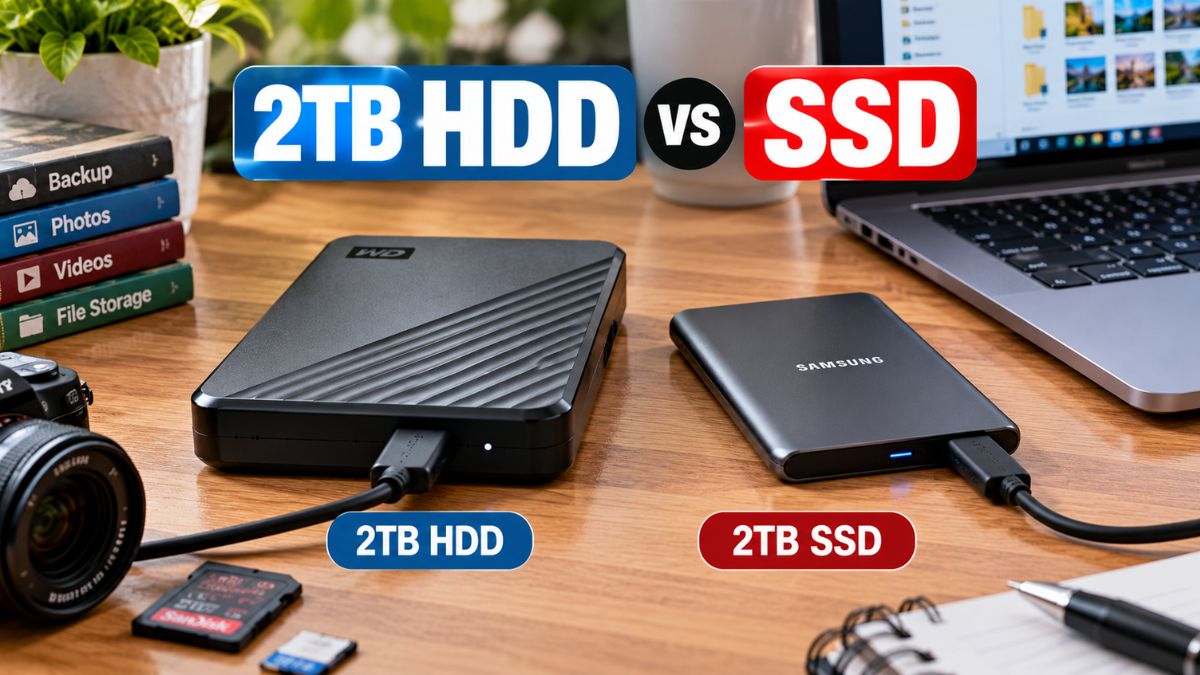
Choose a 2TB portable HDD if you want the most storage for your money and mainly store or back up files. Choose a 2TB portable SSD if you carry the drive often, edit files straight from it, or want faster, quieter transfers. SSDs cost more per terabyte but have no moving parts.
An HDD (hard disk drive) stores data on spinning platters. An SSD (solid-state drive) uses flash memory, as your phone does. That one difference explains almost everything in the table below.
| Feature | 2TB Portable HDD | 2TB Portable SSD |
| Cost per terabyte | Lower | Higher |
| Speed | Slower | Faster |
| Moving parts | Yes. | No |
| Handling bumps | More sensitive while running | Better |
| Noise | Can hum or click softly | Silent |
| Best for | Backups, archives, home use | Travel, editing, daily carry |
What about reliability? The best public data comes from Backblaze, which tracks hard drives in its data centers. Its 2025 Drive Stats report shows a yearly failure rate of 1.36% across more than 344,000 drives.
Please read that number carefully. Those are data center drives, not portable ones that get tossed in bags. It’s not a promise about the drive you buy. The takeaway is simple: every drive can fail someday, so plan for it.
My take: if the drive lives on your desk, an HDD is usually enough. If it travels with you, an SSD is worth the extra cost. [YOUR EXPERIENCE HERE: Which type do you recommend most often, and why?
USB 3.0, USB 3.2, and USB-C: Why Your 2TB External Hard Drive Can Run Slow
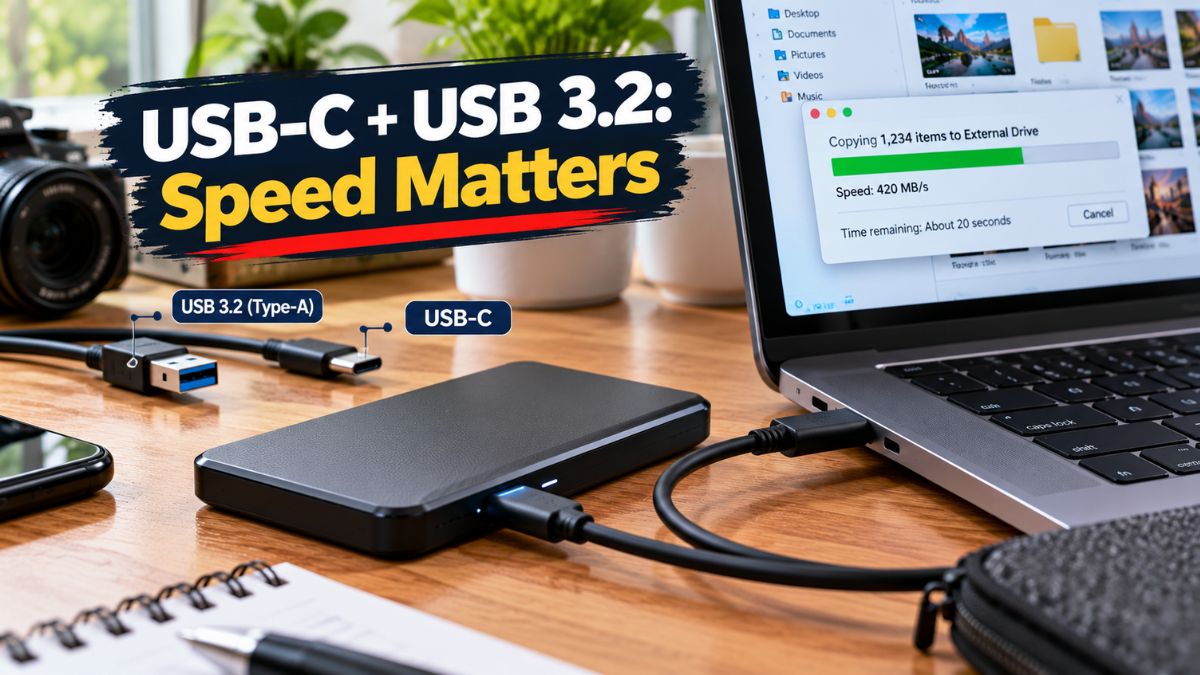
You can buy a fast drive and still get slow transfers. The reason is usually the connection. Speed depends on three parts working together: the drive, the cable, and the port on your computer. The slowest part sets the limit.
The names make this confusing. USB 3.0, USB 3.1 Gen 1, and USB 3.2 Gen 1 all mean the same 5Gbps speed, as Tom’s Hardware explains. USB 3.2 Gen 2 means 10 Gbps. A simpler way to shop is to look for “5Gbps” or “10Gbps” on the box.
Here’s one more thing that trips people up. USB-C is a plug shape, not a speed. Two USB-C cables can look identical and perform very differently. For a faster drive, use the cable that came in the box, or buy a good USB-C to USB-C cable rated for the speed you want.
A portable HDD usually can’t fill even a 5Gbps connection. So a faster port helps portable SSDs the most. Don’t pay extra for 10Gbps if you’re buying an HDD.
What does “bus-powered” mean?
A bus-powered drive gets its power from the USB port, so there’s no wall plug. Most 2TB portable drives work this way. If a drive keeps disconnecting, try a different port on your computer or skip the USB hub. A weak port can’t always feed a spinning HDD.
Which Format Should You Use: exFAT, NTFS, or APFS?
Use exFAT if you switch between Windows and Mac. Use NTFS if the drive stays with Windows PCs. Use APFS if it stays with a modern Mac. Apple says APFS is the default on macOS 10.13 or later, and exFAT is its Windows-compatible option for volumes over 32GB.
You can read Apple’s full list of file system formats in Disk Utility if you want the details. Macs can usually read NTFS drives but can’t write to them without extra software. That’s why exFAT is the safe pick for mixed households.
One warning before you start. Formatting erases everything on the drive. Copy your files somewhere safe first.
Here’s the quick version:
- On a Mac: Open Disk Utility, pick your drive, click Erase, and choose APFS or ExFAT.
- On Windows: Open File Explorer, right-click the drive, choose Format, and pick exFAT or NTFS.
- Name the drive something clear, like “Photos 2TB,” so you can spot it fast.
A 6-Point Checklist for Buying a 2TB External Hard Drive
Ready to shop? Run through these six checks. They take about two minutes and can save you a return.
- Drive type. Pick an HDD for budget storage or an SSD for speed and travel.
- Connection. Check that your laptop has the port the drive needs, and look for “5Gbps” or “10Gbps” on the box.
- Power. Make sure it’s bus-powered if you want a single cable and nothing else.
- Durability. “Shock-resistant” helps, but it doesn’t make a drive drop-proof. A padded pouch is cheap insurance.
- Format. Check which computers it needs to work with, and plan to reformat if needed.
- Warranty and support. Read the maker’s warranty terms on the product page. Don’t assume.
Once your drive arrives, test it in the first week. Copy a large folder, check that the files open, and eject the drive properly each time. If something’s wrong, you’ll want to know while the return window is still open. ✅
Is One 2TB Portable Drive a Real Backup?
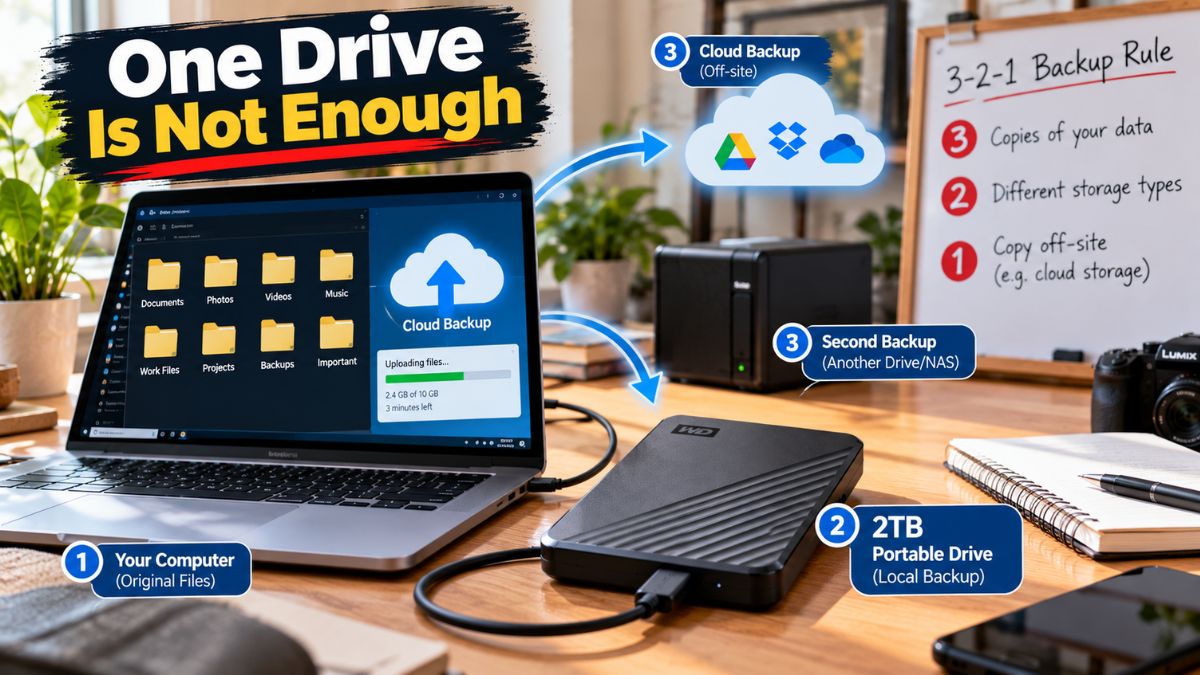
No, not by itself. A single portable drive is one copy, and drives can fail, get lost, or get stolen. A real backup keeps your files in at least two places, ideally with one copy off-site or in the cloud. Use the drive as one layer, not your only safety net.
Think about what happens if your laptop and your drive live in the same bag. One lost bag, and everything is gone. That’s why many IT pros suggest three copies of your data, on two kinds of storage, with one stored somewhere else.
What about the cloud? Cloud storage is great for sharing files and for the off-site copy. A drive is faster for restoring a lot of data and works without internet. The two work best together. Our backup external hard drive guide walks through setting this up on Mac and Windows.
Planning a computer upgrade? Windows 10 support has ended, so many people are moving to a newer system. Copy your files to your drive first, and keep a second copy.
Conclusion
A 2TB portable drive is a great fit for most people, as long as you check the right things first. Here’s what to remember:
- Add up your files and double the number. If it’s under 1.8TB, 2TB works.
- Pick an HDD for desk use and budget storage, or an SSD for travel and speed.
- Match the port, cable, and format to your computer, and keep a second copy of anything important.
Ready to choose? Browse our external hard drive guides and our backup guide to find the right drive for your setup. A little checking now means a lot less stress later. You’ve got this! 🙌
Frequently Asked Questions
Is a 2TB portable hard drive enough for photos and videos?
For most people, yes. It can hold a large photo library and many hours of video. If you shoot long 4K clips often, you may fill it faster, so check your own file sizes and double your estimate.
Why does my 2TB drive show less than 2TB?
Drive makers count 1TB as one trillion bytes, while Windows counts storage differently. So a 2TB drive shows up as roughly 1.8TB. That’s normal and not a defect.
Is a portable SSD worth it over a portable HDD?
It depends on how you use it. An SSD is faster, quieter, and has no moving parts, so it suits travel and editing. An HDD costs less per terabyte and works well for backups and storage at home.
Can one drive work on both Windows and Mac?
Yes. Format it as exFAT, which Apple lists as its Windows-compatible option for volumes over 32GB. Remember that formatting erases the drive, so copy your files off first.
Do I need a powered drive, or is USB power enough?
Most 2TB portable drives are bus-powered, which means USB power is enough. If a drive keeps disconnecting, try another port or skip the USB hub. Some older or weaker ports struggle to power a spinning HDD.