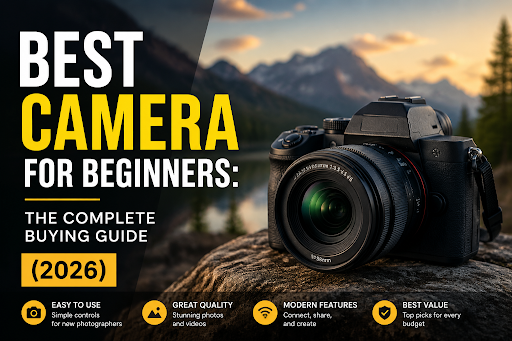
Best Camera for Beginners: The Complete Buying Guide (2026)

Best Camera for Beginners

Quick Answer

The best camera for beginners in 2026 is generally a mirrorless camera with an APS-C sensor, such as the Sony ZV-E10 II or Canon EOS R50β€”both offer excellent image quality, simple controls, and room to grow. Budget-conscious beginners can also start strong with a capable smartphone camera or a compact point-and-shoot. The right choice depends on your budget, shooting goals, and how much you want to learn.

Key Takeaways

  • πŸ“· Mirrorless cameras are the top recommendation for most beginners in 2026β€”lighter than DSLRs, with modern autofocus and good video.
  • πŸ’° Budget range: Entry-level beginner cameras typically cost between $400 and $900 for the body only.
  • 🎯 Sensor size matters: APS-C sensors hit the sweet spot between image quality and affordability for new photographers.
  • πŸ“± Smartphones are a valid starting point β€” especially flagship models β€” before investing in dedicated camera gear.
  • πŸ” Autofocus quality is one of the most important specs for beginners, since it reduces missed shots.
  • πŸŽ₯ Video shooters should prioritize cameras with 4K recording and good in-body or lens stabilization.
  • 🧳 Kit lenses (usually 15–45 mm or 18–55 mm) bundled with beginner cameras are genuinely useful starting points.
  • ❌ Avoid over-buying: A $2,000 professional body won’t make you a better photographer faster than a $500 beginner model.
  • πŸ”‹ Battery life and ergonomics are often overlooked but matter a lot for day-to-day shooting comfort.
  • πŸ“š Learning resources matter as much as gear β€” pick a camera with a strong community and tutorial ecosystem.

What Makes a Camera Truly “Beginner-Friendly”?

A beginner-friendly camera combines ease of use with enough flexibility to grow your skills over time. It should have guided shooting modes, reliable autofocus, and a comfortable gripβ€”without burying you in menus.

Key qualities to look for:

  • Auto and scene modes that produce good results out of the box
  • Clear, logical menu systems (Sony, Canon, and Fujifilm are generally praised here)
  • Touchscreen or tilting screen for easier framing
  • Built-in tutorials or help text on-screen
  • Lightweight body β€” heavy gear gets left at home
  • Wide lens compatibility for future upgrades

“The best camera is the one you’ll actually carry with you”β€”a principle repeated across photography communities for good reason.

Visit Amazon: https://amzn.to/4fpDNZw

What Are the Main Camera Types for Beginners?

best camera for beginners

Beginners have four realistic options: mirrorless, DSLR, compact/point-and-shoot, and smartphone. Each fits a different use case and budget.

Camera Type Best For Typical Price Range Pros Cons
Mirrorless (APS-C) Most beginners $450–$900 Compact, modern AF, good video Shorter battery life
DSLR Budget hunters, optical viewfinder fans $350–$700 Long battery, huge lens ecosystem Bulkier, older tech
Compact / Point-and-Shoot Travel, simplicity $200–$600 Pocketable, easy Limited manual control
Smartphone Total beginners, social media Already owned Always with you, AI-enhanced Small sensors limit low light

Choose a mirrorless camera if you want the best balance of image quality, size, and future-proofing.

Choose a DSLR if you’re on a tight budget and can find a used model or prefer an optical viewfinder.

Choose a compact if you want something pocketable for travel with better quality than a phone.

Choose a smartphone if you’re just starting and want to learn composition before spending money.

Best Camera for Beginners: Top Picks in 2026

These cameras consistently earn strong marks from photography educators and user communities for beginner use.

πŸ₯‡ Sony ZV-E10 II β€” Best Overall Beginner Mirrorless

  • Sensor: 26MP APS-C
  • Video: 4K/60fps
  • Why beginners love it: Simple vlog-friendly design, excellent subject-tracking AF, compact body
  • Price (est.): Around $750 with kit lens
  • Best for: Vloggers, content creators, photography students

πŸ₯ˆ Canon EOS R50 β€” Best for Photo-First Beginners

  • Sensor: 24.2MP APS-C
  • Video: 4K (with crop)
  • Why beginners love it: Canon’s color science, beginner-friendly intuitive menus, and great RF-S lens lineup
  • Price (est.): Around $680 with kit lens
  • Best for: Portrait, family, and travel photography beginners

πŸ₯‰ Fujifilm X-S20 β€” Best for Creative Learners

  • Sensor: 26.1MP APS-C X-Trans
  • Video: 6.2K open-gate, 4K/60fps
  • Why beginners love it: Film simulation modes make learning color grading fun, excellent build quality
  • Price (est.): Around $1,299 body only (slightly above entry-level but worth the stretch)
  • Best for: Beginners who want to grow fast and love a retro shooting experience

Budget Pick: Canon EOS Rebel SL3 (DSLR)

  • Sensor: 24.1MP APS-C
  • Why it works: It’s the Lightest DSLR Canon makes, and the guided mode walks beginners through every setting
  • Price (est.): Around $650 with kit lens (often found used for $350–$450)
  • Best for: Budget-conscious beginners who prefer a traditional camera feel

How Much Should a Beginner Spend on a Camera?

Most beginners get the best value in the $400–$800 range for a camera body plus kit lens. Spending more doesn’t accelerate learning β€” spending on courses and practice does.

A realistic beginner budget breakdown:

  • Camera body + kit lens: $450–$800
  • Extra battery: $25–$50
  • Memory card (UHS-I or UHS-II): $20–$50
  • Camera bag or strap: $30–$80
  • Editing software: Free (Lightroom mobile, Snapseed) to $10/month

Total realistic starter kit: $525–$980

One often-overlooked accessory: a stable tripod. If you plan to shoot landscapes, portraits, or video, a stable and portable tripod makes a meaningful difference even for beginners.

Common mistake: Buying a body-only camera without budgeting for a lens. Always factor in the full kit cost.

Best Camera for Beginners: Mirrorless vs. DSLR β€” Which Wins in 2026?

For most beginners starting in 2026, mirrorless cameras are the better choice. DSLRs are mature technology with shrinking manufacturer support, while mirrorless systems are where all major brands are investing.

Mirrorless advantages for beginners:

  • Faster, more accurate autofocus (especially face and eye tracking)
  • Lighter and more compact bodies
  • Better video capabilities at the same price point
  • The electronic viewfinder shows exposure preview before you shoot

DSLR advantages that still matter:

  • Longer battery life per charge (often 500–900 shots vs. 300–400 for mirrorless)
  • Lower used pricesβ€”a used Canon Rebel T8i or Nikon D3500 can be found for under $400
  • Optical viewfinder preferred by some photographers

Bottom line: If buying new, go mirrorless. If on a tight budget and buying used, a DSLR is still a solid learning tool.

Does Sensor Size Matter for Beginner Photographers?

Yes, but not as much as marketing suggests. For beginners, an APS-C sensor is the practical sweet spot β€” it produces noticeably better low-light photos than a smartphone and is far more affordable than a full-frame sensor.

Sensor size comparison:

  • Full-frame (35mm): Professional quality, expensive ($1,500+), heavier lenses
  • APS-C: Best beginner option β€” great image quality, affordable, wide lens selection
  • Micro Four Thirds (MFT): Compact system with good quality (Olympus/OM System, Panasonic)
  • 1-inch: Found in premium compacts like Sony RX100 seriesβ€”good for travel

Choose APS-C if you want the best balance of image quality, cost, and lens availability as a beginner.

Can a smartphone replace a beginner camera in 2026?

For casual photography and social media content, yes β€” modern flagship smartphones are genuinely capable. For learning photography fundamentals or producing print-quality images, a dedicated camera still has clear advantages.

Smartphones like the Apple iPhone 17 Pro Max and Google Pixel 10 Pro XL produce stunning photos with computational photography. However, they have physical limits:

  • Smaller sensors struggle more in low light without AI processing
  • Limited optical zoom range compared to interchangeable lenses
  • Less manual control for learning aperture, shutter speed, and ISO

Use a smartphone if you’re just discovering photography and not ready to invest in gear yet. Transition to a dedicated camera when you find yourself frustrated by the phone’s limitationsβ€”that’s the signal you’re ready.

For content creators who shoot video on the go, pairing a smartphone with a DJI Osmo Mobile 8 gimbal is a practical alternative to buying a dedicated camera.

What Accessories Does a Beginner Photographer Actually Need?

Keep it simple at first. The gear that genuinely helps beginners:

Essential:

  • Extra battery (one is never enough)
  • Fast memory card (64GB–128GB, UHS-I minimum)
  • Microfiber cleaning cloth
  • Camera strap (the included one is usually fine)

Useful but not urgent:

  • Tripod (critical for video, landscapes, and low-light shots)
  • 50mm prime lens (often called the “nifty fifty” β€” cheap and teaches composition)
  • Camera bag or backpack

Skip for now:

  • External flash (learn natural light first)
  • Filters (useful later, not essential at the start)
  • Multiple lenses (the kit lens covers 90% of beginner needs)

For those who also shoot with a smartphone, explore the full range of camera accessories and gear to find options that complement your setup.

How Do You Learn Photography Faster as a Beginner?

Gear is secondary to practice and deliberate learning. The fastest path to improvement:

  1. Shoot in aperture priority (Av/A) mode firstβ€”learn how aperture affects depth of field before going full manual.
  2. Review your shots critically β€” ask why a photo didn’t work, not just whether you like it.
  3. Limit yourself to one lens for the first 3 months β€” constraints force creativity.
  4. Follow a structured online course β€” YouTube channels like Tony Northrup, Peter McKinnon, and Mango Street are free and excellent.
  5. Join a community β€” Reddit’s r/photography and r/photoclass are active and beginner-friendly.
  6. Edit your photos β€” post-processing is half the craft; start with free tools like Lightroom Mobile.

FAQ: Best Camera for Beginners

Q: What is the single best camera for an absolute beginner in 2026?
The Sony ZV-E10 II is the top pick for most beginners in 2026 β€” it’s compact, shoots excellent 4K video, has reliable autofocus, and is priced around $750 with a kit lens.

Q: Is a mirrorless or DSLR better for beginners?
Mirrorless is better for beginners buying new gear in 2026. DSLRs are still viable if bought used on a budget, but mirrorless cameras offer better autofocus, video, and future lens support.

Q: How much should a beginner spend on their first camera?
A budget of $500–$800 for a camera body plus kit lens is the practical sweet spot. Spending more won’t accelerate skill development.

Q: Can I learn photography with a smartphone first?
Yes. A flagship smartphone is a legitimate learning tool for composition and light. Upgrade to a dedicated camera when you consistently feel limited by the phone’s capabilities.

Q: What is the best beginner camera for video?
The Sony ZV-E10 II leads for video beginners due to its 4K/60fps output, subject-tracking AF, and vlog-friendly design. The Fujifilm X-S20 is the premium alternative.

Q: Do I need a full-frame camera as a beginner?
No. Full-frame cameras are heavier, more expensive, and require pricier lenses. An APS-C mirrorless camera will produce excellent results for years before you outgrow it.

Q: What lens should a beginner use first?
The kit lens (typically 15–45mm or 18–55mm) that comes bundled with the camera is the right starting point. A 50mm f/1.8 prime lens (around $100–$200) is the best first upgrade.

Q: Is the Canon EOS R50 good for beginners?
Yes. The Canon EOS R50 is one of the most beginner-friendly mirrorless cameras available, with intuitive menus, reliable autofocus, and excellent still image quality.

Q: What’s the best budget beginner camera under $500?
A used Canon EOS Rebel SL3 or Nikon D3500 can be found for under $400–$450 and is an excellent learning tool. For new purchases, the Sony ZV-E10 (original) occasionally dips below $500.

Q: Should a beginner buy a camera kit or body only?
Always buy a kit (body + lens) as a beginner. Kit lenses are genuinely useful and cost far less when bundled than when purchased separately.

Q: How important is megapixel count for beginners?
Not very important at the beginner stage. Any camera with 20+ megapixels produces more than enough detail for social media, prints, and learning. Focus on autofocus quality and usability instead.

Q: What camera brand is best for beginners?
Sony, Canon, and Fujifilm all make excellent beginner cameras in 2026. Canon is often recommended for its intuitive menus, Sony for its autofocus technology, and Fujifilm for its creative film simulations and build quality.

Conclusion: Your Next Steps

Finding the best camera for beginners comes down to three honest questions: How much do you want to spend? What will you shoot most (photos, videos, or travel)? And how seriously do you want to pursue photography long-term?

For most people reading this in 2026, the Sony ZV-E10 II or Canon EOS R50 are the clearest starting pointsβ€”both are well-supported, genuinely capable, and won’t feel limiting for at least two to three years of active learning.

Actionable next steps:

  1. Set your budget before browsingβ€”include a lens, a memory card, and a spare battery.
  2. Visit a camera store if possible to hold the body before buyingβ€”ergonomics matter.
  3. Buy the kit lens bundle rather than the body-only for your first camera.
  4. Start shooting the day it arrives β€” don’t wait to “learn more” first.
  5. Pick one free online course and work through it in your first month.
  6. Pair your camera with a stabilizer if video is a priorityβ€”check out the DJI Osmo Mobile 8 as a compact option.

The best camera for beginners is the one that gets you shooting, learning, and improving β€” not the one with the most impressive spec sheet.

References

  • Sony Official Product Page, ZV-E10 II Specificationsβ€”sony.com (2024)
  • Canon Official Product Page, EOS R50 Specificationsβ€”canon.com (2023)
  • Fujifilm Official Product Page, X-S20 Specifications β€” fujifilm.com (2023)
  • DPReview Camera Buying Guide for Beginnersβ€”dpreview.com (2024)
  • Photography Life, “Best Cameras for Beginners” β€” photographylife.com (2024)

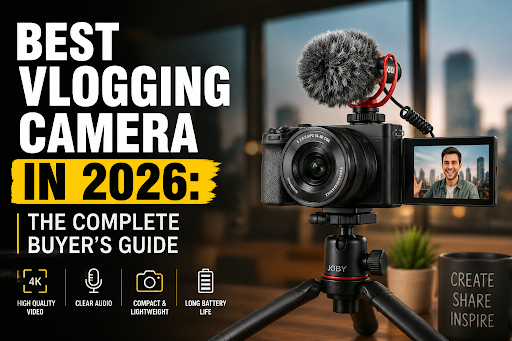
Best Vlogging Camera in 2026: The Complete Buyer’s Guide

best vlogging camera

Key Takeaways

  • πŸ“· Flip screens are non-negotiable for solo vloggers β€” always check for a fully articulating display before buying.
  • πŸŽ™οΈ Audio quality matters as much as video β€” built-in mics are rarely enough; plan for an external mic from day one.
  • πŸ”‹ Battery life and overheating are the two most common complaints in real-world vlogging use β€” check user reviews carefully.
  • πŸ’‘ Sensor size affects low-light performance β€” APS-C sensors offer the best balance of image quality and compact body size for most vloggers.
  • 🎯 4K at 30fps is now the baseline β€” look for 4K/60fps if you plan to slow down footage or future-proof your content.
  • πŸ’° Budget tiers matter β€” under $500, $500–$1,200, and $1,200+ each offer meaningfully different capabilities.
  • 🀳 Smartphone cameras have closed the gap β€” for travel vloggers who prioritize portability, a phone like the Apple iPhone 18 Pro Max is a serious contender.
  • 🎬 Stabilization type matters β€” in-body image stabilization (IBIS) beats electronic stabilization for quality; a gimbal adds another layer.
  • βš–οΈ Weight and form factor affect how often you actually use the camera β€” the best camera is the one you carry.
  • πŸ”Œ USB-C charging is now expected β€” avoid cameras that still rely on proprietary chargers.

What Makes a Camera the Best Vlogging Camera?

Best Vlogging Camera

The best vlogging camera must solve three practical problems at once: capturing clean video in variable lighting, recording usable audio, and staying portable enough to use consistently.

Unlike filmmaking cameras built for controlled sets, a vlogging camera lives in the real world β€” in bags, on selfie sticks, and in front of faces in coffee shops. That context changes everything about what specs actually matter.

Core features every vlogging camera should have:

  • Fully articulating or flip-out touchscreen β€” essential for framing yourself when shooting solo
  • Fast, reliable autofocus β€” face and eye tracking saves footage that would otherwise be blurry and unusable
  • 4K video recording β€” at minimum 4K/30fps; 4K/60fps is better for flexibility in editing
  • Good low-light performance β€” most vlogging happens in imperfect lighting; a larger sensor helps significantly
  • External microphone input β€” a 3.5mm jack or USB-C audio input opens up far better audio options
  • Compact, lightweight body β€” anything over 700g with a lens becomes a burden on long shooting days
  • USB-C charging β€” charge from a power bank while traveling; this is a practical necessity in 2026

Features that sound important but rarely matter for vloggers:

  • RAW photo shooting (most vloggers shoot video only)
  • Weather sealing (useful but rarely decisive)
  • Dual card slots (overkill for solo content creators)

Best Vlogging Camera by Budget: Which Tier Is Right for You?

Choosing the best vlogging camera starts with being honest about budget, because the performance gap between tiers is real but not always worth the price difference for new creators.

Under $500: Best Entry-Level Vlogging Cameras

At this price, the options are compact cameras, older mirrorless bodies, and smartphones. The Sony ZV-1 II (compact, fixed lens) and Canon PowerShot V10 are purpose-built for vlogging at this price point. Both include flip screens, decent autofocus, and built-in ND filters or wind noise reduction.

Choose this tier if: You’re just starting, unsure about long-term commitment, or primarily shooting in good lighting conditions.

Common mistake: Buying a DSLR at this price. Older DSLRs lack flip screens and have poor video autofocus compared to modern mirrorless options.

Visit Amazon: https://amzn.to/4eMk5Hd

$500–$1,200: The Sweet Spot for Most Vloggers

This range includes the Sony ZV-E10 II, Canon EOS R50, and Fujifilm X-S20 β€” all APS-C mirrorless cameras with interchangeable lenses, excellent autofocus, and 4K video. This is where most serious vloggers land, and for good reason. The image quality jump from the sub-$500 tier is significant.

Choose this tier if: You’re committed to creating content regularly and want room to grow your lens collection.

$1,200 and Above: Advanced Vlogging Cameras

The Sony ZV-E1 (full-frame, designed specifically for video creators), Canon EOS R7, and Sony A7C II live here. Full-frame sensors deliver noticeably better low-light footage and a more cinematic look. These cameras also tend to have better heat management for long recording sessions.

Choose this tier if: You’re monetizing content, shooting in challenging environments, or need the absolute best image quality.

Mirrorless vs. Compact vs. Smartphone: Which Type Wins?

For most vloggers in 2026, a mirrorless camera is the best vlogging camera type β€” but that’s not true for everyone.

Camera Type Best For Drawbacks
Mirrorless (APS-C) Most vloggers; best balance of quality and size Requires lens investment; learning curve
Mirrorless (Full-Frame) Professional creators; low-light heavy shooting Expensive, larger, and heavier
Compact/Fixed Lens Travel, simplicity, and budget-conscious creators Limited upgrade path; smaller sensors
Action Camera (GoPro) Adventure, sports, hands-free vlogging Poor audio; limited zoom; small sensor
Smartphone Ultra-portability; casual creators Limited manual control; smaller sensor

The smartphone case: Modern flagships like the Google Pixel 10 Pro XL or Samsung Galaxy S26 Ultra shoot genuinely impressive 4K video with computational stabilization. For travel vloggers who can’t carry extra gear, a flagship phone paired with a wireless microphone and a phone tripod can replace a dedicated camera entirely.

What Autofocus Features Actually Matter for Vlogging?

Autofocus quality is arguably the most important spec for solo vloggers, more than resolution or sensor size.

When shooting alone β€” walking, talking, moving β€” the camera must track your face and eyes without losing focus or hunting. The difference between good and bad autofocus is the difference between usable and unusable footage.

What to look for:

  • Real-time face and eye tracking β€” Sony’s autofocus system (used in the ZV-E10 II and ZV-E1) is widely considered the benchmark; Canon’s Dual Pixel CMOS AF II is a close competitor
  • Subject recognition β€” some cameras now recognize animals, vehicles, and even specific face profiles
  • Tracking speed β€” test how quickly the camera reacquires focus after you step out of frame and return

Edge case: In very low light (below EV 0), even the best autofocus systems struggle. If you shoot in dark environments regularly, manual focus peaking becomes a useful fallback.

How Important Is Audio for a Vlogging Camera?

Audio quality can make or break a vlog more than video quality. Viewers tolerate imperfect visuals far longer than they tolerate bad audio.

Built-in microphones on most cameras β€” even good ones β€” pick up wind noise, camera handling sounds, and room echo. An external microphone is almost always worth the investment.

Audio setup options by budget:

  • Budget: Rode VideoMicro II or DJI Mic Mini (clips directly to camera or clothing; under $80)
  • Mid-range: Rode Wireless GO II (wireless lavalier system; around $300)
  • Pro: Sennheiser MKE 400 (directional shotgun mic; excellent for outdoor use)

What to check on the camera itself:

  • 3.5mm microphone input (standard; most mirrorless cameras have this)
  • Headphone monitoring jack (lets you hear audio while recording β€” underrated feature)
  • Wind noise reduction settings (useful for outdoor shooting)

For wireless microphone options, the Mini Mic Pro Wireless is a compact and affordable solution that works well with most cameras and smartphones.

Stabilization: IBIS, Electronic, or Gimbal?

Shaky footage kills viewer retention. Stabilization is a must-have for any vlogging camera used while walking or moving.

Three stabilization approaches:

  1. In-Body Image Stabilization (IBIS): Physical sensor movement compensates for camera shake. Delivers the best quality with no crop. Found in Sony ZV-E1, Canon EOS R7, Fujifilm X-S20.
  2. Electronic Image Stabilization (EIS): Crops the image and uses software to smooth footage. Works well, but reduces the field of view and can look artificial in fast movement.
  3. Gimbal: A motorized stabilizer that physically keeps the camera level. Adds bulk but delivers cinema-quality smooth footage. The DJI Osmo Mobile 8 is a popular option for smartphone vloggers.

Best approach for most vloggers: IBIS combined with a wide-angle lens. Add a gimbal only if you shoot a lot of walking footage or action sequences.

Top Vlogging Camera Picks for 2026 at a Glance

Camera Sensor 4K Flip Screen IBIS Price Range
Sony ZV-E10 II APS-C 4K/60fps βœ… ❌ ~$750
Canon EOS R50 APS-C 4K/30fps βœ… ❌ ~$680
Fujifilm X-S20 APS-C 4K/60fps βœ… βœ… ~$1,299
Sony ZV-E1 Full-Frame 4K/60fps βœ… βœ… ~$2,200
Canon EOS R7 APS-C 4K/60fps βœ… βœ… ~$1,499
Sony ZV-1 II 1-inch 4K/30fps βœ… βœ… ~$750

Prices are approximate retail estimates as of mid-2026 and may vary by region and retailer.

Common Mistakes When Buying a Vlogging Camera

Even experienced buyers make avoidable errors. Here are the most common ones:

  • Prioritizing megapixels over video specs. Megapixels are a photometric. For video, look at bitrate, color profiles, and rolling shutter performance instead.
  • Ignoring the lens. A $700 camera body with a kit lens will often underperform a $500 body with a quality prime lens. Budget for glass.
  • Forgetting about battery life. Most mirrorless cameras get 200–400 shots per charge. For long shooting days, buy at least two extra batteries and a dual charger.
  • Skipping audio planning. Buying a great camera and using the built-in mic is one of the most common beginner mistakes.
  • Buying too many cameras too soon. A $2,000 camera won’t make content better if the fundamentals β€” lighting, framing, audio β€” aren’t in place first.

For broader camera and tech gear reviews, the TechnoItem camera category covers a wide range of options across budgets.

FAQ: Best Vlogging Camera Questions Answered

Q: What is the best vlogging camera for beginners in 2026?
The Sony ZV-E10 II or Canon EOS R50 are the top beginner picks. Both offer flip screens, reliable face-tracking autofocus, 4K video, and interchangeable lenses at under $800.

Q: Can a smartphone replace a dedicated vlogging camera?
For casual creators and travel vloggers, yes. Flagships like the Apple iPhone 18 Pro Max or Samsung Galaxy S26 Ultra shoot excellent 4K video. A dedicated camera still wins on low-light performance, shallow depth of field, and external audio options.

Q: Do I need a full-frame camera for vlogging?
No. APS-C cameras handle the vast majority of vlogging scenarios well. Full-frame is worth considering only if you shoot heavily in low light or want a more cinematic look and have the budget.

Q: What lens should I use for vlogging?
A wide-angle prime lens (16mm–24mm equivalent) works best for solo vlogging at arm’s length. The Sony 15mm f/1.4 G and Sigma 16mm f/1.4 are popular choices for APS-C cameras.

Q: Is 4K really necessary for vlogging?
In 2026, yes β€” 4K is the standard upload resolution for YouTube and most platforms. It also gives you the flexibility to crop in editing without losing quality.

Q: How much should I spend on my first vlogging camera?
A realistic starting budget is $500–$800 for the body, plus $100–$200 for a lens and $50–$100 for a basic external microphone. Total: around $700–$1,100 for a solid beginner setup.

Q: What’s the best vlogging camera for travel?
The Sony ZV-1 II (compact, fixed lens, built-in ND filter) or a flagship smartphone with a gimbal like the DJI Osmo Mobile 8. Both prioritize portability without sacrificing too much quality.

Q: Does the camera need Wi-Fi or Bluetooth?
It’s a useful feature but not essential. Wi-Fi and Bluetooth allow wireless file transfer to a phone for quick social media uploads. Most modern cameras include this.

Q: What’s the difference between a vlogging camera and a regular camera?
A vlogging camera prioritizes video features β€” flip screen, face-tracking autofocus, clean HDMI output, good audio input, and compact size. A “regular” camera may prioritize still photo specs instead.

Q: How do I stabilize my vlogging footage without IBIS?
Use a gimbal, shoot with a wide-angle lens (wider lenses hide shake better), enable electronic stabilization in-camera, or use stabilization in editing software. Combining two of these methods works well.

Conclusion: Choosing the Best Vlogging Camera for Your Needs

The best vlogging camera isn’t the one with the most specs β€” it’s the one that fits your workflow, budget, and the environments where you actually shoot.

Actionable next steps:

  1. Define your use case first. Are you shooting indoors, outdoors, traveling, or in a studio? This narrows your options faster than any spec sheet.
  2. Set a realistic total budget β€” body, lens, microphone, and extra batteries together.
  3. Prioritize flip screen + autofocus + audio input as your three non-negotiables.
  4. Test before you buy if possible β€” many camera stores allow in-store demos.
  5. Don’t wait for the perfect camera. Start with what you can afford and upgrade once you understand what you actually need.

For creators who want the best balance of quality and value in 2026, the Sony ZV-E10 II and Canon EOS R50 remain the strongest recommendations at the mid-range. If budget allows, the Fujifilm X-S20 adds IBIS and better video specs for a meaningful quality upgrade. And if portability is the priority, pair a flagship phone with a quality wireless mic and a phone tripod β€” that setup will outperform many dedicated cameras in the hands of a skilled creator.

References

  • Sony Corporation. ZV-E10 II Product Specifications. Sony.com. 2024.
  • Canon USA. EOS R50 Product Page. Canon.com. 2023.
  • Fujifilm. X-S20 Specifications. Fujifilm.com. 2023.
  • DPReview Staff. Best Cameras for Video 2024. DPReview.com. 2024.
  • Rode Microphones. VideoMicro II Product Overview. Rode.com. 2023.
  • DJI. Osmo Mobile 8 Product Specifications. DJI.com. 2024.

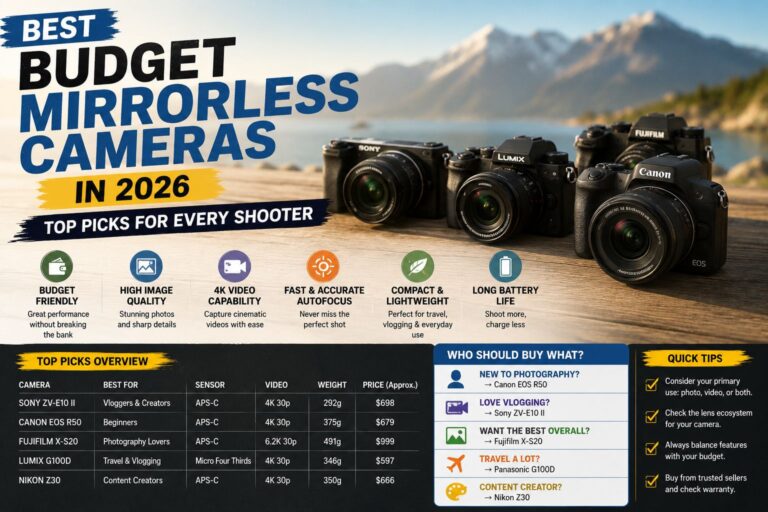
Best Budget Mirrorless Cameras in 2026: Top Picks for Every Shooter

Best Budget Mirrorless Cameras in 2026

Quick Answer

The best budget mirrorless cameras in 2026 fall in the $400–$900 range and include the Sony ZV-E10 II, Fujifilm X-S20, Canon EOS R50, and Nikon Z30. These cameras feature APS-C sensors, 4K video, and interchangeable lenses at a price lower than full-frame bodies. For most beginners and hobbyists, any of these options will outperform a smartphone camera by a wide margin.

Key Takeaways πŸ“·

  • Budget mirrorless cameras typically cost between $400 and $900 for the body only in 2026.
  • APS-C sensors dominate this price range and deliver excellent image quality for stills and video.
  • The Sony ZV-E10 II, Canon EOS R50, Fujifilm X-S20, and Nikon Z30 are the top picks for most buyers.
  • Lens ecosystem matters as much as the camera bodyβ€”factor in future lens costs before buying.
  • 4K video recording is now standard, even at entry-level prices.
  • In-body image stabilization (IBIS) is rare below $700; expect electronic stabilization instead.
  • Beginners benefit most from cameras with guided shooting modes and strong autofocus.
  • Content creators should prioritize flip screens, USB-C charging, and clean HDMI output.
  • Mirrorless cameras are lighter and more compact than DSLRs, making them great for travel.
  • Pairing a camera with a stable phone tripod works well for solo shooting setups.

What Makes a Mirrorless Camera “Budget” in 2026?

A mirrorless camera qualifies as budget-friendly when it costs under $900 body-only and doesn’t require expensive proprietary accessories to function well. In 2026, this price band delivers genuinely capable hardware β€” not stripped-down compromises.

Key characteristics of budget mirrorless cameras:

  • Sensor size: APS-C (most common) or Micro Four Thirds
  • Price range: $400–$900 body-only
  • Video: 4K at 24/30fps, often with a crop
  • Autofocus: Phase-detect or hybrid AF with subject tracking
  • Build: Polycarbonate body (not weather-sealed at most price points)
  • Stabilization: Electronic or lens-based (IBIS rare under $700)

Who this is NOT for: Professional photographers needing weather sealing, full-frame dynamic range, or high-speed burst shooting should budget $1,200 or more.

Visit Amazon: https://amzn.to/3QVInES

Which are the best budget mirrorless cameras right now?

The best budget mirrorless cameras in 2026 are the Sony ZV-E10 II, the Canon EOS R50, the Fujifilm X-S20, and the Nikon Z30. Each targets a slightly different type of shooter, so the “best” one depends on your priorities.

πŸ“Š Top Budget Mirrorless Cameras Compared (2026)

Camera Price (Body) Sensor 4K Video IBIS Best For
Sony ZV-E10 II ~$500 APS-C Yes (4K/30p) No Vloggers, content creators
Canon EOS R50 ~$680 APS-C Yes (4K/30p) No Beginners, photo/video hybrid
Fujifilm X-S20 ~$800 APS-C Yes (6.2K/30p) Yes Enthusiasts, film simulation fans
Nikon Z30 ~$630 APS-C Yes (4K/30p) No Video-first creators
OM System OM-5 ~$900 MFT Yes (4K/30p) Yes Outdoor/travel shooters

Choose the Sony ZV-E10 II if you want the lightest, most vlog-friendly body with a massive lens selection through Sony’s E-mount ecosystem.

Choose the Fujifilm X-S20 if you want in-body stabilization, exceptional film simulations, and the best still-image color science in this price range.

Choose the Canon EOS R50 if you’re new to photography and want Canon’s intuitive menus, strong autofocus, and a large support community.

Choose the Nikon Z30 if you shoot video primarily and want a clean, no-viewfinder design optimized for vlogging and streaming.

What Should You Look for When Buying a Budget Mirrorless Camera?

Best Budget Mirrorless Cameras

The right budget mirrorless camera depends on five core factors: sensor quality, autofocus performance, video specs, lens ecosystem, and ergonomics. Prioritizing all five equally is a mistake β€” rank them by your actual use case first.

The 5 Factors That Matter Most

  1. Sensor size and resolution β€” APS-C sensors (around 24MP) handle low light well and produce files with plenty of detail for printing and cropping.
  2. Autofocus system β€” Look for phase-detect AF with eye/face tracking. This makes a real difference for portraits, run-and-gun video, and action shots.
  3. Video capabilities β€” 4K is the baseline in 2026. Check for overheating limits, rolling shutter performance, and whether the camera supports clean HDMI output for external recording.
  4. Lens ecosystem β€” A cheap body paired with expensive lenses defeats the purpose. Sony E-mount, Canon RF-S, and Nikon Z all have affordable kit lens options, but long-term costs vary.
  5. Ergonomics and interface β€” A camera you enjoy using gets used more. Flip screens, physical dials, and intuitive menus matter more than spec sheets suggest.

Common mistake: Buying a camera body without researching the cost of a second lens. The kit lens is fine to start, but a fast 35mm or 50mm prime can cost $150–$400, depending on the system.

Are Budget Mirrorless Cameras Good Enough for Video?

 Budget Mirrorless Cameras
Budget Mirrorless Cameras

Yesβ€”the best budget mirrorless cameras in 2026 are more than capable for YouTube, social media, and even short film production. 4K video is standard across all major budget models, and most support USB-C charging, which simplifies on-location power management.

What you get at this price:

  • 4K/30p video (some models offer 4K/60p with a crop)
  • Continuous autofocus with subject tracking
  • Microphone input (3.5mm jack on most models)
  • Flat/log picture profiles for colour grading (varies by model)

What you may miss:

  • 10-bit colour depth (usually reserved for $1,000+ cameras)
  • Unlimited recording time (some budget cameras have 30-minute limits)
  • Full-size HDMI port (micro-HDMI is common at this price)

For creators who also want to capture high-quality wireless audio, pairing a budget mirrorless camera with a wireless microphone like the Mini Mic Pro significantly improves production value without a large investment.

How Do Budget Mirrorless Cameras Compare to Budget Smartphones?

Budget mirrorless cameras outperform smartphones in optical zoom, low-light performance, and creative control, but smartphones win on convenience, connectivity, and computational photography. For most casual users, a smartphone is sufficient β€” but for anyone serious about photography or video quality, a mirrorless camera is worth the upgrade.

Feature Budget Mirrorless Budget Smartphone
Low-light performance Much better Decent with AI processing
Optical zoom Yes (with the right lens) Limited or simulated
Sensor size APS-C (much larger) 1/2″ or smaller
Creative control Full manual control Limited
Portability Moderate Excellent
Connectivity SD card + USB Instant cloud sharing

For reference, even a capable budget phone like the Motorola Moto G 2026 or the Google Pixel 7 5G produces impressive photosβ€”but neither matches a mirrorless camera with a good prime lens in challenging light.

What Lenses Should You Buy With a Budget Mirrorless Camera?

Start with the kit lens (usually an 18-45mm or 16-50mm zoom), then add a fast prime lens as your second purchase. A 35mm f/1.8 or 50mm f/1.8 in your camera’s native mount typically costs $150–$300 and dramatically improves low-light and portrait performance.

Recommended Starter Lens Kits by System

Sony E-mount:

  • Kit: Sony 16-50mm f/3.5-5.6 (included with ZV-E10 II kit)
  • Second lens: Sony 35mm f/1.8 OSS (~$250)

Canon RF-S:

  • Kit: Canon RF-S 18-45mm f/4.5-6.3 (included with R50 kit)
  • Second lens: Canon RF 50mm f/1.8 STM (~$200)

Fujifilm X-mount:

  • Kit: Fujinon XC 15-45mm f/3.5-5.6 OIS
  • Second lens: Fujinon XF 35mm f/2 R WR (~$300)

Nikon Z:

  • Kit: Nikkor Z DX 16-50mm f/3.5-6.3 VR
  • Second lens: Nikkor Z 40mm f/2 (~$280)

Edge case: If you’re switching from a DSLR, check whether your existing lenses are compatible with an adapter before committing to a new system. Canon EF lenses adapt well to the RF mount; Nikon F lenses adapt to the Z mount with full AF support.

What Are the Most Common Mistakes When Buying a Budget Mirrorless Camera?

The biggest mistakes are buying based solely on megapixel count, ignoring the lens ecosystem, and underestimating the importance of ergonomics. A 24MP camera with a sharp, fast lens will always outperform a 32MP camera with a slow kit lens.

Mistakes to Avoid

  • Chasing specs over usability: A camera with complex menus you never learn to use is a wasted investment.
  • Ignoring battery life: Budget mirrorless cameras typically get 300–400 shots per charge. Buy a spare battery from day one.
  • Skipping a memory card budget: Fast UHS-I or UHS-II SD cards are essential for 4K video. Slow cards cause dropped frames.
  • Buying the wrong mount: Switching systems later means replacing all your lenses. Research the ecosystem before committing.
  • Overlooking used/refurbished options: Certified refurbished cameras from Sony, Canon, and Nikon often cost 20–30% less with a full warranty.

Best Budget Mirrorless Cameras for Specific Use Cases

Not every shooter has the same needs. Here’s a quick decision guide based on how you plan to use your camera most.

For travel photography: Fujifilm X-S20 (IBIS, compact body, and excellent JPEGs straight from the camera) or OM System OM-5 (weather-sealed, very compact). A sturdy tripod is a useful companion for landscape and long-exposure shots.

For YouTube and vlogging: Sony ZV-E10 II or Nikon Z30 (both optimized for front-facing content, with flip screens and strong continuous AF).

For portrait photography: the Canon EOS R50 (excellent skin tones and reliable eye-tracking AF) or the Fujifilm X-S20 (film simulations produce beautiful, natural portraits).

For wildlife and sports: Any of the above with a telephoto lens, though note that budget bodies have slower burst speeds (typically 11–15 fps) compared to mid-range options.

For beginners, the Canon EOS R50 has the most beginner-friendly interface, guided modes, and an extensive online learning community.

For more tech buying decisions across categories, the TechnoItem camera category offers a wide range of reviews of photography and videography gear.

Conclusion: Which Budget Mirrorless Camera Should You Buy?

The best budget mirrorless cameras in 2026 make serious photography accessible without a serious price tag. The right choice comes down to your primary use case:

  • Vloggers and content creators β†’ Sony ZV-E10 II
  • Beginners and photo/video hybrid shooters β†’ Canon EOS R50
  • Enthusiasts who want the best image quality β†’ Fujifilm X-S20
  • Video-first creators β†’ Nikon Z30
  • Outdoor and travel shooters β†’ OM System OM-5

Actionable next steps:

  1. Decide whether stills or video is your primary useβ€”this immediately narrows your choice.
  2. Set a total budget that includes a body, a kit lens, one prime lens, a spare battery, and a fast SD card.
  3. Visit a camera store (if possible) to handle the body before buying β€” ergonomics matter.
  4. Buy from a retailer that offers a return window so you can test the camera in real conditions.
  5. Start shooting on auto, then gradually move to aperture priority as you build confidence.

The best camera is the one you’ll actually carry and use. At these price points, any of the top picks above will produce images that would have required a professional camera just five years ago.

Frequently Asked Questions

What is the best budget mirrorless camera for beginners in 2026?

The Canon EOS R50 is the top pick for beginners. It has guided shooting modes, reliable eye-tracking autofocus, and one of the most intuitive menu systems in this price range.

Can a budget mirrorless camera shoot professional-quality photos?

Yes, for most professional applications, including portraits, events, and product photography. The limiting factor is usually the lens, not the camera body.

Is a mirrorless camera better than a DSLR for beginners?

Generally yes. Mirrorless cameras are lighter, offer real-time exposure preview through the electronic viewfinder, and have better video autofocus. DSLRs still have longer battery life and a wider used-lens market.

What sensor size do budget mirrorless cameras use?

Most budget mirrorless cameras use APS-C sensors. A few use Micro Four Thirds (MFT). Full-frame sensors are rarely available for under $1,200.

Do budget mirrorless cameras overheat during video recording?

Some do, especially during extended 4K recording in warm environments. The Sony ZV-E10 II and Nikon Z30 have better-than-average heat management for this price range. Always check real-world recording limits before buying.

Is 4K video available on budget mirrorless cameras?

Yesβ€”4K video is standard on all major budget mirrorless models in 2026, though some models apply a crop factor at 4K.

What accessories do I need with a budget mirrorless camera?

At minimum: a spare battery, a fast SD card (UHS-I V30 or better), a UV filter to protect the lens, and a camera bag. A tripod is useful for video and long-exposure work.

How long do budget mirrorless cameras last?

Most are rated for 100,000–200,000 shutter actuations. For casual shooters taking a few hundred photos per week, a well-maintained budget mirrorless camera can last 5–10 years.

Should I buy a kit lens or a body-only lens?

Buy the kit. Kit lenses have improved significantly, offering a versatile starting point. Buying a body only makes sense if you already own compatible lenses.

Are budget mirrorless cameras weather-sealed?

Rarely below $800. The OM System OM-5 is a notable exception at around $900. Most APS-C budget bodies are polycarbonate with no weather sealing.

Sources