Quick Answer
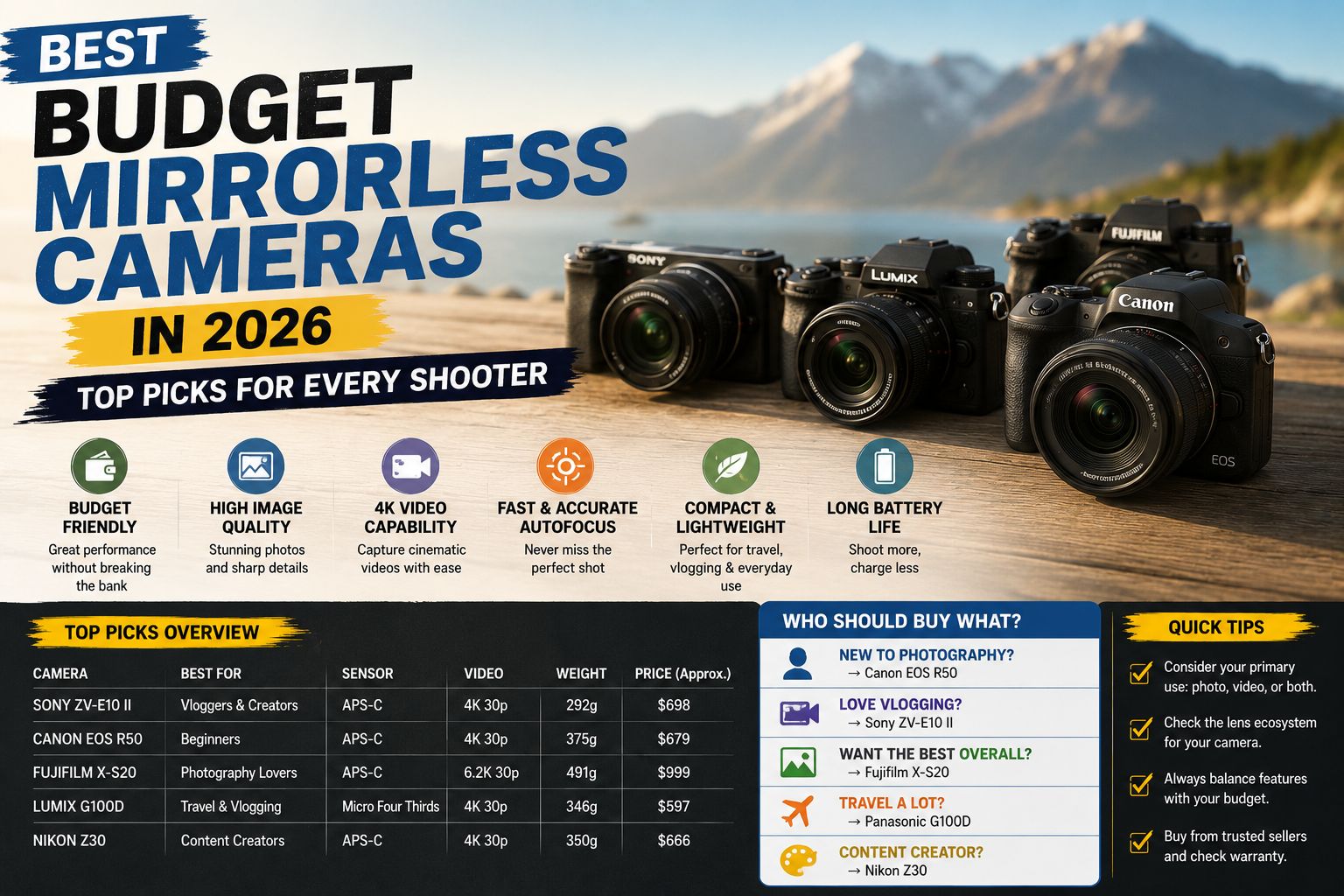
The best budget mirrorless cameras in 2026 fall in the $400–$900 range and include the Sony ZV-E10 II, Fujifilm X-S20, Canon EOS R50, and Nikon Z30. These cameras feature APS-C sensors, 4K video, and interchangeable lenses at a price lower than full-frame bodies. For most beginners and hobbyists, any of these options will outperform a smartphone camera by a wide margin.
Key Takeaways 📷
- Budget mirrorless cameras typically cost between $400 and $900 for the body only in 2026.
- APS-C sensors dominate this price range and deliver excellent image quality for stills and video.
- The Sony ZV-E10 II, Canon EOS R50, Fujifilm X-S20, and Nikon Z30 are the top picks for most buyers.
- Lens ecosystem matters as much as the camera body—factor in future lens costs before buying.
- 4K video recording is now standard, even at entry-level prices.
- In-body image stabilization (IBIS) is rare below $700; expect electronic stabilization instead.
- Beginners benefit most from cameras with guided shooting modes and strong autofocus.
- Content creators should prioritize flip screens, USB-C charging, and clean HDMI output.
- Mirrorless cameras are lighter and more compact than DSLRs, making them great for travel.
- Pairing a camera with a stable phone tripod works well for solo shooting setups.
What Makes a Mirrorless Camera “Budget” in 2026?
A mirrorless camera qualifies as budget-friendly when it costs under $900 body-only and doesn’t require expensive proprietary accessories to function well. In 2026, this price band delivers genuinely capable hardware — not stripped-down compromises.
Key characteristics of budget mirrorless cameras:
- Sensor size: APS-C (most common) or Micro Four Thirds
- Price range: $400–$900 body-only
- Video: 4K at 24/30fps, often with a crop
- Autofocus: Phase-detect or hybrid AF with subject tracking
- Build: Polycarbonate body (not weather-sealed at most price points)
- Stabilization: Electronic or lens-based (IBIS rare under $700)
Who this is NOT for: Professional photographers needing weather sealing, full-frame dynamic range, or high-speed burst shooting should budget $1,200 or more.
Visit Amazon: https://amzn.to/3QVInES
Which are the best budget mirrorless cameras right now?
The best budget mirrorless cameras in 2026 are the Sony ZV-E10 II, the Canon EOS R50, the Fujifilm X-S20, and the Nikon Z30. Each targets a slightly different type of shooter, so the “best” one depends on your priorities.
📊 Top Budget Mirrorless Cameras Compared (2026)
| Camera | Price (Body) | Sensor | 4K Video | IBIS | Best For |
| Sony ZV-E10 II | ~$500 | APS-C | Yes (4K/30p) | No | Vloggers, content creators |
| Canon EOS R50 | ~$680 | APS-C | Yes (4K/30p) | No | Beginners, photo/video hybrid |
| Fujifilm X-S20 | ~$800 | APS-C | Yes (6.2K/30p) | Yes | Enthusiasts, film simulation fans |
| Nikon Z30 | ~$630 | APS-C | Yes (4K/30p) | No | Video-first creators |
| OM System OM-5 | ~$900 | MFT | Yes (4K/30p) | Yes | Outdoor/travel shooters |
Choose the Sony ZV-E10 II if you want the lightest, most vlog-friendly body with a massive lens selection through Sony’s E-mount ecosystem.
Choose the Fujifilm X-S20 if you want in-body stabilization, exceptional film simulations, and the best still-image color science in this price range.
Choose the Canon EOS R50 if you’re new to photography and want Canon’s intuitive menus, strong autofocus, and a large support community.
Choose the Nikon Z30 if you shoot video primarily and want a clean, no-viewfinder design optimized for vlogging and streaming.
What Should You Look for When Buying a Budget Mirrorless Camera?
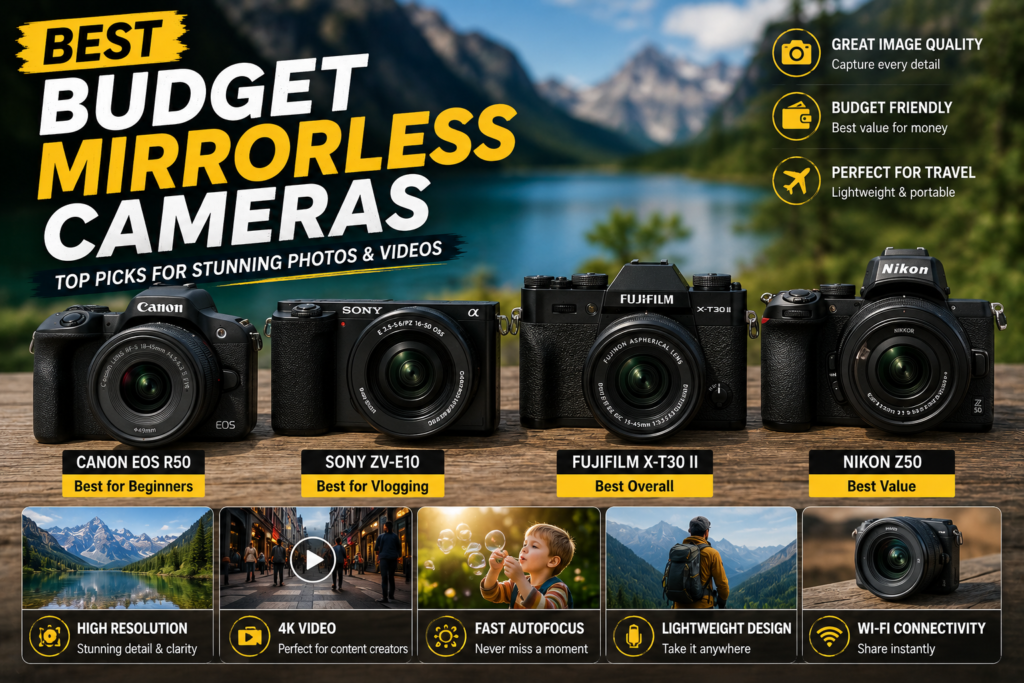
The right budget mirrorless camera depends on five core factors: sensor quality, autofocus performance, video specs, lens ecosystem, and ergonomics. Prioritizing all five equally is a mistake — rank them by your actual use case first.
The 5 Factors That Matter Most
- Sensor size and resolution — APS-C sensors (around 24MP) handle low light well and produce files with plenty of detail for printing and cropping.
- Autofocus system — Look for phase-detect AF with eye/face tracking. This makes a real difference for portraits, run-and-gun video, and action shots.
- Video capabilities — 4K is the baseline in 2026. Check for overheating limits, rolling shutter performance, and whether the camera supports clean HDMI output for external recording.
- Lens ecosystem — A cheap body paired with expensive lenses defeats the purpose. Sony E-mount, Canon RF-S, and Nikon Z all have affordable kit lens options, but long-term costs vary.
- Ergonomics and interface — A camera you enjoy using gets used more. Flip screens, physical dials, and intuitive menus matter more than spec sheets suggest.
Common mistake: Buying a camera body without researching the cost of a second lens. The kit lens is fine to start, but a fast 35mm or 50mm prime can cost $150–$400, depending on the system.
Are Budget Mirrorless Cameras Good Enough for Video?
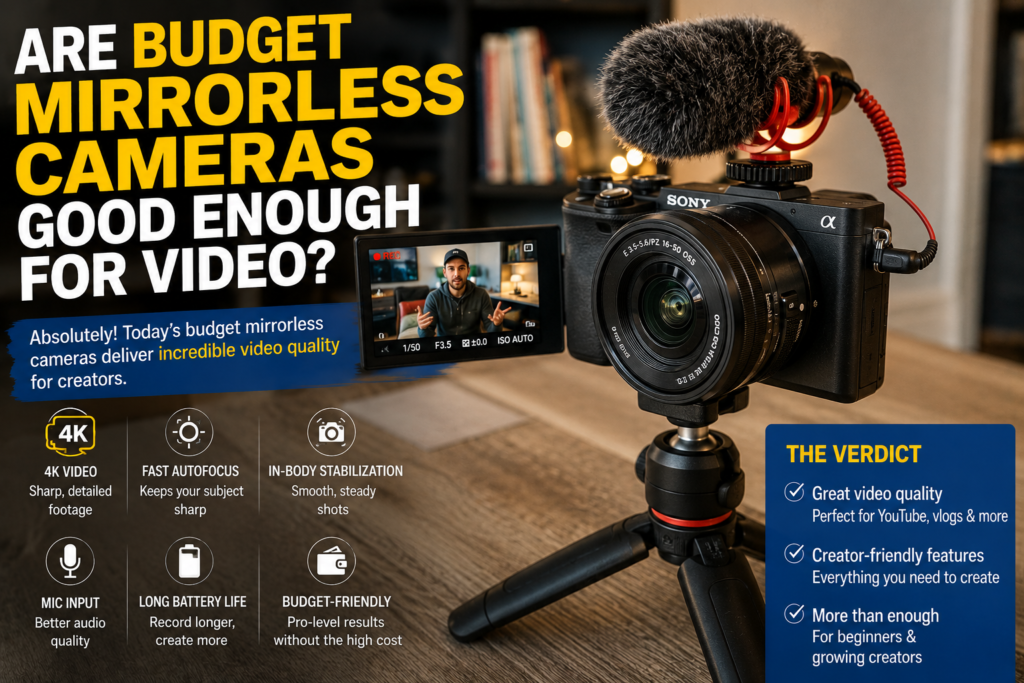
Yes—the best budget mirrorless cameras in 2026 are more than capable for YouTube, social media, and even short film production. 4K video is standard across all major budget models, and most support USB-C charging, which simplifies on-location power management.
What you get at this price:
- 4K/30p video (some models offer 4K/60p with a crop)
- Continuous autofocus with subject tracking
- Microphone input (3.5mm jack on most models)
- Flat/log picture profiles for colour grading (varies by model)
What you may miss:
- 10-bit colour depth (usually reserved for $1,000+ cameras)
- Unlimited recording time (some budget cameras have 30-minute limits)
- Full-size HDMI port (micro-HDMI is common at this price)
For creators who also want to capture high-quality wireless audio, pairing a budget mirrorless camera with a wireless microphone like the Mini Mic Pro significantly improves production value without a large investment.
How Do Budget Mirrorless Cameras Compare to Budget Smartphones?
Budget mirrorless cameras outperform smartphones in optical zoom, low-light performance, and creative control, but smartphones win on convenience, connectivity, and computational photography. For most casual users, a smartphone is sufficient — but for anyone serious about photography or video quality, a mirrorless camera is worth the upgrade.
| Feature | Budget Mirrorless | Budget Smartphone |
| Low-light performance | Much better | Decent with AI processing |
| Optical zoom | Yes (with the right lens) | Limited or simulated |
| Sensor size | APS-C (much larger) | 1/2″ or smaller |
| Creative control | Full manual control | Limited |
| Portability | Moderate | Excellent |
| Connectivity | SD card + USB | Instant cloud sharing |
For reference, even a capable budget phone like the Motorola Moto G 2026 or the Google Pixel 7 5G produces impressive photos—but neither matches a mirrorless camera with a good prime lens in challenging light.
What Lenses Should You Buy With a Budget Mirrorless Camera?
Start with the kit lens (usually an 18-45mm or 16-50mm zoom), then add a fast prime lens as your second purchase. A 35mm f/1.8 or 50mm f/1.8 in your camera’s native mount typically costs $150–$300 and dramatically improves low-light and portrait performance.
Recommended Starter Lens Kits by System
Sony E-mount:
- Kit: Sony 16-50mm f/3.5-5.6 (included with ZV-E10 II kit)
- Second lens: Sony 35mm f/1.8 OSS (~$250)
Canon RF-S:
- Kit: Canon RF-S 18-45mm f/4.5-6.3 (included with R50 kit)
- Second lens: Canon RF 50mm f/1.8 STM (~$200)
Fujifilm X-mount:
- Kit: Fujinon XC 15-45mm f/3.5-5.6 OIS
- Second lens: Fujinon XF 35mm f/2 R WR (~$300)
Nikon Z:
- Kit: Nikkor Z DX 16-50mm f/3.5-6.3 VR
- Second lens: Nikkor Z 40mm f/2 (~$280)
Edge case: If you’re switching from a DSLR, check whether your existing lenses are compatible with an adapter before committing to a new system. Canon EF lenses adapt well to the RF mount; Nikon F lenses adapt to the Z mount with full AF support.
What Are the Most Common Mistakes When Buying a Budget Mirrorless Camera?
The biggest mistakes are buying based solely on megapixel count, ignoring the lens ecosystem, and underestimating the importance of ergonomics. A 24MP camera with a sharp, fast lens will always outperform a 32MP camera with a slow kit lens.
Mistakes to Avoid
- Chasing specs over usability: A camera with complex menus you never learn to use is a wasted investment.
- Ignoring battery life: Budget mirrorless cameras typically get 300–400 shots per charge. Buy a spare battery from day one.
- Skipping a memory card budget: Fast UHS-I or UHS-II SD cards are essential for 4K video. Slow cards cause dropped frames.
- Buying the wrong mount: Switching systems later means replacing all your lenses. Research the ecosystem before committing.
- Overlooking used/refurbished options: Certified refurbished cameras from Sony, Canon, and Nikon often cost 20–30% less with a full warranty.
Best Budget Mirrorless Cameras for Specific Use Cases
Not every shooter has the same needs. Here’s a quick decision guide based on how you plan to use your camera most.
For travel photography: Fujifilm X-S20 (IBIS, compact body, and excellent JPEGs straight from the camera) or OM System OM-5 (weather-sealed, very compact). A sturdy tripod is a useful companion for landscape and long-exposure shots.
For YouTube and vlogging: Sony ZV-E10 II or Nikon Z30 (both optimized for front-facing content, with flip screens and strong continuous AF).
For portrait photography: the Canon EOS R50 (excellent skin tones and reliable eye-tracking AF) or the Fujifilm X-S20 (film simulations produce beautiful, natural portraits).
For wildlife and sports: Any of the above with a telephoto lens, though note that budget bodies have slower burst speeds (typically 11–15 fps) compared to mid-range options.
For beginners, the Canon EOS R50 has the most beginner-friendly interface, guided modes, and an extensive online learning community.
For more tech buying decisions across categories, the TechnoItem camera category offers a wide range of reviews of photography and videography gear.
Conclusion: Which Budget Mirrorless Camera Should You Buy?
The best budget mirrorless cameras in 2026 make serious photography accessible without a serious price tag. The right choice comes down to your primary use case:
- Vloggers and content creators → Sony ZV-E10 II
- Beginners and photo/video hybrid shooters → Canon EOS R50
- Enthusiasts who want the best image quality → Fujifilm X-S20
- Video-first creators → Nikon Z30
- Outdoor and travel shooters → OM System OM-5
Actionable next steps:
- Decide whether stills or video is your primary use—this immediately narrows your choice.
- Set a total budget that includes a body, a kit lens, one prime lens, a spare battery, and a fast SD card.
- Visit a camera store (if possible) to handle the body before buying — ergonomics matter.
- Buy from a retailer that offers a return window so you can test the camera in real conditions.
- Start shooting on auto, then gradually move to aperture priority as you build confidence.
The best camera is the one you’ll actually carry and use. At these price points, any of the top picks above will produce images that would have required a professional camera just five years ago.
Frequently Asked Questions
What is the best budget mirrorless camera for beginners in 2026?
The Canon EOS R50 is the top pick for beginners. It has guided shooting modes, reliable eye-tracking autofocus, and one of the most intuitive menu systems in this price range.
Can a budget mirrorless camera shoot professional-quality photos?
Yes, for most professional applications, including portraits, events, and product photography. The limiting factor is usually the lens, not the camera body.
Is a mirrorless camera better than a DSLR for beginners?
Generally yes. Mirrorless cameras are lighter, offer real-time exposure preview through the electronic viewfinder, and have better video autofocus. DSLRs still have longer battery life and a wider used-lens market.
What sensor size do budget mirrorless cameras use?
Most budget mirrorless cameras use APS-C sensors. A few use Micro Four Thirds (MFT). Full-frame sensors are rarely available for under $1,200.
Do budget mirrorless cameras overheat during video recording?
Some do, especially during extended 4K recording in warm environments. The Sony ZV-E10 II and Nikon Z30 have better-than-average heat management for this price range. Always check real-world recording limits before buying.
Is 4K video available on budget mirrorless cameras?
Yes—4K video is standard on all major budget mirrorless models in 2026, though some models apply a crop factor at 4K.
What accessories do I need with a budget mirrorless camera?
At minimum: a spare battery, a fast SD card (UHS-I V30 or better), a UV filter to protect the lens, and a camera bag. A tripod is useful for video and long-exposure work.
How long do budget mirrorless cameras last?
Most are rated for 100,000–200,000 shutter actuations. For casual shooters taking a few hundred photos per week, a well-maintained budget mirrorless camera can last 5–10 years.
Should I buy a kit lens or a body-only lens?
Buy the kit. Kit lenses have improved significantly, offering a versatile starting point. Buying a body only makes sense if you already own compatible lenses.
Are budget mirrorless cameras weather-sealed?
Rarely below $800. The OM System OM-5 is a notable exception at around $900. Most APS-C budget bodies are polycarbonate with no weather sealing.
Sources
- Sony Electronics product specifications, 2024–2025. sony.com
- Canon USA product page, EOS R50, 2023. usa.canon.com
- Fujifilm X-S20 official specifications, 2023. fujifilm.com
- Nikon Z30 product overview, 2022. nikon.com
- OM System OM-5 specifications, 2022. om-digitalsolutions.com