Best Digital Budget Camera: Top Picks & Buying Guide for 2026

best digital budget camera

(By TechnoItem Expert Team | Last Updated: July 2026)

Quick Answer: The best digital budget camera in 2026 delivers sharp image quality, reliable autofocus, and practical features for under $300. Top contenders include the Canon PowerShot ELPH 360 HS, Sony Cyber-shot DSC-W800, and Kodak PIXPRO FZ55—each offering strong value for beginners, travelers, and casual photographers who want better results than a smartphone without a steep price tag.

🔑 Key Takeaways

  • Budget digital cameras typically range from $50 to $300, with the sweet spot for quality landing between $100 and $200.
  • Sensor size matters more than megapixel count — a larger sensor captures more light and produces cleaner images.
  • Optical zoom beats digital zoom every time; look for at least 5x optical zoom for versatile shooting.
  • Image stabilization (OIS) is critical for handheld shots, especially in low light or at long zoom ranges.
  • For video, aim for at least 1080p/30fps recording capability; some budget models now offer 4K.
  • Battery life varies widely—check shots-per-charge ratings before buying, especially for travel use.
  • A budget camera still outperforms most mid-range smartphones in optical zoom, dedicated controls, and battery life.
  • Always factor in the cost of a memory card and carrying case — these are rarely included.

What Makes a Camera the Best Digital Budget Camera?

The best digital budget camera balances image quality, ease of use, and durability at a price that doesn’t require a serious financial commitment. It’s not about finding the cheapest option—it’s about finding the most capable camera for the money.

Key criteria to evaluate:

  • Sensor size: 1/2.3-inch sensors are standard at this price range; larger sensors (1/1.7-inch or bigger) appear in higher-end budget models and produce noticeably better low-light shots.
  • Megapixels: 16–20MP is plenty for prints up to 16×20 inches and social media sharing. Don’t chase higher numbers at the expense of other features.
  • Optical zoom range: A 5x–10x optical zoom covers most everyday needs. Superzoom budget cameras (30x+) exist but often sacrifice image quality.
  • Autofocus speed: Faster AF means fewer missed moments, especially with kids or pets.
  • Build quality: Plastic bodies are expected at this price, but look for solid construction and a comfortable grip.
  • Connectivity: Wi-Fi and Bluetooth for wireless photo transfer are increasingly common even in budget models.

Choose a budget camera over a smartphone if you need optical zoom beyond 3x, want a dedicated device with longer battery life, or prefer physical controls for manual adjustments.

Visit Amazon: https://amzn.to/4uQdIYs

Who Should Buy a Budget Digital Camera in 2026?

Budget digital cameras are ideal for specific types of users, not everyone. They’re a strong fit for:

  • Beginners and kids learning photography basics without risking an expensive device
  • Casual travelers who want better zoom and battery life than a phone provides
  • Parents capturing school events, sports days, and family gatherings
  • Vloggers and content creators on a tight budget who need a dedicated camera
  • Backup camera users who want a second device for outdoor activities

Who should skip a budget camera: Professional photographers, serious hobbyists wanting interchangeable lenses, or anyone who needs 4K video as a primary feature. In those cases, a mirrorless entry-level camera (starting around $400–$500) or a capable smartphone like the Google Pixel 9a with Gemini may serve better.

Top Picks: Best Digital Budget Camera Options in 2026

These cameras represent the strongest value across different use cases. Prices are approximate retail estimates as of mid-2026.

Camera Price Range Zoom Video Best For
Canon PowerShot ELPH 360 HS ~$150 12x optical 1080p All-around beginner
Sony Cyber-shot DSC-W800 ~$70 5x optical 720p Ultra-budget, simple use
Kodak PIXPRO FZ55 ~$80 5x optical 1080p Value + 1080p video
Nikon COOLPIX B500 ~$200 40x optical 1080p Superzoom on a budget
Canon PowerShot SX530 HS ~$250 50x optical 1080p Travel + wildlife
Fujifilm FinePix XP140 ~$170 5x optical 4K Waterproof + 4K video

Quick decision rules:

  • Choose the Sony DSC-W800 if the budget is under $80 and simplicity is the priority.
  • Choose the Kodak PIXPRO FZ55 if 1080p video at the lowest possible price is the goal.
  • Choose the Canon ELPH 360 HS for the best all-around balance of features and image quality under $200.
  • Choose the Nikon COOLPIX B500 if the zoom range is the top priority for sports or wildlife.
  • Choose the Fujifilm XP140 for outdoor adventures where water, dust, or drops are a real risk.

How Does a Budget Digital Camera Compare to a Smartphone Camera?
best digital budget camera

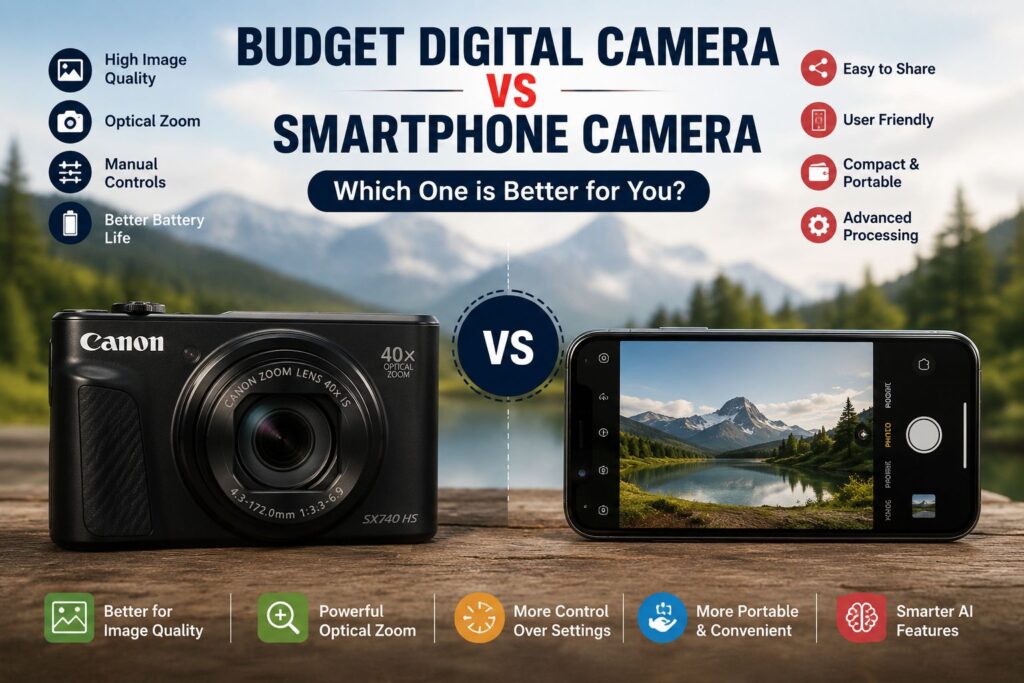
Budget cameras and modern smartphones each have genuine strengths. Neither is universally better.

Where budget cameras win:

  • Optical zoom (smartphones cap out at 3x–5x optical; budget cameras offer 5x–50x)
  • Dedicated battery life (200–300 shots per charge vs. draining a phone battery)
  • Physical shutter button and zoom controls for easier one-handed shooting
  • Longer reach for wildlife, sports, and events

Where smartphones win:

  • Computational photography (AI scene detection, portrait mode, night mode)
  • Convenience — always in your pocket
  • Instant sharing via apps
  • Video stabilization is often superior on flagship phones

For example, the Samsung Galaxy A16 4G LTE with its 50MP camera produces excellent results for everyday shots and social media. But it can’t match a 40x optical zoom camera for distance shooting.

Common mistake: Assuming more megapixels on a budget camera means better photos than a smartphone. A 48MP sensor on a phone with advanced processing often beats a 20MP budget camera sensor in low light.

What Features to Prioritize When Buying the Best Digital Budget Camera

Not all specs matter equally. Here’s a practical priority order for budget camera shoppers:

  1. Optical zoom range — Decide how much reach you need before anything else.
  2. Image stabilization — Optical IS (OIS) is far better than digital IS; check the spec sheet carefully.
  3. Low-light performance — Look for cameras with wider apertures (f/2.8 or lower) or larger sensors.
  4. Battery life — Aim for at least 200 shots per charge; carry a spare battery for travel.
  5. Video resolution — 1080p/30fps is the minimum acceptable standard in 2026; 4K is a bonus.
  6. Wi-Fi/Bluetooth — Wireless transfer saves time and makes sharing photos far easier.
  7. Size and weight — Compact point-and-shoot cameras are more likely to be carried regularly.

Edge case: If shooting in extreme conditions (beach, rain, snow), waterproofing becomes the top priority, even above zoom range. The Fujifilm XP140 is waterproof to 65 feet and shockproof to 5.8 feet — rare at this price point.

For photographers who want to stabilize their shots further, pairing a budget camera with a stable and portable tripod (many work with compact cameras via a standard ¼-inch thread) makes a real difference for landscapes and long exposures.

How Much Should You Spend on a Budget Digital Camera?

The right budget depends on what the camera needs to do.

  • Under $80: Basic point-and-shoot with 5x zoom and 720p–1080p video. Acceptable for casual family photos and simple travel shots. Limited low-light performance.
  • $80–$150: Noticeably better image quality, 10x–12x optical zoom, 1080p video, and often Wi-Fi connectivity. This is the sweet spot for most buyers.
  • $150–$300: Better sensors, faster autofocus, 4K video in some models, and more durable builds. Worth spending if photography is a regular hobby.

Above $300, you’re entering entry-level mirrorless or DSLR territory, which offers interchangeable lenses and significantly better image quality—but also more complexity and cost.

💡 Pro tip: Buying a refurbished or certified renewed camera from a reputable seller can get you a $250 camera for $130–$160. Check manufacturer-certified programs and major retailers for warranty-backed renewed options.

What Are the Most Common Mistakes When Buying a Budget Camera?

Avoiding these mistakes saves money and frustration:

  • Prioritizing megapixels over sensor size. A 20MP 1/2.3-inch sensor will underperform a 12MP 1-inch sensor in almost every real-world situation.
  • Ignoring digital zoom vs. optical zoom. Digital zoom is just cropping — it degrades image quality. Always check the optical zoom spec.
  • Forgetting accessories in the budget. A 32GB or 64GB memory card ($8–$15) and a carrying case ($10–$20) are near-essential add-ons.
  • Skipping battery life research. Some budget cameras only last 150 shots per charge — a serious problem for a full day of travel.
  • Buying based on brand alone. Lesser-known brands like Kodak PIXPRO and Panasonic Lumix offer genuinely competitive specs at budget prices.

Are Budget Cameras Good for video in 2026?

Most budget digital cameras now record 1080p video, and a growing number offer 4K. For casual video—family events, travel vlogs, and short social clips—a budget camera handles the job well.

Limitations to know:

  • Autofocus during video recording is slower and less reliable than on dedicated video cameras or flagship smartphones.
  • Built-in microphones on budget cameras are generally poor; external mic support is rare at this price.
  • Rolling shutter (the “jello effect” when panning quickly) is common on small-sensor budget cameras.

For anyone serious about video content creation, pairing a budget camera with a wireless microphone like the Mini Mic Pro dramatically improves audio quality—the biggest weakness of budget camera video.

Also worth considering: a gimbal stabilizer can compensate for shaky handheld footage, which is a common issue with budget camera video due to limited OIS systems.

Frequently Asked Questions

Q: What is the best digital budget camera for beginners in 2026?
The Canon PowerShot ELPH 360 HS is the top all-around pick for beginners. It offers 12x optical zoom, 1080p video, Wi-Fi, and a straightforward interface at around $150.

Q: Can a budget camera take professional-looking photos?
Yes, with good lighting and composition. Budget cameras have real limitations in low light and fast-action shooting, but in daylight conditions, results can look excellent — especially when printed or shared digitally.

Q: Is a budget camera better than a phone camera?
For optical zoom, dedicated battery life, and physical controls, yes. For low-light photography, AI processing, and convenience, a modern smartphone often wins.

Q: What memory card do I need for a budget digital camera?
Most budget cameras use SD cards. A Class 10 or UHS-I-rated card with 32 GB or 64 GB capacity is sufficient for most users. For 4K video recording, use a UHS-I or UHS-II card rated at 30MB/s or faster.

Q: Do budget cameras have image stabilization?
Some do, some don’t. Always check the spec sheet for “Optical Image Stabilization” (OIS). Digital IS is available on more models but is far less effective.

Q: How long do budget cameras last?
With reasonable care, a budget camera typically lasts 3–5 years. The most common failure points are the zoom mechanism and battery capacity degradation over time.

Q: Are waterproof budget cameras worth it?
Yes, if shooting near water, in rain, or during outdoor activities. The Fujifilm XP140 is the most recommended waterproof option under $200.

Q: What’s the difference between a point-and-shoot and a DSLR?
A point-and-shoot (compact camera) has a fixed lens, is smaller, and is easier to use. A DSLR has interchangeable lenses, a larger sensor, and more manual control—but costs significantly more.

Q: Can I use a budget camera for YouTube or social media content?
Yes, for basic content. The image quality at 1080p is acceptable for YouTube. Adding an external mic and good lighting makes a significant difference to production quality.

Q: What brand makes the most reliable budget cameras?
Canon, Sony, and Nikon consistently produce reliable budget cameras with good after-sales support. Kodak PIXPRO and Panasonic Lumix also offer competitive options at lower price points.

Conclusion: Choosing the Right Budget Camera for Your Needs

The best digital budget camera in 2026 isn’t a single model — it’s the one that matches specific shooting needs, zoom requirements, and budget constraints. For most buyers, spending between $100 and $200 delivers the best balance of image quality, features, and durability.

Actionable next steps:

  1. Define your primary use case — travel, family events, wildlife, or video — before comparing models.
  2. Set a firm budget, including accessories (memory card, case, and spare battery).
  3. Compare optical zoom and image stabilization specs as your first filter.
  4. Read sample photo galleries from real users on photography forums before purchasing.
  5. Consider certified renewed models for better specs at lower prices.
  6. Check the camera category in TechnoItem’s camera section for updated reviews and comparisons.

For those whose needs eventually outgrow a compact camera, exploring capable smartphones with advanced camera systems—like the Google Pixel 10 Pro XL—offers a natural upgrade path without committing to a full camera system.

A budget camera won’t replace professional gear, but it absolutely delivers photos and videos worth keeping — and that’s the point.

References

  • Canon USA. (2022). PowerShot ELPH 360 HS Specifications. canon.com
  • Sony Electronics. (2021). Cyber-shot DSC-W800 Product Page: sony.com
  • Fujifilm. (2019). FinePix XP140 Specifications. fujifilm.com
  • Nikon. (2016). COOLPIX B500 Product Page. nikonusa.com
  • Kodak PIXPRO. (2022). FZ55 Digital Camera Specifications. kodakpixpro.com
  • Digital Photography Review (DPReview). (2023). Budget Camera Buying Guide. dpreview.com

Meta Title: Best Digital Budget Camera: Top Picks & Guide 2026

Meta Description: Find the best digital budget camera in 2026. Compare top picks under $300, key specs to check, and expert buying tips for beginners and travelers.

Tags: best digital budget camera, budget camera 2026, point and shoot camera, cheap digital camera, beginner camera guide, compact camera buying guide, best camera under $200, optical zoom camera, travel camera, Canon PowerShot, Sony Cyber-shot, budget photography
Best Camera for Beginners: The Complete Buying Guide (2026)

Best Camera for Beginners

Quick Answer

The best camera for beginners in 2026 is generally a mirrorless camera with an APS-C sensor, such as the Sony ZV-E10 II or Canon EOS R50—both offer excellent image quality, simple controls, and room to grow. Budget-conscious beginners can also start strong with a capable smartphone camera or a compact point-and-shoot. The right choice depends on your budget, shooting goals, and how much you want to learn.

Key Takeaways

  • 📷 Mirrorless cameras are the top recommendation for most beginners in 2026—lighter than DSLRs, with modern autofocus and good video.
  • 💰 Budget range: Entry-level beginner cameras typically cost between $400 and $900 for the body only.
  • 🎯 Sensor size matters: APS-C sensors hit the sweet spot between image quality and affordability for new photographers.
  • 📱 Smartphones are a valid starting point — especially flagship models — before investing in dedicated camera gear.
  • 🔍 Autofocus quality is one of the most important specs for beginners, since it reduces missed shots.
  • 🎥 Video shooters should prioritize cameras with 4K recording and good in-body or lens stabilization.
  • 🧳 Kit lenses (usually 15–45 mm or 18–55 mm) bundled with beginner cameras are genuinely useful starting points.
  • Avoid over-buying: A $2,000 professional body won’t make you a better photographer faster than a $500 beginner model.
  • 🔋 Battery life and ergonomics are often overlooked but matter a lot for day-to-day shooting comfort.
  • 📚 Learning resources matter as much as gear — pick a camera with a strong community and tutorial ecosystem.

What Makes a Camera Truly “Beginner-Friendly”?

A beginner-friendly camera combines ease of use with enough flexibility to grow your skills over time. It should have guided shooting modes, reliable autofocus, and a comfortable grip—without burying you in menus.

Key qualities to look for:

  • Auto and scene modes that produce good results out of the box
  • Clear, logical menu systems (Sony, Canon, and Fujifilm are generally praised here)
  • Touchscreen or tilting screen for easier framing
  • Built-in tutorials or help text on-screen
  • Lightweight body — heavy gear gets left at home
  • Wide lens compatibility for future upgrades

“The best camera is the one you’ll actually carry with you”—a principle repeated across photography communities for good reason.

Visit Amazon: https://amzn.to/4fpDNZw

What Are the Main Camera Types for Beginners?

best camera for beginners

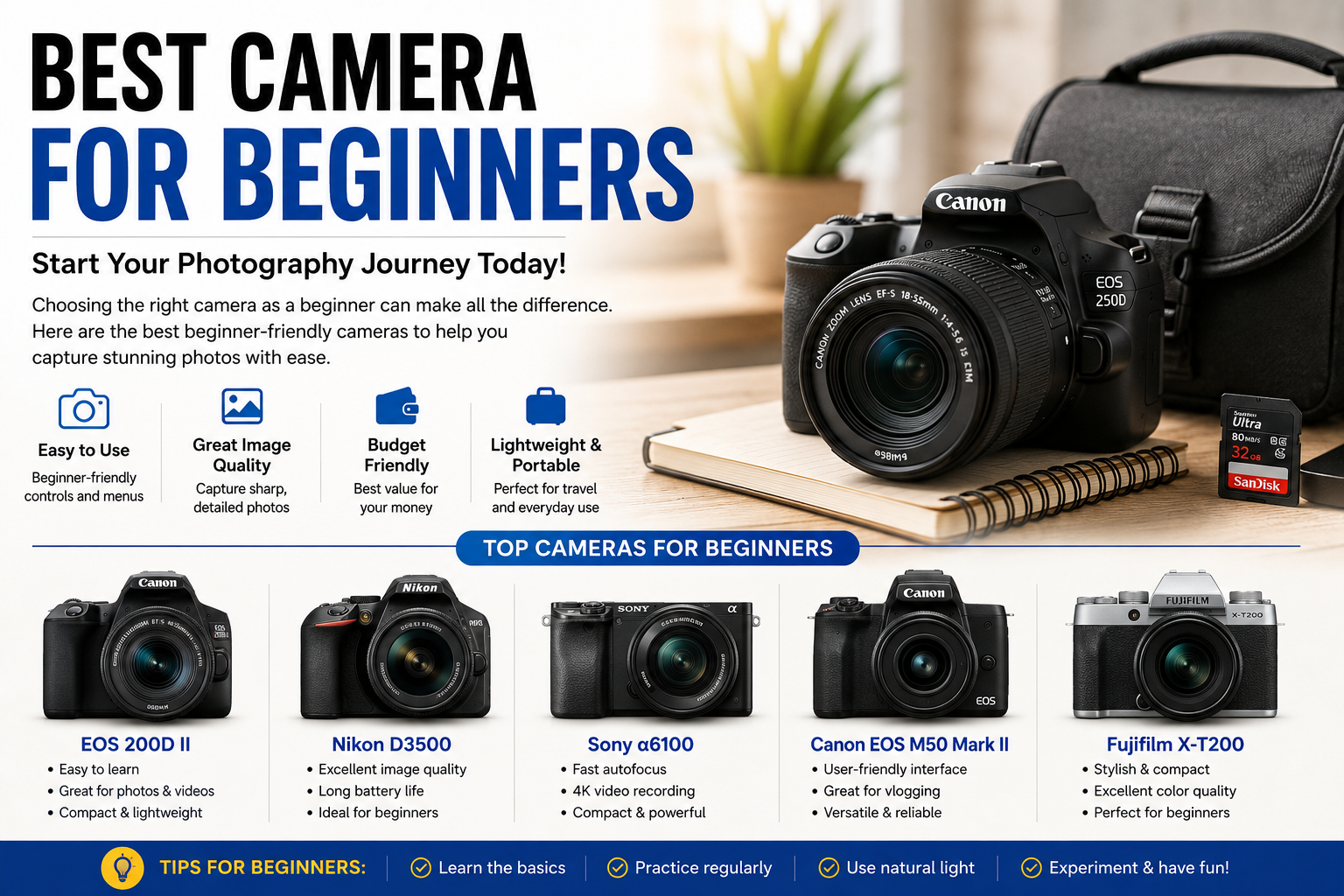
Beginners have four realistic options: mirrorless, DSLR, compact/point-and-shoot, and smartphone. Each fits a different use case and budget.

Camera Type Best For Typical Price Range Pros Cons
Mirrorless (APS-C) Most beginners $450–$900 Compact, modern AF, good video Shorter battery life
DSLR Budget hunters, optical viewfinder fans $350–$700 Long battery, huge lens ecosystem Bulkier, older tech
Compact / Point-and-Shoot Travel, simplicity $200–$600 Pocketable, easy Limited manual control
Smartphone Total beginners, social media Already owned Always with you, AI-enhanced Small sensors limit low light

Choose a mirrorless camera if you want the best balance of image quality, size, and future-proofing.

Choose a DSLR if you’re on a tight budget and can find a used model or prefer an optical viewfinder.

Choose a compact if you want something pocketable for travel with better quality than a phone.

Choose a smartphone if you’re just starting and want to learn composition before spending money.

Best Camera for Beginners: Top Picks in 2026

These cameras consistently earn strong marks from photography educators and user communities for beginner use.

🥇 Sony ZV-E10 II — Best Overall Beginner Mirrorless

  • Sensor: 26MP APS-C
  • Video: 4K/60fps
  • Why beginners love it: Simple vlog-friendly design, excellent subject-tracking AF, compact body
  • Price (est.): Around $750 with kit lens
  • Best for: Vloggers, content creators, photography students

🥈 Canon EOS R50 — Best for Photo-First Beginners

  • Sensor: 24.2MP APS-C
  • Video: 4K (with crop)
  • Why beginners love it: Canon’s color science, beginner-friendly intuitive menus, and great RF-S lens lineup
  • Price (est.): Around $680 with kit lens
  • Best for: Portrait, family, and travel photography beginners

🥉 Fujifilm X-S20 — Best for Creative Learners

  • Sensor: 26.1MP APS-C X-Trans
  • Video: 6.2K open-gate, 4K/60fps
  • Why beginners love it: Film simulation modes make learning color grading fun, excellent build quality
  • Price (est.): Around $1,299 body only (slightly above entry-level but worth the stretch)
  • Best for: Beginners who want to grow fast and love a retro shooting experience

Budget Pick: Canon EOS Rebel SL3 (DSLR)

  • Sensor: 24.1MP APS-C
  • Why it works: It’s the Lightest DSLR Canon makes, and the guided mode walks beginners through every setting
  • Price (est.): Around $650 with kit lens (often found used for $350–$450)
  • Best for: Budget-conscious beginners who prefer a traditional camera feel

How Much Should a Beginner Spend on a Camera?

Most beginners get the best value in the $400–$800 range for a camera body plus kit lens. Spending more doesn’t accelerate learning — spending on courses and practice does.

A realistic beginner budget breakdown:

  • Camera body + kit lens: $450–$800
  • Extra battery: $25–$50
  • Memory card (UHS-I or UHS-II): $20–$50
  • Camera bag or strap: $30–$80
  • Editing software: Free (Lightroom mobile, Snapseed) to $10/month

Total realistic starter kit: $525–$980

One often-overlooked accessory: a stable tripod. If you plan to shoot landscapes, portraits, or video, a stable and portable tripod makes a meaningful difference even for beginners.

Common mistake: Buying a body-only camera without budgeting for a lens. Always factor in the full kit cost.

Best Camera for Beginners: Mirrorless vs. DSLR — Which Wins in 2026?

For most beginners starting in 2026, mirrorless cameras are the better choice. DSLRs are mature technology with shrinking manufacturer support, while mirrorless systems are where all major brands are investing.

Mirrorless advantages for beginners:

  • Faster, more accurate autofocus (especially face and eye tracking)
  • Lighter and more compact bodies
  • Better video capabilities at the same price point
  • The electronic viewfinder shows exposure preview before you shoot

DSLR advantages that still matter:

  • Longer battery life per charge (often 500–900 shots vs. 300–400 for mirrorless)
  • Lower used prices—a used Canon Rebel T8i or Nikon D3500 can be found for under $400
  • Optical viewfinder preferred by some photographers

Bottom line: If buying new, go mirrorless. If on a tight budget and buying used, a DSLR is still a solid learning tool.

Does Sensor Size Matter for Beginner Photographers?

Yes, but not as much as marketing suggests. For beginners, an APS-C sensor is the practical sweet spot — it produces noticeably better low-light photos than a smartphone and is far more affordable than a full-frame sensor.

Sensor size comparison:

  • Full-frame (35mm): Professional quality, expensive ($1,500+), heavier lenses
  • APS-C: Best beginner option — great image quality, affordable, wide lens selection
  • Micro Four Thirds (MFT): Compact system with good quality (Olympus/OM System, Panasonic)
  • 1-inch: Found in premium compacts like Sony RX100 series—good for travel

Choose APS-C if you want the best balance of image quality, cost, and lens availability as a beginner.

Can a smartphone replace a beginner camera in 2026?

For casual photography and social media content, yes — modern flagship smartphones are genuinely capable. For learning photography fundamentals or producing print-quality images, a dedicated camera still has clear advantages.

Smartphones like the Apple iPhone 17 Pro Max and Google Pixel 10 Pro XL produce stunning photos with computational photography. However, they have physical limits:

  • Smaller sensors struggle more in low light without AI processing
  • Limited optical zoom range compared to interchangeable lenses
  • Less manual control for learning aperture, shutter speed, and ISO

Use a smartphone if you’re just discovering photography and not ready to invest in gear yet. Transition to a dedicated camera when you find yourself frustrated by the phone’s limitations—that’s the signal you’re ready.

For content creators who shoot video on the go, pairing a smartphone with a DJI Osmo Mobile 8 gimbal is a practical alternative to buying a dedicated camera.

What Accessories Does a Beginner Photographer Actually Need?

Keep it simple at first. The gear that genuinely helps beginners:

Essential:

  • Extra battery (one is never enough)
  • Fast memory card (64GB–128GB, UHS-I minimum)
  • Microfiber cleaning cloth
  • Camera strap (the included one is usually fine)

Useful but not urgent:

  • Tripod (critical for video, landscapes, and low-light shots)
  • 50mm prime lens (often called the “nifty fifty” — cheap and teaches composition)
  • Camera bag or backpack

Skip for now:

  • External flash (learn natural light first)
  • Filters (useful later, not essential at the start)
  • Multiple lenses (the kit lens covers 90% of beginner needs)

For those who also shoot with a smartphone, explore the full range of camera accessories and gear to find options that complement your setup.

How Do You Learn Photography Faster as a Beginner?

Gear is secondary to practice and deliberate learning. The fastest path to improvement:

  1. Shoot in aperture priority (Av/A) mode first—learn how aperture affects depth of field before going full manual.
  2. Review your shots critically — ask why a photo didn’t work, not just whether you like it.
  3. Limit yourself to one lens for the first 3 months — constraints force creativity.
  4. Follow a structured online course — YouTube channels like Tony Northrup, Peter McKinnon, and Mango Street are free and excellent.
  5. Join a community — Reddit’s r/photography and r/photoclass are active and beginner-friendly.
  6. Edit your photos — post-processing is half the craft; start with free tools like Lightroom Mobile.

FAQ: Best Camera for Beginners

Q: What is the single best camera for an absolute beginner in 2026?
The Sony ZV-E10 II is the top pick for most beginners in 2026 — it’s compact, shoots excellent 4K video, has reliable autofocus, and is priced around $750 with a kit lens.

Q: Is a mirrorless or DSLR better for beginners?
Mirrorless is better for beginners buying new gear in 2026. DSLRs are still viable if bought used on a budget, but mirrorless cameras offer better autofocus, video, and future lens support.

Q: How much should a beginner spend on their first camera?
A budget of $500–$800 for a camera body plus kit lens is the practical sweet spot. Spending more won’t accelerate skill development.

Q: Can I learn photography with a smartphone first?
Yes. A flagship smartphone is a legitimate learning tool for composition and light. Upgrade to a dedicated camera when you consistently feel limited by the phone’s capabilities.

Q: What is the best beginner camera for video?
The Sony ZV-E10 II leads for video beginners due to its 4K/60fps output, subject-tracking AF, and vlog-friendly design. The Fujifilm X-S20 is the premium alternative.

Q: Do I need a full-frame camera as a beginner?
No. Full-frame cameras are heavier, more expensive, and require pricier lenses. An APS-C mirrorless camera will produce excellent results for years before you outgrow it.

Q: What lens should a beginner use first?
The kit lens (typically 15–45mm or 18–55mm) that comes bundled with the camera is the right starting point. A 50mm f/1.8 prime lens (around $100–$200) is the best first upgrade.

Q: Is the Canon EOS R50 good for beginners?
Yes. The Canon EOS R50 is one of the most beginner-friendly mirrorless cameras available, with intuitive menus, reliable autofocus, and excellent still image quality.

Q: What’s the best budget beginner camera under $500?
A used Canon EOS Rebel SL3 or Nikon D3500 can be found for under $400–$450 and is an excellent learning tool. For new purchases, the Sony ZV-E10 (original) occasionally dips below $500.

Q: Should a beginner buy a camera kit or body only?
Always buy a kit (body + lens) as a beginner. Kit lenses are genuinely useful and cost far less when bundled than when purchased separately.

Q: How important is megapixel count for beginners?
Not very important at the beginner stage. Any camera with 20+ megapixels produces more than enough detail for social media, prints, and learning. Focus on autofocus quality and usability instead.

Q: What camera brand is best for beginners?
Sony, Canon, and Fujifilm all make excellent beginner cameras in 2026. Canon is often recommended for its intuitive menus, Sony for its autofocus technology, and Fujifilm for its creative film simulations and build quality.

Conclusion: Your Next Steps

Finding the best camera for beginners comes down to three honest questions: How much do you want to spend? What will you shoot most (photos, videos, or travel)? And how seriously do you want to pursue photography long-term?

For most people reading this in 2026, the Sony ZV-E10 II or Canon EOS R50 are the clearest starting points—both are well-supported, genuinely capable, and won’t feel limiting for at least two to three years of active learning.

Actionable next steps:

  1. Set your budget before browsing—include a lens, a memory card, and a spare battery.
  2. Visit a camera store if possible to hold the body before buying—ergonomics matter.
  3. Buy the kit lens bundle rather than the body-only for your first camera.
  4. Start shooting the day it arrives — don’t wait to “learn more” first.
  5. Pick one free online course and work through it in your first month.
  6. Pair your camera with a stabilizer if video is a priority—check out the DJI Osmo Mobile 8 as a compact option.

The best camera for beginners is the one that gets you shooting, learning, and improving — not the one with the most impressive spec sheet.

References

  • Sony Official Product Page, ZV-E10 II Specifications—sony.com (2024)
  • Canon Official Product Page, EOS R50 Specifications—canon.com (2023)
  • Fujifilm Official Product Page, X-S20 Specifications — fujifilm.com (2023)
  • DPReview Camera Buying Guide for Beginners—dpreview.com (2024)
  • Photography Life, “Best Cameras for Beginners” — photographylife.com (2024)