(By TechnoItem Expert Team | Last Updated: July 2026)
Quick Answer
The best digital camera for beginners in 2026 is a mirrorless camera in the $400–$800 range, such as the Sony ZV-E10 II or Canon EOS M50 Mark II, because these cameras balance ease of use with genuine room to grow. Beginners should avoid buying a camera that’s either too simple (no manual controls) or too complex (full-frame with no guidance modes). The right entry-level camera teaches you photography while still producing professional-quality images.
Key Takeaways
- 🎯 Mirrorless cameras are the top pick for most beginners in 2026 — lighter, smarter, and more future-proof than DSLRs.
- 💰 Budget sweet spot: $400–$800 covers most beginner needs without overspending on features you won’t use yet.
- 📷 Sensor size matters: APS-C sensors offer the best balance of image quality and affordability for new photographers.
- 🔋 Battery life and kit lens quality are often overlooked but critically affect your first-year experience.
- 📱 Smartphone cameras are not the same — dedicated cameras offer manual control, interchangeable lenses, and far better low-light performance.
- 🎥 Video capability is worth checking even if you plan to shoot mostly photos — 4K is standard at this price range now.
- 🛡️ Avoid buying used without a warranty as a beginner—shutter count and sensor condition are hard to assess without experience.
- 📚 Auto modes are fine to start — the best beginner cameras let you shoot in auto and gradually shift to manual.
- 🔗 Accessories matter: A good tripod and extra memory card should be part of your first purchase plan.
What Makes a Camera Truly Beginner-Friendly?
A beginner-friendly digital camera does three things well: it produces good photos in automatic mode, it teaches you to improve, and it doesn’t frustrate you with a steep learning curve.
Specifically, look for these traits:
- Guided or scene modes that explain what each setting does
- A flip-out or tilting touchscreen for easy framing at awkward angles
- Lightweight body under 450g, so you can actually carry it
- Fast autofocus so you don’t miss moments while the camera hunts for focus
- Wi-Fi or Bluetooth connectivity for easy transfers to your phone
- A kit lens included in the box (usually an 18-55mm equivalent)
“The best camera for a beginner is the one they’ll actually pick up and use — not the one with the most specs on paper.”
Common mistake: Many first-time buyers choose a camera based on megapixel count alone. In reality, a 24MP APS-C sensor in good light will outperform a 48MP smartphone sensor in almost every scenario that matters — but megapixels alone don’t determine image quality. Lens quality, sensor size, and dynamic range matter far more.
What Are the Main Camera Types for Beginners?
For someone choosing their first dedicated camera, there are four main categories to understand:
| Camera Type | Best For | Price Range | Portability |
| Mirrorless (APS-C) | Most beginners | $400–$900 | High |
| DSLR (APS-C) | Budget-conscious buyers | $350–$700 | Medium |
| Point-and-Shoot | Ultra-portability | $200–$500 | Very High |
| Bridge Camera | Zoom-focused shooters | $300–$600 | Medium |
Choose mirrorless if you want the best long-term investment, care about video quality, and want a lighter kit.
Choose a DSLR if you find a great deal on a used or older model and want excellent battery life (DSLRs can last 600–1,000 shots per charge vs. 300–400 for many mirrorless).
Choose a point-and-shoot if you want something pocketable and have no interest in swapping lenses.
Choose a bridge camera if you want an extreme zoom range (say, 60x optical zoom for wildlife or sports) in one fixed-lens body.
For most people reading this guide, mirrorless is the right answer in 2026.
Which are the best digital cameras for beginners right now?
The best digital cameras for beginners in 2026 come from Sony, Canon, Fujifilm, and Nikon — all of which offer strong APS-C mirrorless options with beginner-friendly features and solid ecosystem support.
Here are the top picks by category:
Best Overall Beginner Camera
Sony ZV-E10 II (~$750 with kit lens)
- 26MP APS-C sensor
- 4K video with real-time eye tracking
- Flip-out screen ideal for vlogging and selfies
- Compact, lightweight body
Best Budget Beginner Camera
Canon EOS M50 Mark II (~$500–$600 with kit lens)
- 24.1MP APS-C sensor
- Dual Pixel autofocus (fast and reliable)
- Guided UI mode for absolute beginners
- Strong Canon color science out of the camera
Best for Creative Shooters
Fujifilm X-S20 (~$800 with kit lens)
- 26.1MP APS-C sensor
- 40 built-in film simulations for unique looks
- Excellent in-body image stabilization (IBIS)
- Strong video specs, including 6.2K raw output
Best DSLR Option (Budget Pick)
Nikon D3500 (used, ~$300–$400)
- 24.2MP APS-C sensor
- Exceptional battery life (~1,500 shots per charge)
- “Guide Mode” walks beginners through settings step-by-step.
- No longer in production, but widely available used with a warranty
Note: Prices are approximate and vary by retailer and region. Always confirm current pricing before purchasing.
How Much Should a Beginner Spend on a Digital Camera?
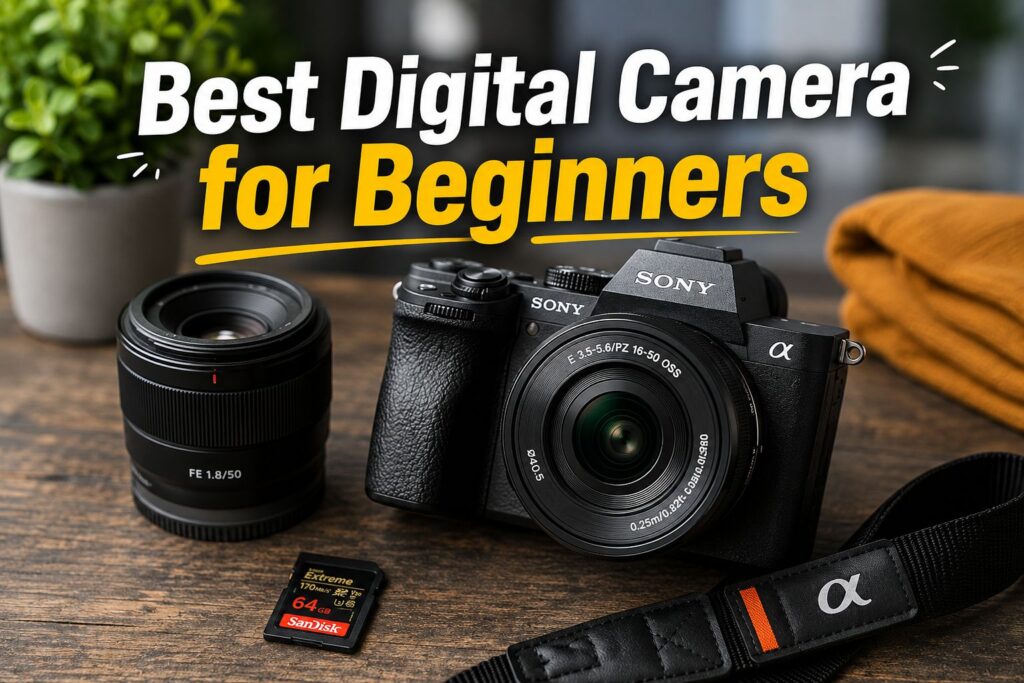
Most beginners should plan to spend between $400 and $800 on their first camera setup, including a kit lens. Spending less often means sacrificing autofocus speed or video quality; spending more usually means paying for features that take years of experience to use.
Realistic budget breakdown for a beginner kit:
- Camera body + kit lens: $450–$800
- Extra battery: $25–$50
- 64GB or 128GB SD card (UHS-I or faster): $15–$35
- Camera bag or case: $30–$70
- Stable tripod for phone or camera: $30–$80
Total realistic first kit: $550–$1,035
Edge case: If you’re buying a camera specifically for travel, factor in weight. A mirrorless body plus one compact lens can weigh under 600g total — much easier to carry than a DSLR kit for extended trips.
What Specs Actually Matter for a Beginner?
When shopping for the best digital camera for beginners, focus on these specs and ignore the rest:
Specs that matter:
- Sensor size (APS-C is the sweet spot—larger than Micro Four Thirds, smaller and cheaper than full-frame)
- Autofocus system (phase-detect AF is faster than contrast-detect; eye-tracking AF is a major advantage)
- Image stabilization (in-body stabilization, or IBIS, is more flexible than lens-only stabilization)
- Battery life (anything under 250 shots per charge will frustrate you on a long day out)
- Screen type (fully articulating screens are more useful than fixed or tilt-only screens)
Specs beginners can safely ignore:
- Burst shooting speed above 10fps
- Weather sealing (useful, but rarely critical at this price point)
- Dual card slots
- Maximum ISO above 25600
What Accessories Do Beginners Actually Need?
Beyond the camera itself, a few accessories genuinely improve the beginner experience. Skip the overpriced bundles most retailers push — they often include low-quality filters and bags that aren’t worth the markup.
Essential accessories:
- Extra battery — Most kit batteries last 300–400 shots. Bring two on any serious outing.
- Fast SD card — Look for UHS-I Speed Class 3 (U3) or UHS-II for 4K video. Cheap cards cause dropped frames.
- Camera strap — The included strap is usually uncomfortable. A third-party sling or wrist strap is worth $20–$40.
- Lens cleaning kit — A blower, microfiber cloth, and lens pen cost under $15 and protect your investment.
- Tripod — Even a basic tripod expands what you can shoot dramatically (long exposures, group shots, video). See our guide to stable and portable tripods for options that work with cameras and phones alike.
Optional but useful:
- A 50mm prime lens (usually $100–$200) for portraits and low-light shooting
- A camera bag that fits your travel style
Should Beginners Buy a Camera or Just Use Their Smartphone?
A dedicated camera outperforms a smartphone in specific situations — and in 2026, smartphones have genuinely closed the gap in others. The honest answer depends on what you want to shoot.
A dedicated camera wins when:
- Shooting in low light without flash (larger sensor = less noise)
- You want creative control over depth of field (background blur)
- You need optical zoom beyond 5x without quality loss
- You’re shooting fast-moving subjects (sports, wildlife, kids)
- You want to print images at large sizes
A smartphone wins when:
- You need instant sharing to social media
- Portability is the top priority
- Computational photography (AI scene detection, HDR) suits your style
- Budget is under $300
For reference, the Google Pixel 10 Pro XL and Apple iPhone 17 Pro Max both produce outstanding results in good light—but neither replaces a dedicated camera for full manual control or interchangeable lenses.
If you’re serious about learning photography as a skill, buy a dedicated camera. If you want better photos with zero learning curve, a flagship smartphone may be enough.
What Are the Most Common Mistakes Beginners Make When Buying a Camera?
Knowing what to avoid saves money and frustration. These are the most frequent mistakes new photographers make:
- Buying full-frame too soon: Full-frame cameras produce stunning images, but lenses are expensive, and the bodies are heavy. Most beginners don’t need a full-frame for years.
- Ignoring the lens ecosystem: A camera body is just the start. Check whether the brand has affordable lenses you can grow into.
- Skipping the kit lens: Many buyers think the kit lens is low quality and skip it. In reality, modern kit lenses are solid for beginners and save you $200–$400 upfront.
- Buying based on YouTube reviews alone: Many camera reviewers test cameras in ideal conditions. Look for reviews from beginner photographers, not just pros.
- Forgetting about software: Editing software like Adobe Lightroom or free tools like Darktable can transform RAW files from any decent camera. The camera is only half the equation.
For those who also use their camera alongside other tech, it’s worth having a reliable setup—from a good laptop for editing to the right accessories for your workflow.
How Do Beginners Learn to Use a New Camera Faster?
The fastest path from “auto mode” to confident manual shooting takes most people 3–6 months with consistent practice.
A practical learning path:
- Week 1–2: Shoot everything in Auto mode. Focus on composition, not settings.
- Week 3–4: Switch to Aperture Priority (Av or A mode). Learn how aperture affects background blur.
- Month 2: Add Shutter Priority (Tv or S mode). Practice shooting moving subjects.
- Month 3: Try full manual mode in a controlled setting (indoors, still subjects).
- Month 4–6: Shoot RAW files and start basic editing.
Resources that actually help:
- YouTube channels like Tony & Chelsea Northrup or Mark Wallace’s Adorama series
- The camera’s own manual (underrated — most modern manuals are well-written)
- Photography subreddits for feedback on your actual shots
Also consider that accessories like a wireless microphone can expand your camera’s video capability if you start exploring vlogging or content creation alongside photography.
FAQ: Best Digital Camera for Beginners
Q: What is the single best digital camera for beginners in 2026?
The Sony ZV-E10 II is the top overall pick for most beginners in 2026 — it balances image quality, video capability, and ease of use at a fair price point.
Q: Is a mirrorless camera better than a DSLR for beginners?
Yes, for most beginners in 2026. Mirrorless cameras are lighter, have better video autofocus, and receive more active lens development from manufacturers. DSLRs are still viable, but are largely in maintenance mode from most brands.
Q: How many megapixels does a beginner’s camera need?
24MP is more than enough for any beginner use case, including large prints and cropping. Chasing higher megapixel counts at the expense of other features is a common and costly mistake.
Q: Can a beginner use a camera in manual mode right away?
Technically, yes, but it’s not recommended. Start with auto or semi-auto modes, then gradually shift to manual as you understand how aperture, shutter speed, and ISO interact.
Q: What is the best beginner camera under $500?
The Canon EOS M50 Mark II (with kit lens) and the Nikon D3500 (used) are both strong options under $500. The Canon is better for video; the Nikon has superior battery life.
Q: Do I need to buy extra lenses right away?
No. The kit lens that comes with most beginner cameras covers a wide range of situations. A 50mm prime lens is a worthwhile second purchase after 3–6 months, but it’s not urgent.
Q: Is it worth buying a used camera as a beginner?
It can be, but stick to certified refurbished options from the manufacturer or reputable retailers. Check the shutter count and ensure the camera comes with at least a 90-day warranty.
Q: What camera brand is best for beginners?
Sony, Canon, and Fujifilm all have strong beginner lineups. Sony leads in autofocus technology; Canon has the most beginner-friendly interface; Fujifilm offers the most creative in-camera options. Nikon is also solid but has a smaller mirrorless APS-C lens selection.
Q: Does camera brand matter long-term?
Yes, your lens investment ties you to a brand’s ecosystem. Choose a brand with a broad, affordable lens lineup so you can grow without switching systems.
Q: What’s the best digital camera for beginners who also want to vlog?
The Sony ZV-E10 II is built with vloggers in mind — it has a directional microphone, a fully articulating screen, and smooth 4K video. The Fujifilm X-S20 is a strong alternative with better in-body stabilization.
Conclusion: Choosing Your First Camera With Confidence
The best digital camera for beginners in 2026 isn’t the most expensive one or the one with the most features — it’s the one that matches your actual shooting style, budget, and willingness to learn.
Actionable next steps:
- Set your budget first—decide how much you’re comfortable spending on the body, lens, and accessories combined.
- Pick your camera type — mirrorless for most people; DSLR only if you find a great budget deal.
- Choose a brand with a lens ecosystem you can afford to grow into (Sony, Canon, or Fujifilm are safe bets).
- Buy the kit lens — don’t skip it to save money on a prime lens you’re not ready for yet.
- Get one extra battery and a fast SD card before your first shoot.
- Commit to shooting regularly — even 20 minutes a week of deliberate practice accelerates improvement faster than any gear upgrade.
For more camera and tech buying guides, explore the full camera category on TechnoItem to find reviews and comparisons that match your needs.
Photography is a skill that compounds over time. The right beginner camera is just the starting point — what you do with it is what matters.
References
- Sony Corporation. (2024). ZV-E10 II Product Specifications. Sony Electronics. https://www.sony.com
- Canon USA. (2021). EOS M50 Mark II Product Overview. Canon. https://www.usa.canon.com
- Fujifilm. (2023). X-S20 Camera Specifications. Fujifilm Global. https://fujifilm-x.com
- Nikon. (2018). D3500 Digital SLR Camera Guide. Nikon Corporation. https://www.nikon.com
- Digital Photography Review (DPReview). (2024). Best cameras for beginners. https://www.dpreview.com