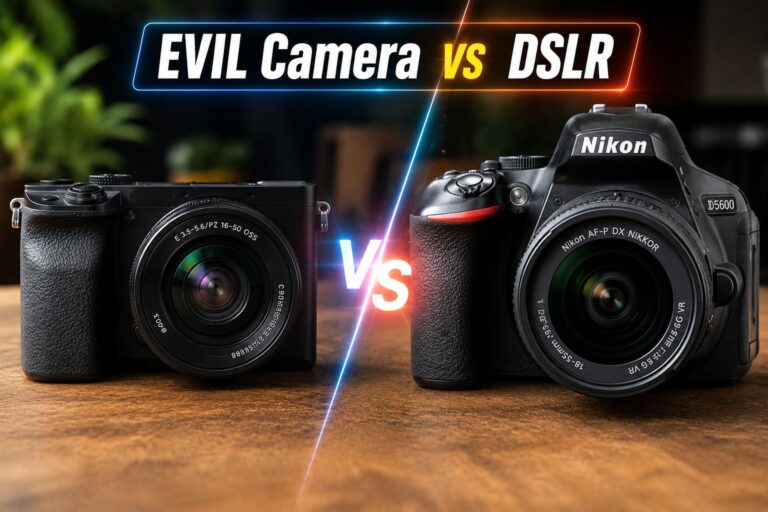
Amazing EVIL Camera vs DSLR: Which Camera Is Better for Photography in 2026?

EVIL Camera vs DSLR

(By TechnoItem Expert Team | Last Updated: July 2026)

Quick Answer: An EVIL camera (Electronic Viewfinder, Interchangeable Lens)—also called a mirrorless camera—uses an electronic viewfinder and no mirror mechanism, making it lighter and more compact than a DSLR. DSLRs use an optical viewfinder and a reflex mirror, offering longer battery life and a wider selection of native lenses. For most new photographers in 2026, a mirrorless (EVIL) camera is the better long-term investment. DSLRs still make sense for shooters who already own glass or need maximum battery endurance in the field. (EVIL Camera vs DSLR)

Key Takeaways

  • EVIL stands for “Electronic Viewfinder Interchangeable Lens”—it’s the technical term for mirrorless cameras.
  • Mirrorless cameras are generally lighter, more compact, and better suited for video than DSLRs.
  • DSLRs offer optical viewfinders, longer battery life per charge, and a massive back-catalog of affordable native lenses.
  • Major manufacturers (Canon, Nikon, Sony) have shifted R&D focus almost entirely to mirrorless systems as of 2026.
  • Image quality at equivalent sensor sizes is comparable between both systems — sensor size matters more than camera type.
  • Budget matters: entry-level DSLRs can still undercut mirrorless cameras at the same image quality tier.
  • Autofocus speed and subject tracking favor modern mirrorless cameras by a clear margin.
  • Choosing between an EVIL camera and a DSLR ultimately comes down to your shooting style, budget, and existing gear.

What Is an EVIL Camera, and How Does It Differ from a DSLR?

An EVIL camera is a mirrorless interchangeable-lens camera that replaces the optical viewfinder and reflex mirror of a DSLR with an electronic viewfinder (EVF) and direct sensor readout. The result is a physically smaller body with fewer moving parts.

A DSLR (Digital Single-Lens Reflex) works by bouncing light from the lens up through a mirror into an optical viewfinder. When you press the shutter, the mirror flips up, the shutter opens, and light hits the sensor. This mechanism adds bulk but gives a true optical view of the scene.

Key structural differences at a glance:

Feature EVIL / Mirrorless DSLR
Viewfinder type Electronic (EVF) Optical (OVF)
Mirror mechanism None Yes
Body size/weight Smaller, lighter Larger, heavier
Battery life (typical) 300–500 shots/charge 600–1,200 shots/charge
Video capability Excellent Good to moderate
AF speed (2026) Very fast (phase + AI) Fast (phase detect)
Native lens selection Growing rapidly Extensive (decades of glass)
New model releases Active Slowing significantly


Visit Amazon:

1:https://amzn.to/4e2eviY

2:https://amzn.to/4wUfdXd

Why the EVIL Camera vs DSLR Debate Still Matters in 2026

mirrorless vs DSLR
Mirrorless vs. DSLR

Some photographers assume this debate is settled — and in terms of manufacturer investment, it largely is. Canon released its last major DSLR body update in 2022, and Nikon has publicly committed its future to the Z-mount mirrorless system. Sony stopped producing new DSLR bodies years ago.

But the debate still matters for buyers because

  • Millions of used DSLRs are available at steep discounts, making them compelling entry points.
  • Existing lens ecosystems mean many working photographers have thousands of dollars in DSLR glass.
  • Battery life and ruggedness remain genuine DSLR advantages in specific field conditions.
  • Beginners searching for “evil camera vs. DSLR” are often choosing their first serious camera system—a decision that shapes their gear investment for years.

💡 The real question isn’t which technology is “better” — it’s which system fits your shooting habits, budget, and growth path.


Image Quality: Does the Camera Type Actually Matter?

For image quality, the camera type (mirrorless vs DSLR) is largely irrelevant. Sensor size and quality determine dynamic range, low-light performance, and resolution — not whether a mirror is present.

A full-frame mirrorless camera and a full-frame DSLR with the same generation sensor will produce nearly identical raw files. The meaningful comparisons are the following:

  • Full-frame vs. APS-C vs. Micro Four Thirds—sensor size differences create real IQ gaps.
  • Sensor generation — a newer APS-C mirrorless sensor can outperform an older full-frame DSLR sensor.
  • Lens quality — a sharp prime on either system beats a mediocre zoom on either system.

Choose based on sensor size and lens quality, not mirror presence.

Autofocus: Where Mirrorless Cameras Pull Ahead

Modern mirrorless cameras have a clear autofocus advantage over DSLRs, particularly for moving subjects. This is one area where the evil camera vs. DSLR comparison has a definitive answer for most use cases.

DSLRs use a dedicated phase-detection AF module in the mirror box, which is fast but limited to the center of the frame. Mirrorless cameras embed phase-detection pixels across the entire sensor and layer AI subject recognition on top, enabling eye, face, animal, and vehicle tracking across the full frame.

Where this matters most:

  • 📸 Sports and wildlife photography
  • 👶 Children and unpredictable subjects
  • 🎬 Video with continuous subject tracking
  • 🐦 Birds in flight (a classic AF stress test)

For static subjects—landscapes, architecture, and studio portraits—DSLR autofocus is perfectly adequate.

Video Performance: A Clear Win for Mirrorless

If video is part of your workflow, mirrorless cameras are the stronger choice. DSLRs typically use sensor crop during video recording and often lack features like in-body image stabilization (IBIS), log profiles, and 4K at higher frame rates.

Mirrorless cameras in 2026 commonly offer:

  • 4K at 60fps or higher
  • 6K and 8K options on higher-end bodies
  • In-body image stabilization (IBIS)
  • Clean HDMI output for external recorders
  • Log color profiles for post-production grading

For vloggers, filmmakers, or hybrid photo-video shooters, the mirrorless advantage here is significant. If you’re pairing your camera with a smartphone gimbal like the DJI Osmo Mobile 8 for run-and-gun shooting, a lighter mirrorless body also balances better on a gimbal.

Size, Weight, and Portability: The Practical Reality

EVIL cameras are generally smaller and lighter than DSLRs, but the gap narrows with larger lenses. A compact mirrorless body paired with a large telephoto lens is no lighter than a DSLR with an equivalent lens.

Where the size advantage is real:

  • Street photography with a small prime lens
  • Travel photography where bag space is limited
  • Daily carry where you want a capable camera without a large bag

Where the size advantage shrinks:

  • Wildlife or sports shooting with 400mm+ telephoto lenses
  • Studio work where portability doesn’t matter
  • Shooters who prefer a larger grip for ergonomic comfort

If portability is a priority and you’re also comparing your camera to a capable smartphone, it’s worth checking out the Samsung Galaxy S26 Ultra or the Google Pixel 10 Pro XL—flagship phones that can complement or even replace a dedicated camera for casual shooting.

Battery Life: The DSLR’s Lasting Advantage

DSLRs consistently outperform mirrorless cameras on battery life. The optical viewfinder uses no power, and the mirror mechanism only activates at the moment of capture. A mid-range DSLR can deliver 800–1,200 shots per charge. Most mirrorless cameras manage 300–500 shots under CIPA test conditions.

Practical workarounds for mirrorless shooters:

  • Carry two or three spare batteries (they’re small and relatively inexpensive)
  • Use a battery grip for extended shooting sessions
  • Turn off the EVF when reviewing shots on the rear screen
  • Use power-saving modes during idle periods

For travel photographers or photojournalists in remote locations without reliable charging access, this is a genuine consideration — not just a spec sheet footnote.

You can also pair your camera with a stable cell phone tripod to extend shooting sessions without holding the camera, which conserves battery on both mirrorless and DSLR bodies.

Cost Comparison: What Does Each System Actually Cost?

Entry-level pricing in 2026 (approximate USD):

System Entry Body Mid-Range Body Kit Lens (18-55mm equiv.)
DSLR (new) $400–$600 $900–$1,400 $100–$200
DSLR (used/refurbished) $150–$350 $400–$700 $50–$150
Mirrorless (new) $600–$900 $1,200–$2,000 $200–$400
Mirrorless (used) $350–$600 $700–$1,200 $150–$300

The budget reality: A used DSLR kit can get a beginner shooting with excellent image quality for under $400. An equivalent mirrorless setup costs more, though prices have dropped as the market matures.

Choose a DSLR if: You’re on a tight budget, you’re buying used, or you already own compatible lenses.

Choose mirrorless if you’re investing in a long-term system, you shoot video, or you want the latest autofocus technology.

For a broader look at camera and electronics options, the Camera category at TechnoItem covers a range of imaging gear across budgets.

Who Should Choose an EVIL Camera vs. a DSLR?

DSLR vs mirrorless 2026

This is the most practical question in the entire EVIL camera vs. DSLR comparison. Here’s a direct decision framework:

Choose a mirrorless (EVIL) camera if you:

  • Are you buying your first serious camera with no existing lens investment
  • Shoot video regularly or plan to
  • Want the best autofocus for fast-moving subjects
  • Prioritize a compact, travel-friendly system
  • Are investing for the next 5–10 years (manufacturer support favors mirrorless)

Choose a DSLR if you:

  • Already own a collection of DSLR lenses (Canon EF, Nikon F, etc.)
  • Need maximum battery life for extended fieldwork
  • Are on a tight budget and want the best image quality per dollar
  • Prefer an optical viewfinder for its natural, lag-free view
  • Are you buying used and want the widest selection of affordable bodies

Common mistake: Buying a mirrorless body and then adapting all your old DSLR lenses. Adapted lenses often lose autofocus speed advantages, which defeats a key reason to go mirrorless. If you’re switching systems, plan to gradually replace lenses with native mirrorless glass.

FAQ: EVIL Camera vs DSLR

Q: Is “EVIL camera” just another name for mirrorless?
Yes. EVIL (Electronic Viewfinder, Interchangeable Lens) is the technical term for what most people call a mirrorless camera. The terms are interchangeable.

Q: Are DSLRs becoming obsolete?
Not immediately. DSLRs still produce excellent images and will continue to work indefinitely. However, manufacturers have largely stopped developing new DSLR models, so the technology is no longer advancing. Used DSLRs remain excellent value buys.

Q: Can I use my DSLR lenses on a mirrorless camera?
Usually, yes, with an adapter. Canon RF, Nikon Z, and Sony E-mount bodies all have manufacturer-made adapters for their legacy DSLR lenses. Autofocus performance varies by lens and adapter combination.

Q: Which is better for portrait photography?
Both systems produce excellent portraits. The mirrorless advantage in eye-tracking autofocus is genuinely useful for portraits, especially with moving subjects or children.

Q: Which is better for wildlife photography?
Modern mirrorless cameras have surpassed DSLRs for wildlife, particularly for bird-in-flight tracking. The Sony A9 series, Canon R3, and Nikon Z9 set a new standard that DSLR AF systems can’t match.

Q: Do mirrorless cameras have a shutter lag problem?
Early mirrorless cameras had noticeable EVF lag. Current-generation bodies (2023 onward) have EVF lag measured in milliseconds — imperceptible in normal shooting. This is no longer a meaningful concern.

Q: Is the electronic viewfinder (EVF) worse than an optical viewfinder?
It depends on preference. EVFs show exposure preview, focus peaking, and live histograms—genuinely useful information. Optical viewfinders offer a natural, lag-free view with no battery drain. Many photographers who switch to mirrorless prefer the EVF after a short adjustment period.

Q: What about weather sealing?
Both systems offer weather-sealed bodies at mid-to-high price points. Weather sealing is a feature of specific models, not an inherent advantage of either system.

Q: Is a mirrorless camera good for beginners?
Yes. Entry-level mirrorless cameras are no harder to use than DSLRs. The learning curve is the same; the technology is just different under the hood.

Q: Will DSLR lenses hold their value?
Canon EF and Nikon F lenses remain widely used and hold reasonable resale value, especially quality L-series and prime lenses. Demand is softening as more photographers move to mirrorless, but quality glass retains value better than bodies.

Conclusion: Making the Right Choice in 2026

The evil camera vs. DSLR debate has a practical answer for most photographers in 2026: mirrorless is the better long-term investment for anyone starting fresh or upgrading without a legacy lens collection. The autofocus advantages, video capabilities, and manufacturer support all point in the same direction.

That said, DSLRs aren’t dead — they’re just mature. A well-chosen used DSLR kit remains one of the best ways to get serious image quality on a limited budget, and existing DSLR users with quality lenses have no urgent reason to switch.

Actionable next steps:

  1. Audit your current gear. If you own quality DSLR lenses, calculate the cost of replacing them before switching systems.
  2. Define your primary use case. Video and fast-action shooting favor mirrorless. Budget-conscious stills shooting may still favor a used DSLR.
  3. Rent before you buy. Many camera rental services let you test a mirrorless body for a weekend—worth doing before a $1,000+ commitment.
  4. Buy the lens, not the body. Whichever system you choose, invest in quality glass. Bodies get upgraded; good lenses last decades.
  5. Check the used market. Both systems have a strong market. A one-generation-old mirrorless body at a 40% discount often beats buying new.

For more camera and tech gear coverage, explore the full Camera section at TechnoItem to compare options across categories and budgets.

References

  • Canon Inc.—EOS R System product announcements and development roadmaps. canon.com
  • Nikon Corporation — Z-mount system development statements. nikonusa.com
  • Sony Electronics—Alpha mirrorless system product line documentation. sony.com
  • CIPA (Camera & Imaging Products Association) — Battery life testing standards and shot count methodology. cipa.jp
  • Digital Photography Review (DPReview) — Mirrorless vs DSLR autofocus comparisons, 2022–2024. dpreview.com

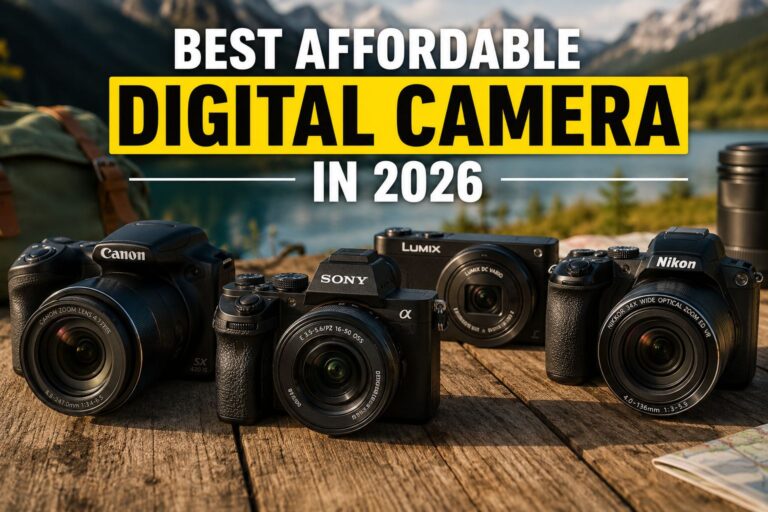
Amazing Best Affordable Digital Camera in 2026: Complete Buying Guide

Best Affordable Digital Camera in 2026

Quick Answer

The best affordable digital camera in 2026 balances image sensor quality, ease of use, and a price under $400 — without forcing you to sacrifice features that actually matter. For most buyers, a compact point-and-shoot or entry-level mirrorless camera in the $150–$350 range delivers excellent results for travel, family photos, and everyday shooting. The Canon PowerShot V10, Sony ZV-1 II, and Fujifilm X-T30 II (refurbished) consistently rank as top picks in this price bracket.

Key Takeaways

  • Budget sweet spot: $150–$350 covers the vast majority of quality, affordable digital cameras in 2026.
  • Sensor size matters more than megapixels — a 1-inch or APS-C sensor will outperform a 20MP phone-sized sensor in low light.
  • Point-and-shoot cameras suit casual photographers; entry-level mirrorless suits those who want to grow their skills.
  • Optical zoom is a major advantage over smartphones — look for at least 3x optical zoom.
  • Video capability is now standard; 4K at 30fps is achievable under $300.
  • Battery life varies widely — always check the rated shot count before buying.
  • Refurbished cameras from Canon, Sony, and Nikon official stores can cut costs by 20–40% with full warranties.
  • Accessories add up—budget an extra $30–$60 for a memory card, an extra battery, and a stable tripod.
  • Smartphones are NOT a replacement for optical zoom, manual controls, or dedicated sensor performance.
  • Image stabilization (optical or sensor-shift) is worth prioritizing if you shoot handheld or in motion.

What Makes a Digital Camera “Affordable” Without Being Cheap?

Affordable does not mean low quality. A camera qualifies as affordable when it delivers professional-adjacent results at a price that doesn’t require financing. In 2026, that threshold sits around $400 or below for a new unit and under $250 for a solid refurbished option.

Key factors that separate affordable-but-capable from just cheap:

  • Sensor size: 1/2.3-inch sensors (common in ultra-budget cameras) struggle in dim light. A 1-inch or larger sensor is the minimum worth recommending.
  • Lens quality: A slower kit lens with poor sharpness limits results regardless of sensor quality.
  • Build quality: Plastic bodies are fine; loose buttons, wobbly zoom rings, and flimsy doors are not.
  • Manufacturer support: Firmware updates, accessory availability, and repair networks matter for long-term value.

Decision rule: If a camera costs under $100 new from an unknown brand, treat it as a toy, not a tool. Stick to Canon, Sony, Nikon, Fujifilm, or Panasonic for reliability in the affordable segment.

Visit Amazon:https://amzn.to/4do9bq5

Who Should Buy the Best Affordable Digital Camera (and Who Shouldn’t)?

Buy an affordable digital camera if you are:

  • A parent who wants sharper, faster photos of kids than a phone provides
  • A traveler who needs optical zoom and better low-light performance
  • A content creator on a budget who wants dedicated video/photo hardware
  • A student learning photography basics before investing in a full system
  • Someone who wants a simple, dedicated device without phone distractions

Skip a dedicated camera if you:

  • Already own a flagship smartphone like the Apple iPhone 17 Pro Max or Google Pixel 10 Pro XL—their computational photography closes the gap significantly for casual use
  • Rarely print photos larger than 5×7 inches
  • Need a device that fits in a front pocket with no compromise

Best Affordable Digital Camera Options by Category in 2026

Best Affordable Digital Camera 2026

The right camera depends on your use case. Here’s a breakdown of the top picks by category:

Best Compact Point-and-Shoot Under $300

Camera Price (est.) Sensor Zoom Video
Canon PowerShot V10 ~$280 1-inch Fixed 4K/30fps
Sony ZV-1 II ~$299 1-inch 2.7x optical 4K/30fps
Ricoh GR IIIx (refurb) ~$350 APS-C Fixed 1080p

The Canon PowerShot V10 is a strong pick for vloggers and casual shooters—its built-in stand, wide-angle lens, and clean 4K video make it genuinely useful for content creation. The 1-inch sensor handles indoor and outdoor light well.

The Sony ZV-1 II adds optical zoom and Sony’s excellent autofocus, making it the better all-rounder for mixed photography and video.

Best Entry-Level Mirrorless Under $500 (Refurbished)

Camera Price (est.) Sensor Lens Mount Standout Feature
Fujifilm X-T30 II (refurb) ~$450 APS-C X-mount Film simulations
Canon EOS M50 Mark II (refurb) ~$380 APS-C EF-M Flip screen, DPAF
Sony A6100 (refurb) ~$420 APS-C E-mount Best-in-class AF

For anyone serious about learning photography, a refurbished APS-C mirrorless camera offers a significant jump in image quality and creative control. The Sony A6100, in particular, has tracking autofocus that rivals cameras costing three times as much.

What Specs Actually Matter When Choosing a Budget Digital Camera?

Most spec sheets are designed to confuse. Focus on these six factors when evaluating any budget digital camera:

  1. Sensor size — 1-inch minimum for quality results; APS-C for serious shooting
  2. Autofocus system—Phase-detect AF is faster and more reliable than contrast-detect AF
  3. Optical image stabilization (OIS) — Critical for handheld video and low-light stills
  4. Battery life — Look for 200+ shots per charge; carry a spare for day trips
  5. Storage format — SD card support is standard; confirm UHS-I or UHS-II compatibility
  6. Connectivity — Built-in Wi-Fi and Bluetooth simplify photo transfer to phone or laptop

Megapixels are overrated. A 20MP image from a small sensor will look worse in low light than a 12MP image from a 1-inch sensor. Don’t let megapixel counts drive your decision.

📷 Common mistake: Buyers often prioritize zoom range over sensor quality. A 30x zoom on a tiny sensor produces blurry, noisy images at full reach. A 3x optical zoom on a 1-inch sensor will almost always look better.

How Does the Best Affordable Digital Camera Compare to a Smartphone?

Smartphones have improved dramatically, but dedicated cameras still hold clear advantages in specific areas.

Feature Affordable Digital Camera Flagship Smartphone
Optical zoom 3x–10x true optical Digital/hybrid (degrades quality)
Low-light performance Superior (larger sensor) Good (computational, not optical)
Manual controls Full access Limited or app-dependent
Battery (dedicated) Replaceable Fixed, shared with all apps
Portability Moderate Excellent
Price $150–$400 $700–$1,200+
Video stabilization OIS hardware Excellent (software + hardware)

For more on what modern smartphones can do photographically, see the Samsung Galaxy S26 Ultra review—it illustrates exactly where the gap between phones and cameras has narrowed and where it hasn’t.

Bottom line: If you shoot mostly in good light and never print large, a flagship phone may be enough. If you need optical zoom, shoot in mixed light, or want manual control, a dedicated camera wins.

Where to Buy an Affordable Digital Camera in 2026: New vs. Refurbished

New cameras offer full warranties and the latest firmware. They’re the right choice when a model is brand new or when you need peace of mind.

Certified refurbished cameras from Canon, Sony, Nikon, and Fujifilm official stores are a better value for most buyers. These units are inspected, repaired to manufacturer standards, and typically carry a 90-day to 1-year warranty. Savings of 20–40% are common.

Best places to buy:

  • Manufacturer-refurbished stores (Canon USA, Sony Certified Refurbished, Nikon Refurbished)—highest confidence
  • B&H Photo and Adorama—reputable retailers with a wide selection and clear grading
  • Amazon Renewed — acceptable for well-reviewed sellers with return policies
  • eBay — higher risk; only buy from sellers with 98%+ feedback and clear return terms

Avoid: Unnamed third-party sellers on marketplaces without return policies. Gray market imports may lack local warranty support.

What accessories do you need with a budget digital camera?

The camera body is just the start. Budget an additional $40–$80 for essentials:

  • Memory card: A 64GB UHS-I SD card covers most needs; 128GB if shooting 4K video
  • Extra battery: Almost every affordable camera comes with one battery—buy a second
  • Camera bag or case: Protects the investment; soft cases start around $15
  • Tripod or mini tripod: Essential for low-light shots, video, and self-portraits—a phone-compatible tripod often works with compact cameras via a universal mount
  • Screen protector: Cheap insurance against scratches on LCD screens

For content creators pairing a camera with a smartphone workflow, a gimbal stabilizer can dramatically improve video quality when shooting handheld.

Top Mistakes to Avoid When Buying a Budget Digital Camera

  1. Buying based on megapixels alone
    Already covered above — sensor size and lens quality matter far more.
  2. Ignoring the lens ecosystem
    If you buy an interchangeable-lens camera, check whether affordable lenses exist for that mount. Some systems have very limited budget lens options.
  3. Forgetting about video autofocus
    Still-photo autofocus and video autofocus are not the same. Test or research video AF performance separately if video is a priority.
  4. Skipping the return window
    Always buy from a seller with a clear return policy. Cameras can have unit-specific defects (hot pixels, sticky aperture blades) that only show up after use.
  5. Underestimating the learning curve
    A mirrorless camera with manual controls is more powerful than a point-and-shoot, but it requires time to learn. If you want immediate results, start with a point-and-shoot.

Frequently Asked Questions

Q: What is the best affordable digital camera for beginners in 2026?
The Sony ZV-1 II or Canon PowerShot V10 are the top beginner picks under $300. Both offer automatic modes, good video quality, and 1-inch sensors that outperform most smartphones.

Q: Is a $200 camera worth buying in 2026?
Yes, if you choose carefully. At $200, the Canon PowerShot ELPH series and refurbished Sony Cyber-shot models offer solid image quality for casual photography. Avoid unknown brands at this price.

Q: How many megapixels do I need in a budget camera?
12–20MP is more than enough for prints up to 16×20 inches and all digital use. Prioritize sensor size over megapixel count.

Q: Can a cheap digital camera shoot good video?
Yes. Many cameras under $300 shoot 4K at 30fps. The Sony ZV-1 II and Canon V10 are strong examples. Check whether the camera can record for more than 30 minutes continuously if you plan longer shoots.

Q: Should I buy a point-and-shoot or a mirrorless camera on a budget?
Buy a point-and-shoot if you want simplicity and portability. Buy a refurbished entry-level mirrorless if you want to learn photography and grow into the system over time.

Q: Are refurbished cameras reliable?
Certified refurbished cameras from manufacturer stores are very reliable. They go through inspection and testing processes and typically include warranties. Third-party refurbished units carry more risk.

Q: What is the best affordable camera for travel photography?
The Sony ZV-1 II or a refurbished Sony A6100 with the 16-50mm kit lens. Both are compact, capable in mixed light, and have optical zoom.

Q: How long do budget digital cameras last?
With normal use, a quality camera from Canon, Sony, or Nikon should last 5–10 years. Shutter actuations (the mechanical count of photos taken) are the main wear factor on mirrorless and DSLR bodies.

Q: Do affordable cameras work well in low light?
Cameras with 1-inch or APS-C sensors perform noticeably better in low light than smartphone-sized sensors. Look for a maximum ISO of at least 3200 with acceptable noise levels.

Q: Is optical zoom important for a budget camera?
Yes, especially for travel and wildlife. Optical zoom maintains image quality at a distance; digital zoom does not. Aim for at least 3x optical zoom.

Conclusion: How to Choose the Right Affordable Digital Camera

Finding the best affordable digital camera in 2026 comes down to three honest questions: What will you photograph most? How much do you want to learn? And what’s your real budget, including accessories?

Actionable next steps:

  1. Set a firm budget including accessories—add $50 to whatever camera price you’re considering.
  2. Decide between point-and-shoot and mirrorless based on whether you want simplicity or creative growth.
  3. Prioritize sensor size (1-inch minimum) and autofocus quality over megapixels or zoom range.
  4. Check refurbished options from official manufacturer stores before buying new.
  5. Read return policies before purchasing, and test the camera thoroughly within the return window.
  6. Browse more camera guides and reviews at TechnoItem’s camera category for updated picks and comparisons.

The right camera is the one you’ll actually carry and use. A $280 compact that goes everywhere beats a $500 mirrorless that stays home because it’s too bulky. Start with your lifestyle, then match the gear to it.

References

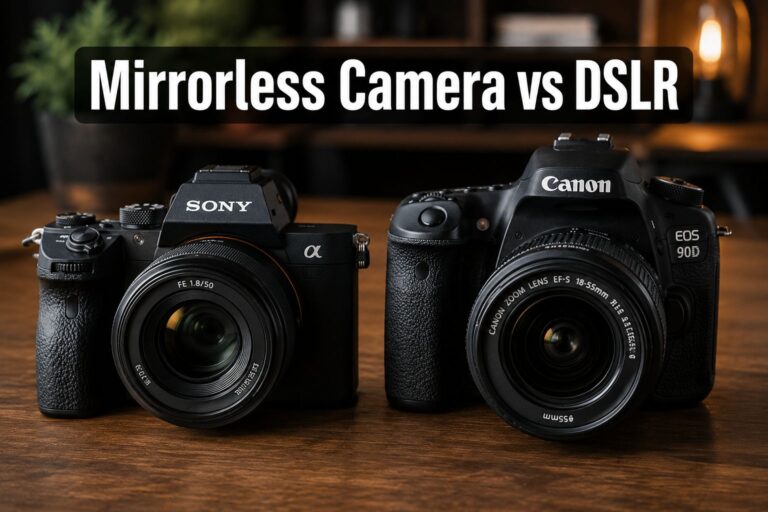
Mirrorless Camera vs DSLR: The Complete 2026 Buying Guide

Mirrorless Camera vs DSLR
  1. KQuick Answer

For most photographers buying a camera in 2026, a mirrorless camera is the better choice. Mirrorless systems offer faster autofocus, lighter bodies, and better video capabilities. DSLRs still hold value for photographers who already own lenses, need longer battery life, or are working with a tight budget on used gear. (Mirrorless Camera vs DSLR)

Key Takeaways

  • Mirrorless cameras are lighter, faster, and better for video than DSLRs in most categories.
  • DSLRs offer longer battery life, a larger used-lens ecosystem, and lower entry prices on the used market.
  • Autofocus speed and accuracy favor mirrorless systems, especially for sports and wildlife photography.
  • Mirrorless cameras use an electronic viewfinder (EVF); DSLRs use an optical viewfinder (OVF)—each has real trade-offs.
  • Most major manufacturers (Canon, Nikon, Sony) have shifted primary R&D investment to mirrorless lines as of 2026.
  • Existing DSLR lens owners can often use adapters to mount their glass on mirrorless bodies.
  • For beginners, a mid-range mirrorless camera offers more room to grow than an equivalent DSLR.
  • Battery life is still a genuine weakness for mirrorless cameras, though newer models have improved significantly.

What is the core difference between mirrorless cameras and DSLRs?

Mirrorless Camera vs DSLR

A DSLR (Digital Single-Lens Reflex) uses a physical mirror inside the camera body to reflect light up through an optical viewfinder. When you press the shutter, the mirror flips up, and light hits the sensor. A mirrorless camera removes that mirror entirely — light goes straight to the sensor at all times, and the viewfinder is an electronic display showing a live feed from the sensor.

This single mechanical difference drives most of the trade-offs between the two systems:

  • No mirror = smaller, lighter body (mirrorless)
  • No mirror = no optical viewfinder (mirrorless uses EVF or rear screen)
  • Mirror mechanism = more moving parts, more wear (DSLR)
  • Live sensor feed = better real-time exposure preview (mirrorless)

“The mirror is both the DSLR’s greatest strength and its greatest limitation—it delivers an optically pure view of the world, but it also adds weight, complexity, and mechanical constraints that mirrorless systems simply don’t have.”

Visit Amazon: 

Mirrorless Camera: https://amzn.to/4tS4hGA

Dslr Camera: https://amzn.to/3Q1hjnk

How Does Image Quality Compare: Mirrorless Camera vs DSLR?

At equivalent sensor sizes and price points, image quality between mirrorless and DSLR cameras is effectively identical. Both systems use the same sensor technologies—full-frame, APS-C, or Micro Four Thirds—and the sensor primarily determines image quality, not the presence or absence of a mirror.

Where mirrorless pulls ahead on image quality:

  • Real-time exposure preview in the EVF means fewer blown highlights or crushed shadows in tricky lighting.
  • On-sensor phase-detect autofocus on mirrorless cameras is more precise for critical focus in portraits and macro work.
  • In-body image stabilization (IBIS) is more common and more advanced in mirrorless systems, reducing motion blur in low light.

Where DSLRs hold their own:

  • Optical viewfinders show the scene with zero lag and no digital noise, which some photographers prefer for composition.
  • Proven, mature sensor technology in flagship DSLRs like the Nikon D850 still produces exceptional results.

Bottom line: Don’t choose between these systems based on image quality alone. The differences are minimal at the sensor level.

Which Has Better Autofocus: Mirrorless or DSLR?

Mirrorless cameras have a clear autofocus advantage in 2026. Because mirrorless systems use on-sensor phase-detect autofocus (PDAF) covering most or all of the frame, they track subjects faster and more accurately than the separate AF modules used in DSLRs.

Key autofocus advantages of mirrorless:

  • Eye, face, and subject tracking are standard on most mid-range and flagship mirrorless bodies (Sony, Canon, Nikon).
  • AF coverage often spans 90–100% of the frame vs. the center-weighted AF zones on most DSLRs.
  • Continuous tracking for sports and wildlife is significantly more reliable on current mirrorless systems.

DSLRs use a dedicated phase-detect AF module that only activates in optical viewfinder mode. In live view (using the rear screen), DSLR autofocus slows dramatically because it switches to contrast-detect AF, a known weakness.

Choose mirrorless if autofocus speed and subject tracking matter for your work (sports, wildlife, events, video).

Choose a DSLR if you shoot primarily static subjects (landscapes, studio portraits) where AF speed is less critical.

Size, Weight, and Portability: Which Wins?

Mirrorless cameras win on size and weight, but the gap is smaller than many people expect once lenses are attached.

Feature Mirrorless DSLR
Body weight (typical full-frame) 450–650g 700–900g
Body depth Shallower (no mirror box) Deeper
Lens size Often larger (new optical designs) Mature, compact primes available
Travel friendliness Better Bulkier
Grip ergonomics Varies; some feel small Generally excellent

The mirrorless body is lighter, but native mirrorless lenses — especially fast primes and telephoto zooms — are sometimes larger than their DSLR equivalents because lens designers are compensating for the shorter flange distance with more complex optical formulas.

For travel photographers or street shooters, mirrorless is the clear winner. For studio or landscape photographers who always use a tripod, the weight difference matters less. If you’re looking for stable support regardless of camera type, a stable and portable tripod can make a real difference in your shooting setup.

Battery Life: A Real Weakness of Mirrorless Cameras

best budget digital cameras

DSLRs last significantly longer per charge than most mirrorless cameras. The optical viewfinder in a DSLR uses no power — the sensor only activates when you shoot. Mirrorless cameras power the sensor and EVF continuously.

Typical battery performance (CIPA ratings, approximate):

  • Entry-level DSLR: 600–1,000 shots per charge
  • Mid-range DSLR: 800–1,500 shots per charge
  • Mirrorless (APS-C): 300–500 shots per charge
  • Mirrorless (full-frame, newer models): 350–600 shots per charge

Note: CIPA ratings are standardized lab estimates. Real-world performance varies based on EVF use, image review, and wireless features.

Practical workarounds for mirrorless battery life:

  1. Carry 2–3 spare batteries (they’re relatively inexpensive).
  2. Use a battery grip for extended shoots.
  3. Enable power-saving modes and reduce EVF brightness.
  4. Turn off Wi-Fi and Bluetooth when not needed.

For professional event photographers shooting all-day jobs, battery management is a real workflow consideration with mirrorless systems.

Video Capabilities: Mirrorless Camera vs DSLR

Mirrorless Camera vs DSLR

Mirrorless cameras are substantially better for video. This is one of the clearest advantages in the mirrorless camera vs. DSLR debate.

Why mirrorless dominates video:

  • Continuous autofocus during video is fast and reliable (DSLR live-view AF is slow and often hunts).
  • 4K and higher resolutions are standard across mirrorless lines; many DSLRs cap at 1080p or offer limited 4K.
  • Log profiles and 10-bit color are more widely available on mirrorless bodies.
  • Compact form factor pairs better with gimbals and rigs. For smooth handheld video, a stabilizer like the DJI Osmo Mobile 8 works well alongside a mirrorless body.
  • Microphone and headphone jacks are standard on most mirrorless bodies.

DSLRs were never designed with video as a primary use case. While cameras like the Canon 5D Mark IV produce usable video, they can’t match what a Sony A7 IV or Canon R6 Mark II delivers out of the box.

Choose mirrorless if video is any part of your workflow—even occasional YouTube content or family videos.

Cost Comparison: Which Is More Affordable?

The answer depends on whether you’re buying new or used.

New camera market (2026):

  • Entry-level mirrorless (APS-C): $600–$900
  • Mid-range mirrorless (full-frame): $1,800–$2,800
  • Entry-level DSLR: $400–$700 (limited new releases)
  • Mid-range DSLR: $900–$1,500 (mostly older stock)

Used/refurbished market:

DSLRs offer excellent value used. A Nikon D750 or Canon 5D Mark III with a kit lens can be found for $500–$800 used, delivering full-frame image quality at a fraction of the mirrorless equivalent. For photographers on a strict budget who primarily shoot stills, the used DSLR market is genuinely compelling.

Lens ecosystem costs:

  • DSLR lenses (Canon EF, Nikon F mount) have decades of third-party support, meaning sharp, affordable primes are widely available.
  • Mirrorless native lenses are newer and often more expensive, though the gap is closing as third-party manufacturers like Sigma and Tamron expand their mirrorless lineups.

Who Should Buy a Mirrorless Camera in 2026?

Mirrorless is the right choice for most new buyers in 2026. Here’s a simple decision framework:

Buy mirrorless if you:

  • Are you buying your first interchangeable-lens camera?
  • Shoot video regularly or plan to.
  • Want the best autofocus for moving subjects.
  • Value a compact, travel-friendly system.
  • Plan to grow your lens collection over time.

Stick with a DSLR (or buy a used DSLR) if you:

  • Already own a large collection of DSLR lenses and aren’t ready to invest in adapters or new glass.
  • Need maximum battery life for long fieldwork without charging access.
  • You are on a very tight budget, and the used DSLR market fits your needs.
  • Strongly prefer an optical viewfinder for sports or fast-action shooting.

For photographers who also want to understand how smartphone cameras compare to dedicated cameras, our Camera category covers a wide range of imaging devices and reviews.

What About Smartphone Cameras vs. Mirrorless and DSLR?

best budget digital cameras

Modern smartphones have closed the gap significantly for casual photography, but dedicated cameras still lead in several areas. Phones like the Apple iPhone 18 Pro Max and Samsung Galaxy S26 Ultra produce impressive results in good light, but they can’t match the low-light performance, optical zoom range, or creative control of a dedicated mirrorless or DSLR system.

Where dedicated cameras still win:

  • Large sensor low-light performance (less noise at high ISO)
  • True optical zoom (not digital crop)
  • Interchangeable lenses for creative flexibility
  • RAW file quality and dynamic range
  • Shallow depth of field for portrait work

Smartphones are ideal for everyday moments and social media. For professional work, portraiture, wildlife, or any situation requiring creative lens control, a dedicated camera system remains the better tool.

FAQ: Mirrorless Camera vs DSLR

Q: Is mirrorless better than a DSLR for beginners?
Yes, for most beginners in 2026. Mirrorless cameras offer better autofocus, more intuitive live-view shooting, and a system with a longer future roadmap. The learning curve is similar.

Q: Can I use my DSLR lenses on a mirrorless camera?
Yes, with an adapter. Canon, Nikon, and Sony all make official adapters that allow DSLR lenses to work on their mirrorless bodies, usually with full autofocus and image stabilization support.

Q: Are DSLRs being discontinued?
Not immediately, but major manufacturers have shifted primary development to mirrorless. Nikon announced no new DSLR development in 2022. Canon and Nikon continue to support existing DSLR lines with firmware, but new model releases are rare.

Q: Which is better for wildlife photography?
Mirrorless, in most cases. Modern mirrorless systems (Sony A9 III, Canon R3, and Nikon Z9) offer blackout-free shooting, superior subject tracking, and faster burst rates than any current DSLR.

Q: Do mirrorless cameras overheat during video recording?
Some do, particularly older or entry-level models. Most current flagship mirrorless cameras have addressed overheating with improved heat management. Check specific model reviews before buying for heavy video use.

Q: Is a DSLR still worth buying in 2026?
Yes, specifically on the used market. A used full-frame DSLR with quality glass is a cost-effective way to get professional image quality. For new purchases, mirrorless offers better long-term value.

Q: Which system has more lens choices?
Currently, DSLR mounts (Canon EF and Nikon F) have more total lenses available due to decades of production. However, mirrorless mounts are growing rapidly, and adapters bridge the gap effectively.

Q: What is an electronic viewfinder (EVF) disadvantage?
EVFs can show slight lag (though modern EVFs are near-imperceptible), look grainy in very low light, and consume battery. Some photographers also find them less natural than an optical viewfinder for panning shots.

Q: Which is better for portrait photography?
Both work well. Mirrorless cameras with eye-tracking autofocus make portrait shooting faster and more reliable, but a DSLR with a quality 85mm or 50mm prime lens produces equally beautiful portrait images.

Q: How long will DSLR support last?
Manufacturers have committed to continued lens and firmware support for existing DSLR systems for the foreseeable future. Practically, DSLRs will remain usable and supported for at least another decade.

Conclusion: Which Camera System Should You Choose?

The mirrorless camera vs. DSLR debate has a clear winner for most buyers in 2026: mirrorless. The technology has matured, prices have become competitive, and the autofocus, video, and portability advantages are real and meaningful.

That said, DSLRs aren’t obsolete. They remain excellent tools, especially for photographers buying used, those who already own DSLR glass, or anyone who values optical viewfinders and extended battery life.

Actionable next steps:

  1. Define your primary use case—stills only, video, sports, or travel—before looking at specific models.
  2. Set a realistic budget, including at least one quality lens, not just the body.
  3. Visit a camera store and hold both types before buying — ergonomics matter more than spec sheets.
  4. Consider used gear if budget is a constraint; a used full-frame DSLR often outperforms a new entry-level mirrorless for pure image quality.
  5. Check the lens roadmap for any system you’re considering—investing in a mount with an active future matters for long-term value.

For more in-depth camera and tech reviews, explore the full Camera section at TechnoItem to compare specific models and find the right fit for your photography goals.

References

Best Camera for Beginners: The Complete Buying Guide (2026)

Best Camera for Beginners

Quick Answer

The best camera for beginners in 2026 is generally a mirrorless camera with an APS-C sensor, such as the Sony ZV-E10 II or Canon EOS R50—both offer excellent image quality, simple controls, and room to grow. Budget-conscious beginners can also start strong with a capable smartphone camera or a compact point-and-shoot. The right choice depends on your budget, shooting goals, and how much you want to learn.

Key Takeaways

  • 📷 Mirrorless cameras are the top recommendation for most beginners in 2026—lighter than DSLRs, with modern autofocus and good video.
  • 💰 Budget range: Entry-level beginner cameras typically cost between $400 and $900 for the body only.
  • 🎯 Sensor size matters: APS-C sensors hit the sweet spot between image quality and affordability for new photographers.
  • 📱 Smartphones are a valid starting point — especially flagship models — before investing in dedicated camera gear.
  • 🔍 Autofocus quality is one of the most important specs for beginners, since it reduces missed shots.
  • 🎥 Video shooters should prioritize cameras with 4K recording and good in-body or lens stabilization.
  • 🧳 Kit lenses (usually 15–45 mm or 18–55 mm) bundled with beginner cameras are genuinely useful starting points.
  • Avoid over-buying: A $2,000 professional body won’t make you a better photographer faster than a $500 beginner model.
  • 🔋 Battery life and ergonomics are often overlooked but matter a lot for day-to-day shooting comfort.
  • 📚 Learning resources matter as much as gear — pick a camera with a strong community and tutorial ecosystem.

What Makes a Camera Truly “Beginner-Friendly”?

A beginner-friendly camera combines ease of use with enough flexibility to grow your skills over time. It should have guided shooting modes, reliable autofocus, and a comfortable grip—without burying you in menus.

Key qualities to look for:

  • Auto and scene modes that produce good results out of the box
  • Clear, logical menu systems (Sony, Canon, and Fujifilm are generally praised here)
  • Touchscreen or tilting screen for easier framing
  • Built-in tutorials or help text on-screen
  • Lightweight body — heavy gear gets left at home
  • Wide lens compatibility for future upgrades

“The best camera is the one you’ll actually carry with you”—a principle repeated across photography communities for good reason.

Visit Amazon: https://amzn.to/4fpDNZw

What Are the Main Camera Types for Beginners?

best camera for beginners

Beginners have four realistic options: mirrorless, DSLR, compact/point-and-shoot, and smartphone. Each fits a different use case and budget.

Camera Type Best For Typical Price Range Pros Cons
Mirrorless (APS-C) Most beginners $450–$900 Compact, modern AF, good video Shorter battery life
DSLR Budget hunters, optical viewfinder fans $350–$700 Long battery, huge lens ecosystem Bulkier, older tech
Compact / Point-and-Shoot Travel, simplicity $200–$600 Pocketable, easy Limited manual control
Smartphone Total beginners, social media Already owned Always with you, AI-enhanced Small sensors limit low light

Choose a mirrorless camera if you want the best balance of image quality, size, and future-proofing.

Choose a DSLR if you’re on a tight budget and can find a used model or prefer an optical viewfinder.

Choose a compact if you want something pocketable for travel with better quality than a phone.

Choose a smartphone if you’re just starting and want to learn composition before spending money.

Best Camera for Beginners: Top Picks in 2026

These cameras consistently earn strong marks from photography educators and user communities for beginner use.

🥇 Sony ZV-E10 II — Best Overall Beginner Mirrorless

  • Sensor: 26MP APS-C
  • Video: 4K/60fps
  • Why beginners love it: Simple vlog-friendly design, excellent subject-tracking AF, compact body
  • Price (est.): Around $750 with kit lens
  • Best for: Vloggers, content creators, photography students

🥈 Canon EOS R50 — Best for Photo-First Beginners

  • Sensor: 24.2MP APS-C
  • Video: 4K (with crop)
  • Why beginners love it: Canon’s color science, beginner-friendly intuitive menus, and great RF-S lens lineup
  • Price (est.): Around $680 with kit lens
  • Best for: Portrait, family, and travel photography beginners

🥉 Fujifilm X-S20 — Best for Creative Learners

  • Sensor: 26.1MP APS-C X-Trans
  • Video: 6.2K open-gate, 4K/60fps
  • Why beginners love it: Film simulation modes make learning color grading fun, excellent build quality
  • Price (est.): Around $1,299 body only (slightly above entry-level but worth the stretch)
  • Best for: Beginners who want to grow fast and love a retro shooting experience

Budget Pick: Canon EOS Rebel SL3 (DSLR)

  • Sensor: 24.1MP APS-C
  • Why it works: It’s the Lightest DSLR Canon makes, and the guided mode walks beginners through every setting
  • Price (est.): Around $650 with kit lens (often found used for $350–$450)
  • Best for: Budget-conscious beginners who prefer a traditional camera feel

How Much Should a Beginner Spend on a Camera?

Most beginners get the best value in the $400–$800 range for a camera body plus kit lens. Spending more doesn’t accelerate learning — spending on courses and practice does.

A realistic beginner budget breakdown:

  • Camera body + kit lens: $450–$800
  • Extra battery: $25–$50
  • Memory card (UHS-I or UHS-II): $20–$50
  • Camera bag or strap: $30–$80
  • Editing software: Free (Lightroom mobile, Snapseed) to $10/month

Total realistic starter kit: $525–$980

One often-overlooked accessory: a stable tripod. If you plan to shoot landscapes, portraits, or video, a stable and portable tripod makes a meaningful difference even for beginners.

Common mistake: Buying a body-only camera without budgeting for a lens. Always factor in the full kit cost.

Best Camera for Beginners: Mirrorless vs. DSLR — Which Wins in 2026?

For most beginners starting in 2026, mirrorless cameras are the better choice. DSLRs are mature technology with shrinking manufacturer support, while mirrorless systems are where all major brands are investing.

Mirrorless advantages for beginners:

  • Faster, more accurate autofocus (especially face and eye tracking)
  • Lighter and more compact bodies
  • Better video capabilities at the same price point
  • The electronic viewfinder shows exposure preview before you shoot

DSLR advantages that still matter:

  • Longer battery life per charge (often 500–900 shots vs. 300–400 for mirrorless)
  • Lower used prices—a used Canon Rebel T8i or Nikon D3500 can be found for under $400
  • Optical viewfinder preferred by some photographers

Bottom line: If buying new, go mirrorless. If on a tight budget and buying used, a DSLR is still a solid learning tool.

Does Sensor Size Matter for Beginner Photographers?

Yes, but not as much as marketing suggests. For beginners, an APS-C sensor is the practical sweet spot — it produces noticeably better low-light photos than a smartphone and is far more affordable than a full-frame sensor.

Sensor size comparison:

  • Full-frame (35mm): Professional quality, expensive ($1,500+), heavier lenses
  • APS-C: Best beginner option — great image quality, affordable, wide lens selection
  • Micro Four Thirds (MFT): Compact system with good quality (Olympus/OM System, Panasonic)
  • 1-inch: Found in premium compacts like Sony RX100 series—good for travel

Choose APS-C if you want the best balance of image quality, cost, and lens availability as a beginner.

Can a smartphone replace a beginner camera in 2026?

For casual photography and social media content, yes — modern flagship smartphones are genuinely capable. For learning photography fundamentals or producing print-quality images, a dedicated camera still has clear advantages.

Smartphones like the Apple iPhone 17 Pro Max and Google Pixel 10 Pro XL produce stunning photos with computational photography. However, they have physical limits:

  • Smaller sensors struggle more in low light without AI processing
  • Limited optical zoom range compared to interchangeable lenses
  • Less manual control for learning aperture, shutter speed, and ISO

Use a smartphone if you’re just discovering photography and not ready to invest in gear yet. Transition to a dedicated camera when you find yourself frustrated by the phone’s limitations—that’s the signal you’re ready.

For content creators who shoot video on the go, pairing a smartphone with a DJI Osmo Mobile 8 gimbal is a practical alternative to buying a dedicated camera.

What Accessories Does a Beginner Photographer Actually Need?

Keep it simple at first. The gear that genuinely helps beginners:

Essential:

  • Extra battery (one is never enough)
  • Fast memory card (64GB–128GB, UHS-I minimum)
  • Microfiber cleaning cloth
  • Camera strap (the included one is usually fine)

Useful but not urgent:

  • Tripod (critical for video, landscapes, and low-light shots)
  • 50mm prime lens (often called the “nifty fifty” — cheap and teaches composition)
  • Camera bag or backpack

Skip for now:

  • External flash (learn natural light first)
  • Filters (useful later, not essential at the start)
  • Multiple lenses (the kit lens covers 90% of beginner needs)

For those who also shoot with a smartphone, explore the full range of camera accessories and gear to find options that complement your setup.

How Do You Learn Photography Faster as a Beginner?

Gear is secondary to practice and deliberate learning. The fastest path to improvement:

  1. Shoot in aperture priority (Av/A) mode first—learn how aperture affects depth of field before going full manual.
  2. Review your shots critically — ask why a photo didn’t work, not just whether you like it.
  3. Limit yourself to one lens for the first 3 months — constraints force creativity.
  4. Follow a structured online course — YouTube channels like Tony Northrup, Peter McKinnon, and Mango Street are free and excellent.
  5. Join a community — Reddit’s r/photography and r/photoclass are active and beginner-friendly.
  6. Edit your photos — post-processing is half the craft; start with free tools like Lightroom Mobile.

FAQ: Best Camera for Beginners

Q: What is the single best camera for an absolute beginner in 2026?
The Sony ZV-E10 II is the top pick for most beginners in 2026 — it’s compact, shoots excellent 4K video, has reliable autofocus, and is priced around $750 with a kit lens.

Q: Is a mirrorless or DSLR better for beginners?
Mirrorless is better for beginners buying new gear in 2026. DSLRs are still viable if bought used on a budget, but mirrorless cameras offer better autofocus, video, and future lens support.

Q: How much should a beginner spend on their first camera?
A budget of $500–$800 for a camera body plus kit lens is the practical sweet spot. Spending more won’t accelerate skill development.

Q: Can I learn photography with a smartphone first?
Yes. A flagship smartphone is a legitimate learning tool for composition and light. Upgrade to a dedicated camera when you consistently feel limited by the phone’s capabilities.

Q: What is the best beginner camera for video?
The Sony ZV-E10 II leads for video beginners due to its 4K/60fps output, subject-tracking AF, and vlog-friendly design. The Fujifilm X-S20 is the premium alternative.

Q: Do I need a full-frame camera as a beginner?
No. Full-frame cameras are heavier, more expensive, and require pricier lenses. An APS-C mirrorless camera will produce excellent results for years before you outgrow it.

Q: What lens should a beginner use first?
The kit lens (typically 15–45mm or 18–55mm) that comes bundled with the camera is the right starting point. A 50mm f/1.8 prime lens (around $100–$200) is the best first upgrade.

Q: Is the Canon EOS R50 good for beginners?
Yes. The Canon EOS R50 is one of the most beginner-friendly mirrorless cameras available, with intuitive menus, reliable autofocus, and excellent still image quality.

Q: What’s the best budget beginner camera under $500?
A used Canon EOS Rebel SL3 or Nikon D3500 can be found for under $400–$450 and is an excellent learning tool. For new purchases, the Sony ZV-E10 (original) occasionally dips below $500.

Q: Should a beginner buy a camera kit or body only?
Always buy a kit (body + lens) as a beginner. Kit lenses are genuinely useful and cost far less when bundled than when purchased separately.

Q: How important is megapixel count for beginners?
Not very important at the beginner stage. Any camera with 20+ megapixels produces more than enough detail for social media, prints, and learning. Focus on autofocus quality and usability instead.

Q: What camera brand is best for beginners?
Sony, Canon, and Fujifilm all make excellent beginner cameras in 2026. Canon is often recommended for its intuitive menus, Sony for its autofocus technology, and Fujifilm for its creative film simulations and build quality.

Conclusion: Your Next Steps

Finding the best camera for beginners comes down to three honest questions: How much do you want to spend? What will you shoot most (photos, videos, or travel)? And how seriously do you want to pursue photography long-term?

For most people reading this in 2026, the Sony ZV-E10 II or Canon EOS R50 are the clearest starting points—both are well-supported, genuinely capable, and won’t feel limiting for at least two to three years of active learning.

Actionable next steps:

  1. Set your budget before browsing—include a lens, a memory card, and a spare battery.
  2. Visit a camera store if possible to hold the body before buying—ergonomics matter.
  3. Buy the kit lens bundle rather than the body-only for your first camera.
  4. Start shooting the day it arrives — don’t wait to “learn more” first.
  5. Pick one free online course and work through it in your first month.
  6. Pair your camera with a stabilizer if video is a priority—check out the DJI Osmo Mobile 8 as a compact option.

The best camera for beginners is the one that gets you shooting, learning, and improving — not the one with the most impressive spec sheet.

References

  • Sony Official Product Page, ZV-E10 II Specifications—sony.com (2024)
  • Canon Official Product Page, EOS R50 Specifications—canon.com (2023)
  • Fujifilm Official Product Page, X-S20 Specifications — fujifilm.com (2023)
  • DPReview Camera Buying Guide for Beginners—dpreview.com (2024)
  • Photography Life, “Best Cameras for Beginners” — photographylife.com (2024)