
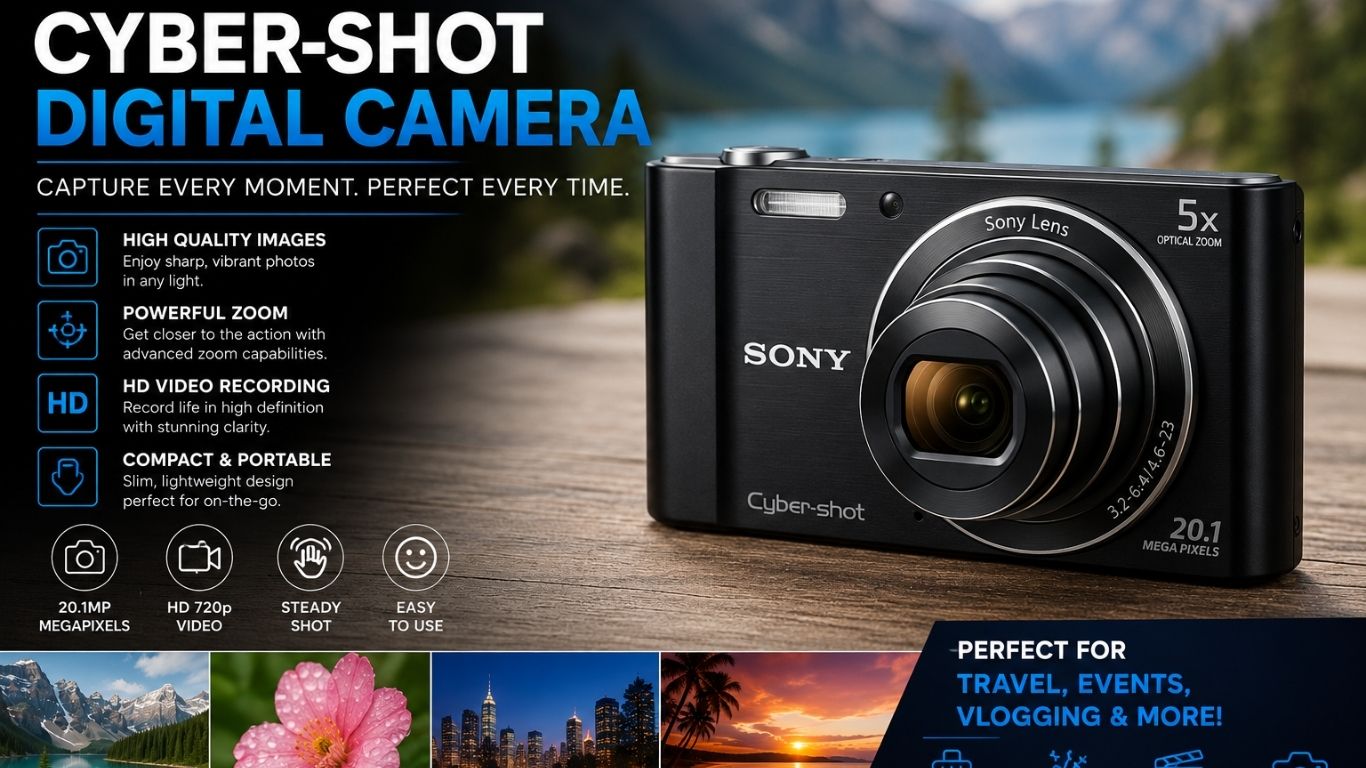
Quick Answer
The Sony Cyber-shot digital camera line is one of the longest-running and most trusted compact camera families in consumer electronics. Sony’s Cyber-shot cameras range from affordable point-and-shoot models to advanced 1-inch sensor compacts, making them suitable for casual photographers and serious enthusiasts alike. Choosing the right model depends on your sensor size preference, zoom range, and budget.
Key Takeaways
- Sony launched the Cyber-shot brand in 1996, and it remains one of the most recognized names in digital compact cameras.
- Cyber-shot cameras span several sub-series: RX, WX, HX, and DSC lines, each targeting different shooting needs.
- The RX100 series (with a 1-inch sensor) is widely regarded as the best compact camera line for image quality in a pocket-sized body.
- Most Cyber-shot models include built-in Wi-Fi or Bluetooth for easy image transfer to smartphones.
- Optical zoom range varies widely: from 3x on premium compacts to 30x+ on bridge-style models.
- Sony’s BIONZ image processors deliver fast autofocus and low-light performance across the lineup.
- Cyber-shot cameras are generally not interchangeable-lens systems — buyers who want lens flexibility should consider Sony’s Alpha (α) mirrorless lineup instead.
- Street prices in 2026 range from roughly $150 for entry-level models to $1,300+ for the RX100 VII.
- Accessories like a stable tripod for your camera can significantly improve your Cyber-shot results, especially in low light.
- Cyber-shot cameras pair well with Sony’s Imaging Edge mobile app for wireless shooting and editing.
What Is the Sony Cyber-shot Digital Camera?
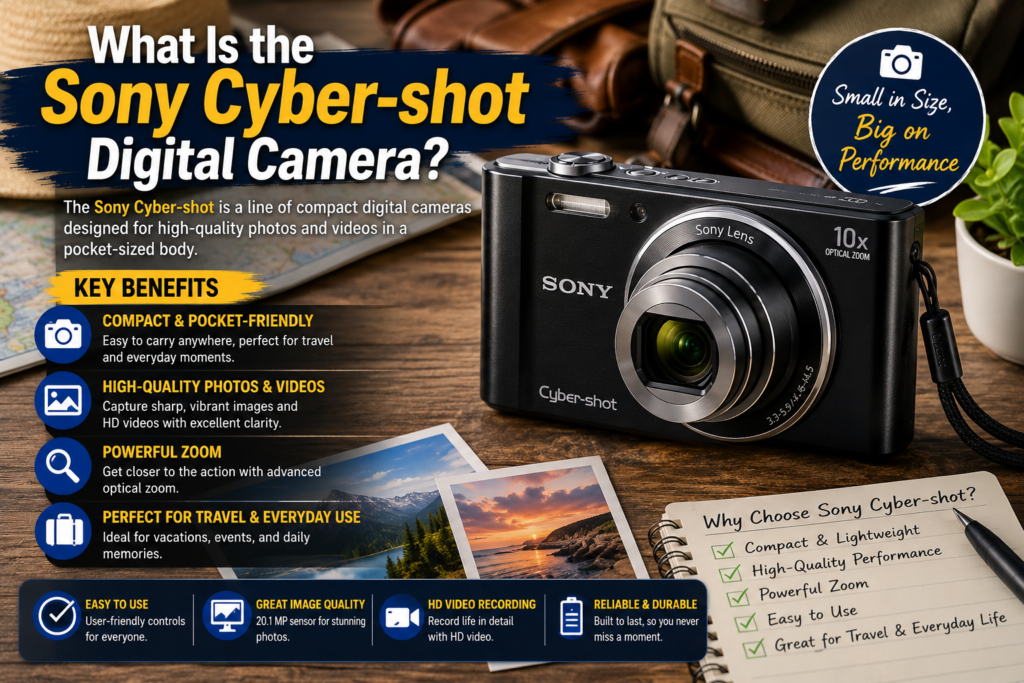
Sony’s Cyber-shot is a line of digital compact cameras first introduced in 1996. The name “Cyber-shot” covers a broad family of fixed-lens digital cameras designed for consumers who want better image quality than a smartphone but don’t want to carry interchangeable lenses.
The Cyber-shot lineup sits between smartphone cameras and Sony’s professional Alpha mirrorless system. It’s the right choice for travelers, vloggers, and everyday photographers who prioritize portability without sacrificing image quality.
Visit Amazon: https://amzn.to/4tufCwg
How Does the Sony Cyber-Shot Digital Camera Line Break Down?
Sony organizes its Cyber-shot range into distinct sub-series. Each targets a different type of photographer.
| Sub-Series | Sensor Size | Best For | Typical Zoom |
| RX100 series | 1-inch | Enthusiasts, travel, vlogging | 24–200mm equiv. |
| RX10 series | 1-inch | Wildlife, events, versatility | 24–600mm equiv. |
| HX series | 1/2.3-inch | Superzoom, travel | Up to 30x optical |
| WX series | 1/2.3-inch | Casual, family photos | 10x–30x optical |
| DSC-W/B series | 1/2.3-inch | Budget, beginners | 3x–5x optical |
Choose the RX100 series if you want the best image quality in a pocketable body and are willing to pay a premium.
Choose the HX or WX series if you need a long zoom range and keep costs under $300.
Choose the RX10 series if you want a 1-inch sensor with a superzoom range for sports or wildlife.
“The RX100 line essentially redefined what a compact camera could do—1-inch sensor, fast lens, pocketable form factor.” —A widely held view among camera reviewers since the RX100’s 2012 launch.
What Are the Best Sony Cyber-Shot Models in 2026?
The best model depends on your use case. Here are the standout options currently available.
Sony RX100 VII
- Sensor: 1-inch, 20.1 MP
- Lens: 24–200mm f/2.8–4.5 ZEISS
- Autofocus: Real-time Eye AF, 357-point phase-detection
- Video: 4K, 120fps slow-motion at 1080p
- Best for: Vloggers, travel photographers, anyone who wants near-mirrorless performance in a shirt pocket
- Street price (2026 estimate): ~$1,100–$1,300
Sony RX100 V / VA
- Same 1-inch sensor, slightly older AF system
- More affordable than the VII at roughly $700–$850
- Still shoots 4K and has 24fps burst shooting
- A strong pick if the VII’s price is out of range
Sony HX99
- 18.2 MP, 1/2.3-inch sensor
- 24–720mm equivalent optical zoom (30x)
- Compact enough for a jacket pocket
- Best for travelers who prioritize zoom range over low-light quality
- Street price: ~$350–$450
Sony DSC-W800
- Entry-level, 20.1 MP, 5x optical zoom
- No Wi-Fi, no 4K — purely a budget point-and-shoot
- Ideal for seniors or children learning photography
- Street price: ~$80–$130
How Does the Sony Cyber-Shot Compare to Smartphone Cameras?
Smartphone cameras have improved dramatically, but the digital Cyber-shot Sony camera lineup still holds clear advantages in specific areas.
Where Cyber-shot wins:
- Optical zoom: Even the HX99’s 30x optical zoom beats any smartphone’s digital or hybrid zoom for true detail at a distance.
- Low-light performance (RX series): The 1-inch sensor captures significantly more light than a smartphone’s tiny sensor.
- Dedicated controls: Physical dials and buttons give faster access to settings during shooting.
- Battery life: Most Cyber-shot models last 200–400 shots per charge, comparable to many smartphones.
Where smartphones win:
- Computational photography (HDR, AI scene detection)
- Connectivity (instant sharing, cloud backup)
- Convenience (always in your pocket)
For a direct comparison of modern smartphone camera quality, see the Google Pixel 10 Pro XL review and the Apple iPhone 17 Pro Max review—both represent what flagship phones can do in 2026.
Bottom line: If you already own a flagship smartphone and mostly share photos online, a budget Cyber-shot adds little. But if you shoot in low light, need real optical zoom, or want manual controls, a mid-range or premium Cyber-shot is still worth the investment.
What key features should you look for in a Sony Cyber-shot digital camera?
Not every Cyber-shot feature matters equally. Focus on these when comparing models.
Sensor Size (Most Important)
Larger sensors capture more light and produce less noise in dim conditions. The 1-inch sensors in the RX series are significantly better than the 1/2.3-inch sensors in the HX and WX lines. If image quality is your top priority, don’t compromise on sensor size.
Autofocus System
Newer Cyber-shot models use Sony’s Fast Hybrid AF, which combines phase-detection and contrast-detection points. The RX100 VII adds real-time tracking and Eye AF, making it far superior for portraits and moving subjects compared to older or budget models.
Video Capabilities
- 4K video: Available on RX100 V and above, and the RX10 IV
- 1080p 120fps slow motion: RX100 VII and RX10 IV
- Basic 1080p: Most HX and WX models
Vloggers should also look for a flip-up selfie screen — the RX100 VII has one; the HX99 does not.
Connectivity
Wi-Fi and Bluetooth allow wireless image transfer via Sony’s Imaging Edge Mobile app. This feature is standard on most models released after 2018 but absent on budget DSC-W-series cameras.
Zoom Range vs. Aperture Trade-off
A wider maximum aperture (f/1.8 vs. f/3.5) lets in more light but usually means a shorter zoom range. The RX100 VII starts at f/2.8 and reaches 200 mm—a reasonable balance. The HX99 reaches 720mm but starts at f/3.5, which limits low-light performance.
How Does the Sony Cyber-shot Fit Against Other Camera Brands?
The digital Cyber-shot Sony camera lineup competes primarily with the Canon PowerShot, Panasonic Lumix, and Ricoh GR series cameras in the compact market.
| Brand/Model | Sensor | Key Strength | Weakness |
| Sony RX100 VII | 1-inch | AF speed, video, portability | Price |
| Canon G7X Mark III | 1-inch | Vlogging, live streaming | Fewer AF points |
| Panasonic LX100 II | 4/3-inch | Larger sensor, manual controls | Bulkier |
| Ricoh GR IIIx | APS-C | Image quality, street photography | Fixed lens, no zoom |
Sony’s main advantage is its autofocus technology, which leads the compact camera category. Canon’s G7X III is the closest competitor for vloggers.
For broader camera and electronics coverage, the TechnoItem camera category has reviews and comparisons across multiple brands and form factors.
What accessories work best with Sony Cyber-shot cameras?
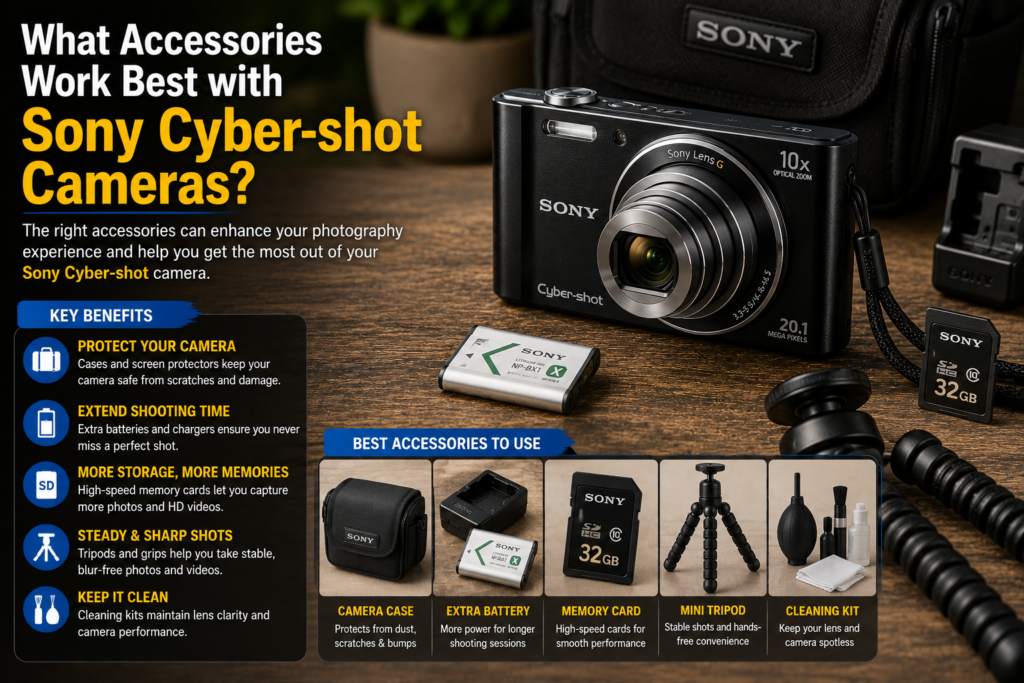
A few well-chosen accessories extend what a Cyber-shot can do.
- Tripod: Essential for low-light shots, time-lapses, and self-portraits. A portable tripod designed for cameras works well with compact Cyber-shot bodies.
- Extra batteries: Most Cyber-shot batteries last 200–300 shots. Carry a spare for full-day shoots.
- UV/ND filters: Some RX models accept 49mm filters via an adapter ring — useful for video and long-exposure photography.
- Waterproof housing: Sony and third-party brands offer underwater cases for select Cyber-shot models, extending shooting to snorkeling and water sports.
- Gimbal stabilizer: For smooth video, a compact gimbal pairs well with the RX100 series. The DJI Osmo Mobile 8 is a popular option, though it’s designed for smartphones—check compatibility before purchasing.
Common Mistakes When Buying a Sony Cyber-Shot Digital Camera
Mistake 1: Choosing zoom range over sensor size.
A 30x zoom sounds impressive, but photos from a 1/2.3-inch sensor at full zoom are often soft and noisy. For most buyers, a 1-inch sensor with a 24–200 mm lens is more useful than a tiny sensor with a 30x zoom.
Mistake 2: Ignoring the lens aperture.
A lens that opens to f/1.8 or f/2.8 makes a real difference indoors and at night. Budget models often start at f/3.5 or slower, which limits their usefulness in dim conditions.
Mistake 3: Buying an older RX100 generation without checking the price gap.
The RX100 III and IV are still sold new or refurbished, but the price difference between them and the V or VA is often small enough that the newer model is the better value.
Mistake 4: Expecting interchangeable lenses.
Cyber-shot cameras have fixed lenses. Buyers who want to swap lenses should look at Sony’s Alpha mirrorless system (a6000 series or ZV-E series) instead.
FAQ: Sony Cyber-Shot Digital Camera
Q: Is the Sony Cyber-shot good for beginners?
Yes. Models like the HX99 and WX series are straightforward to use, with automatic scene modes that handle most situations. The RX100 series also works in full auto but adds manual controls for when you’re ready to learn.
Q: Does the Sony Cyber-shot shoot RAW files?
The RX100 and RX10 series support RAW (ARW format). Budget HX and WX models typically shoot JPEG only.
Q: Can I use a Sony Cyber-shot for vlogging?
The RX100 VII is one of the most recommended compact cameras for vlogging in 2026, thanks to its flip screen, 4K video, real-time eye AF, and built-in ND filter. The Canon G7X III is its main competitor.
Q: How long does a Sony Cyber-shot battery last?
Battery life varies by model. The RX100 VII is rated for approximately 260 shots per charge (CIPA standard). The HX99 is rated for around 310 shots. Actual life depends on Wi-Fi use, screen brightness, and video recording.
Q: Is the Sony Cyber-shot waterproof?
Most Cyber-shot models are not waterproof. Sony’s DSC-RX0 II is splashproof (IP68), and some older WX series models had waterproof variants. Always check the specific model’s specs before taking it near water.
Q: What is the difference between the Sony Cyber-shot and the Sony Alpha?
Cyber-shot cameras have fixed, non-removable lenses. Sony Alpha cameras (mirrorless and DSLR) accept interchangeable lenses. Alpha cameras generally offer larger sensors and more advanced controls at higher prices.
Q: Does Sony still make new Cyber-shot cameras?
Sony has slowed new Cyber-shot releases in recent years, focusing more on its ZV series (ZV-1, ZV-E series) for content creators. However, existing Cyber-shot models remain in production and are widely available in 2026.
Q: What app works with Sony Cyber-shot cameras?
Sony’s Imaging Edge Mobile app (available for iOS and Android) handles wireless image transfer, remote shooting, and location tagging for compatible Cyber-shot models.
Q: How does Cyber-shot compare to the Samsung Galaxy S24 Ultra camera?
For social media sharing and computational photography, the Samsung Galaxy S24 Ultra is extremely capable. But for optical zoom accuracy and low-light depth-of-field control, a dedicated Cyber-shot RX100 still has technical advantages.
Q: What memory card does a Sony Cyber-shot use?
Most Cyber-shot models use SD/SDHC/SDXC cards. Some older models use Sony’s proprietary Memory Stick Micro (M2). Always check the specific model’s manual before buying a card.
Conclusion: Should You Buy a Sony Cyber-shot Digital Camera in 2026?
The Sony Cyber-shot digital camera lineup remains a solid choice for anyone who wants dedicated camera quality without the bulk of a mirrorless system. The RX100 VII is the clear pick for enthusiasts who want the best compact camera available — its 1-inch sensor, fast AF, and 4K video hold up well even against newer competition. Budget buyers who need a long zoom range will find the HX99 a practical option.
Actionable next steps:
- Define your primary use case — travel, vlogging, wildlife, or casual family photos — before comparing models.
- Prioritize sensor size over zoom range if image quality matters to you.
- Check current street prices on Sony’s official site and major retailers, as refurbished RX100 models often offer excellent value.
- Pick up a spare battery and a tripod before your first shoot — these two accessories solve the most common complaints about compact cameras.
- Download Imaging Edge Mobile to your phone before the camera arrives, so wireless transfer is ready from day one.
For more camera and electronics reviews, explore the full camera section at TechnoItem or check out the Sony WH-CH720N headphones review if you’re building out a broader Sony ecosystem.
References
- Sony Corporation. Cyber-shot Product History and Specifications. Sony.com. (Ongoing, accessed 2026)
- CIPA (Camera & Imaging Products Association). Digital Camera Battery Life Standards. CIPA.jp. 2023.
- DPReview. Sony RX100 VII Review. DPReview.com. 2019.
- DPReview. Sony HX99 Review. DPReview.com. 2018.
- Imaging Resource. Sony Cyber-shot RX100 VII Hands-On. ImagingResource.com. 2019.