Key Takeaways
- 📷 Flip screens are non-negotiable for solo vloggers — always check for a fully articulating display before buying.
- 🎙️ Audio quality matters as much as video — built-in mics are rarely enough; plan for an external mic from day one.
- 🔋 Battery life and overheating are the two most common complaints in real-world vlogging use — check user reviews carefully.
- 💡 Sensor size affects low-light performance — APS-C sensors offer the best balance of image quality and compact body size for most vloggers.
- 🎯 4K at 30fps is now the baseline — look for 4K/60fps if you plan to slow down footage or future-proof your content.
- 💰 Budget tiers matter — under $500, $500–$1,200, and $1,200+ each offer meaningfully different capabilities.
- 🤳 Smartphone cameras have closed the gap — for travel vloggers who prioritize portability, a phone like the Apple iPhone 18 Pro Max is a serious contender.
- 🎬 Stabilization type matters — in-body image stabilization (IBIS) beats electronic stabilization for quality; a gimbal adds another layer.
- ⚖️ Weight and form factor affect how often you actually use the camera — the best camera is the one you carry.
- 🔌 USB-C charging is now expected — avoid cameras that still rely on proprietary chargers.
What Makes a Camera the Best Vlogging Camera?
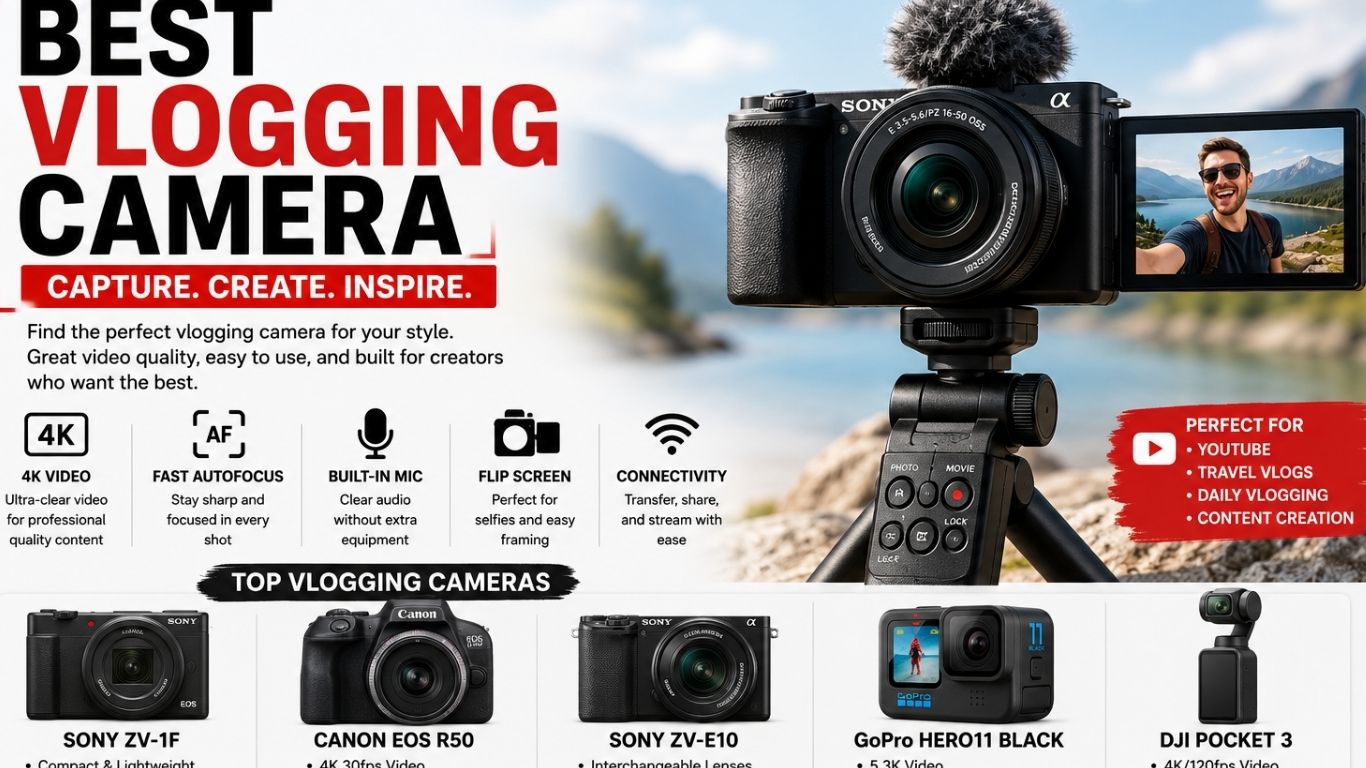
The best vlogging camera must solve three practical problems at once: capturing clean video in variable lighting, recording usable audio, and staying portable enough to use consistently.
Unlike filmmaking cameras built for controlled sets, a vlogging camera lives in the real world — in bags, on selfie sticks, and in front of faces in coffee shops. That context changes everything about what specs actually matter.
Core features every vlogging camera should have:
- Fully articulating or flip-out touchscreen — essential for framing yourself when shooting solo
- Fast, reliable autofocus — face and eye tracking saves footage that would otherwise be blurry and unusable
- 4K video recording — at minimum 4K/30fps; 4K/60fps is better for flexibility in editing
- Good low-light performance — most vlogging happens in imperfect lighting; a larger sensor helps significantly
- External microphone input — a 3.5mm jack or USB-C audio input opens up far better audio options
- Compact, lightweight body — anything over 700g with a lens becomes a burden on long shooting days
- USB-C charging — charge from a power bank while traveling; this is a practical necessity in 2026
Features that sound important but rarely matter for vloggers:
- RAW photo shooting (most vloggers shoot video only)
- Weather sealing (useful but rarely decisive)
- Dual card slots (overkill for solo content creators)
Best Vlogging Camera by Budget: Which Tier Is Right for You?
Choosing the best vlogging camera starts with being honest about budget, because the performance gap between tiers is real but not always worth the price difference for new creators.
Under $500: Best Entry-Level Vlogging Cameras
At this price, the options are compact cameras, older mirrorless bodies, and smartphones. The Sony ZV-1 II (compact, fixed lens) and Canon PowerShot V10 are purpose-built for vlogging at this price point. Both include flip screens, decent autofocus, and built-in ND filters or wind noise reduction.
Choose this tier if: You’re just starting, unsure about long-term commitment, or primarily shooting in good lighting conditions.
Common mistake: Buying a DSLR at this price. Older DSLRs lack flip screens and have poor video autofocus compared to modern mirrorless options.
Visit Amazon: https://amzn.to/4eMk5Hd
$500–$1,200: The Sweet Spot for Most Vloggers
This range includes the Sony ZV-E10 II, Canon EOS R50, and Fujifilm X-S20 — all APS-C mirrorless cameras with interchangeable lenses, excellent autofocus, and 4K video. This is where most serious vloggers land, and for good reason. The image quality jump from the sub-$500 tier is significant.
Choose this tier if: You’re committed to creating content regularly and want room to grow your lens collection.
$1,200 and Above: Advanced Vlogging Cameras
The Sony ZV-E1 (full-frame, designed specifically for video creators), Canon EOS R7, and Sony A7C II live here. Full-frame sensors deliver noticeably better low-light footage and a more cinematic look. These cameras also tend to have better heat management for long recording sessions.
Choose this tier if: You’re monetizing content, shooting in challenging environments, or need the absolute best image quality.
Mirrorless vs. Compact vs. Smartphone: Which Type Wins?
For most vloggers in 2026, a mirrorless camera is the best vlogging camera type — but that’s not true for everyone.
| Camera Type | Best For | Drawbacks |
| Mirrorless (APS-C) | Most vloggers; best balance of quality and size | Requires lens investment; learning curve |
| Mirrorless (Full-Frame) | Professional creators; low-light, heavy shooting | Expensive, larger, and heavier |
| Compact/Fixed Lens | Travel, simplicity, and budget-conscious creators | Limited upgrade path; smaller sensors |
| Action Camera (GoPro) | Adventure, sports, hands-free vlogging | Poor audio; limited zoom; small sensor |
| Smartphone | Ultra-portability; casual creators | Limited manual control; smaller sensor |
The smartphone case: Modern flagships like the Google Pixel 10 Pro XL or Samsung Galaxy S26 Ultra shoot genuinely impressive 4K video with computational stabilization. For travel vloggers who can’t carry extra gear, a flagship phone paired with a wireless microphone and a phone tripod can replace a dedicated camera entirely.
What Autofocus Features Actually Matter for Vlogging?
Autofocus quality is arguably the most important spec for solo vloggers, more than resolution or sensor size.
When shooting alone — walking, talking, moving — the camera must track your face and eyes without losing focus or hunting. The difference between good and bad autofocus is the difference between usable and unusable footage.
What to look for:
- Real-time face and eye tracking — Sony’s autofocus system (used in the ZV-E10 II and ZV-E1) is widely considered the benchmark; Canon’s Dual Pixel CMOS AF II is a close competitor
- Subject recognition — some cameras now recognize animals, vehicles, and even specific face profiles
- Tracking speed — test how quickly the camera reacquires focus after you step out of frame and return
Edge case: In very low light (below EV 0), even the best autofocus systems struggle. If you shoot in dark environments regularly, manual focus peaking becomes a useful fallback.
How Important Is Audio for a Vlogging Camera?
Audio quality can make or break a vlog more than video quality. Viewers tolerate imperfect visuals far longer than they tolerate bad audio.
Built-in microphones on most cameras — even good ones — pick up wind noise, camera handling sounds, and room echo. An external microphone is almost always worth the investment.
Audio setup options by budget:
- Budget: Rode VideoMicro II or DJI Mic Mini (clips directly to camera or clothing; under $80)
- Mid-range: Rode Wireless GO II (wireless lavalier system; around $300)
- Pro: Sennheiser MKE 400 (directional shotgun mic; excellent for outdoor use)
What to check on the camera itself:
- 3.5mm microphone input (standard; most mirrorless cameras have this)
- Headphone monitoring jack (lets you hear audio while recording — underrated feature)
- Wind noise reduction settings (useful for outdoor shooting)
For wireless microphone options, the Mini Mic Pro Wireless is a compact and affordable solution that works well with most cameras and smartphones.
Stabilization: IBIS, Electronic, or Gimbal?
Shaky footage kills viewer retention. Stabilization is a must-have for any vlogging camera used while walking or moving.
Three stabilization approaches:
- In-Body Image Stabilization (IBIS): Physical sensor movement compensates for camera shake. Delivers the best quality with no crop. Found in Sony ZV-E1, Canon EOS R7, Fujifilm X-S20.
- Electronic Image Stabilization (EIS): Crops the image and uses software to smooth footage. Works well, but reduces the field of view and can look artificial in fast movement.
- Gimbal: A motorized stabilizer that physically keeps the camera level. Adds bulk but delivers cinema-quality smooth footage. The DJI Osmo Mobile 8 is a popular option for smartphone vloggers.
Best approach for most vloggers: IBIS combined with a wide-angle lens. Add a gimbal only if you shoot a lot of walking footage or action sequences.
Top Vlogging Camera Picks for 2026 at a Glance
| Camera | Sensor | 4K | Flip Screen | IBIS | Price Range |
| Sony ZV-E10 II | APS-C | 4K/60fps | ✅ | ❌ | ~$750 |
| Canon EOS R50 | APS-C | 4K/30fps | ✅ | ❌ | ~$680 |
| Fujifilm X-S20 | APS-C | 4K/60fps | ✅ | ✅ | ~$1,299 |
| Sony ZV-E1 | Full-Frame | 4K/60fps | ✅ | ✅ | ~$2,200 |
| Canon EOS R7 | APS-C | 4K/60fps | ✅ | ✅ | ~$1,499 |
| Sony ZV-1 II | 1-inch | 4K/30fps | ✅ | ✅ | ~$750 |
Prices are approximate retail estimates as of mid-2026 and may vary by region and retailer.
Common Mistakes When Buying a Vlogging Camera
Even experienced buyers make avoidable errors. Here are the most common ones:
- Prioritizing megapixels over video specs. Megapixels are a photometric. For video, look at bitrate, color profiles, and rolling shutter performance instead.
- Ignoring the lens. A $700 camera body with a kit lens will often underperform a $500 body with a quality prime lens. Budget for glass.
- Forgetting about battery life. Most mirrorless cameras get 200–400 shots per charge. For long shooting days, buy at least two extra batteries and a dual charger.
- Skipping audio planning. Buying a great camera and using the built-in mic is one of the most common beginner mistakes.
- Buying too many cameras too soon. A $2,000 camera won’t make content better if the fundamentals — lighting, framing, audio — aren’t in place first.
For broader camera and tech gear reviews, the TechnoItem camera category covers a wide range of options across budgets.
FAQ: Best Vlogging Camera Questions Answered
Q: What is the best vlogging camera for beginners in 2026?
The Sony ZV-E10 II or Canon EOS R50 are the top beginner picks. Both offer flip screens, reliable face-tracking autofocus, 4K video, and interchangeable lenses at under $800.
Q: Can a smartphone replace a dedicated vlogging camera?
For casual creators and travel vloggers, yes. Flagships like the Apple iPhone 18 Pro Max or Samsung Galaxy S26 Ultra shoot excellent 4K video. A dedicated camera still wins on low-light performance, shallow depth of field, and external audio options.
Q: Do I need a full-frame camera for vlogging?
No. APS-C cameras handle the vast majority of vlogging scenarios well. Full-frame is worth considering only if you shoot heavily in low light or want a more cinematic look and have the budget.
Q: What lens should I use for vlogging?
A wide-angle prime lens (16mm–24mm equivalent) works best for solo vlogging at arm’s length. The Sony 15mm f/1.4 G and Sigma 16mm f/1.4 are popular choices for APS-C cameras.
Q: Is 4K really necessary for vlogging?
In 2026, yes — 4K is the standard upload resolution for YouTube and most platforms. It also gives you the flexibility to crop in editing without losing quality.
Q: How much should I spend on my first vlogging camera?
A realistic starting budget is $500–$800 for the body, plus $100–$200 for a lens and $50–$100 for a basic external microphone. Total: around $700–$1,100 for a solid beginner setup.
Q: What’s the best vlogging camera for travel?
The Sony ZV-1 II (compact, fixed lens, built-in ND filter) or a flagship smartphone with a gimbal like the DJI Osmo Mobile 8. Both prioritize portability without sacrificing too much quality.
Q: Does the camera need Wi-Fi or Bluetooth?
It’s a useful feature but not essential. Wi-Fi and Bluetooth allow wireless file transfer to a phone for quick social media uploads. Most modern cameras include this.
Q: What’s the difference between a vlogging camera and a regular camera?
A vlogging camera prioritizes video features — flip screen, face-tracking autofocus, clean HDMI output, good audio input, and compact size. A “regular” camera may prioritize still photo specs instead.
Q: How do I stabilize my vlogging footage without IBIS?
Use a gimbal, shoot with a wide-angle lens (wider lenses hide shake better), enable electronic stabilization in-camera, or use stabilization in editing software. Combining two of these methods works well.
Conclusion: Choosing the Best Vlogging Camera for Your Needs
The best vlogging camera isn’t the one with the most specs — it’s the one that fits your workflow, budget, and the environments where you actually shoot.
Actionable next steps:
- Define your use case first. Are you shooting indoors, outdoors, traveling, or in a studio? This narrows your options faster than any spec sheet.
- Set a realistic total budget — body, lens, microphone, and extra batteries together.
- Prioritize flip screen + autofocus + audio input as your three non-negotiables.
- Test before you buy if possible — many camera stores allow in-store demos.
- Don’t wait for the perfect camera. Start with what you can afford and upgrade once you understand what you actually need.
For creators who want the best balance of quality and value in 2026, the Sony ZV-E10 II and Canon EOS R50 remain the strongest recommendations at the mid-range. If budget allows, the Fujifilm X-S20 adds IBIS and better video specs for a meaningful quality upgrade. And if portability is the priority, pair a flagship phone with a quality wireless mic and a phone tripod — that setup will outperform many dedicated cameras in the hands of a skilled creator.
References
- Sony Corporation. ZV-E10 II Product Specifications. Sony.com. 2024.
- Canon USA. EOS R50 Product Page. Canon.com. 2023.
- Fujifilm. X-S20 Specifications. Fujifilm.com. 2023.
- DPReview Staff. Best Cameras for Video 2024. DPReview.com. 2024.
- Rode Microphones. VideoMicro II Product Overview. Rode.com. 2023.
- DJI. Osmo Mobile 8 Product Specifications. DJI.com. 2024.