Quick Answer
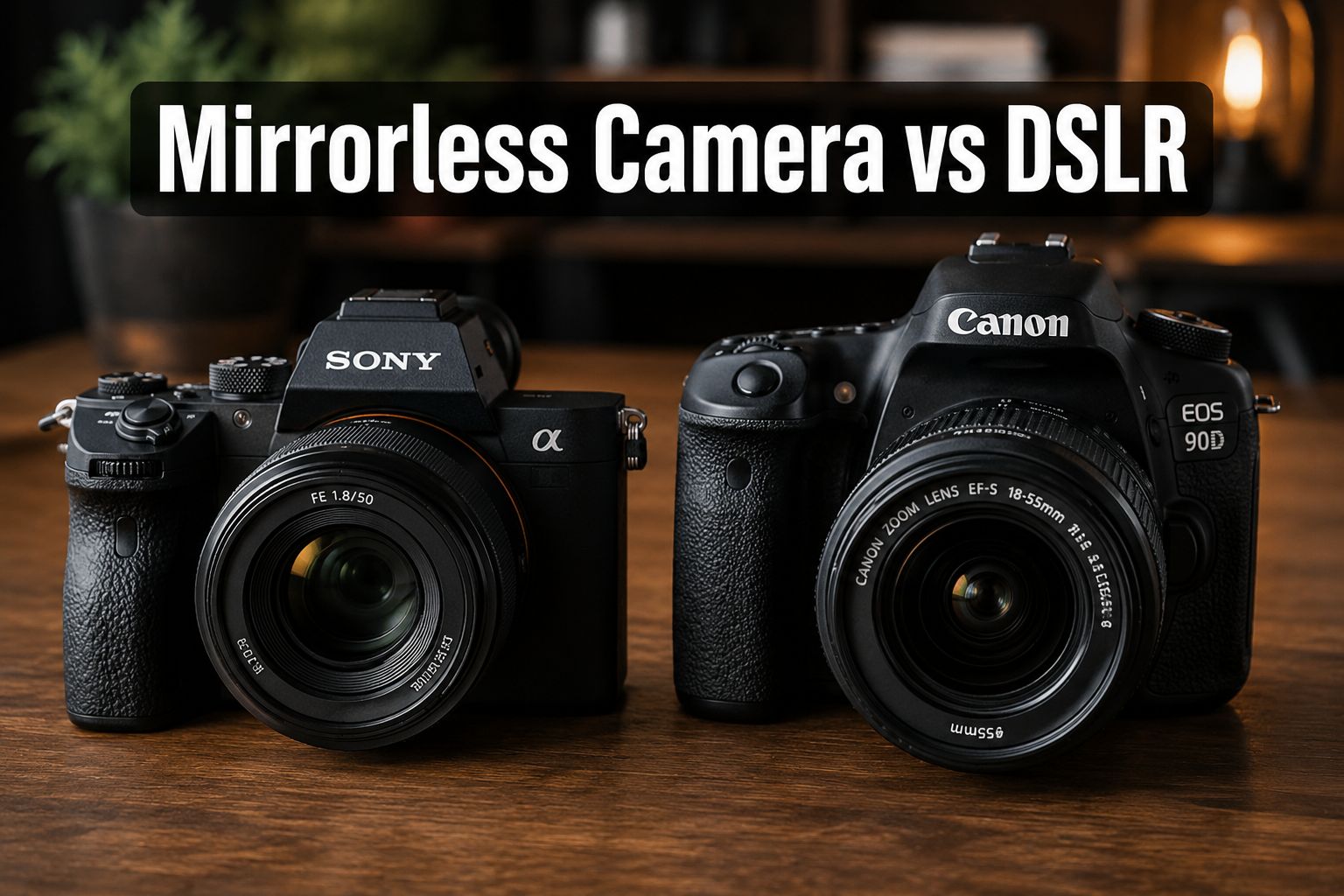
For most photographers buying a camera in 2026, a mirrorless camera is the better choice. Mirrorless systems offer faster autofocus, lighter bodies, and better video capabilities. DSLRs still hold value for photographers who already own lenses, need longer battery life, or are working with a tight budget on used gear. (Mirrorless Camera vs DSLR)
Key Takeaways
- Mirrorless cameras are lighter, faster, and better for video than DSLRs in most categories.
- DSLRs offer longer battery life, a larger used-lens ecosystem, and lower entry prices on the used market.
- Autofocus speed and accuracy favor mirrorless systems, especially for sports and wildlife photography.
- Mirrorless cameras use an electronic viewfinder (EVF); DSLRs use an optical viewfinder (OVF)—each has real trade-offs.
- Most major manufacturers (Canon, Nikon, Sony) have shifted primary R&D investment to mirrorless lines as of 2026.
- Existing DSLR lens owners can often use adapters to mount their glass on mirrorless bodies.
- For beginners, a mid-range mirrorless camera offers more room to grow than an equivalent DSLR.
- Battery life is still a genuine weakness for mirrorless cameras, though newer models have improved significantly.
What is the core difference between mirrorless cameras and DSLRs?
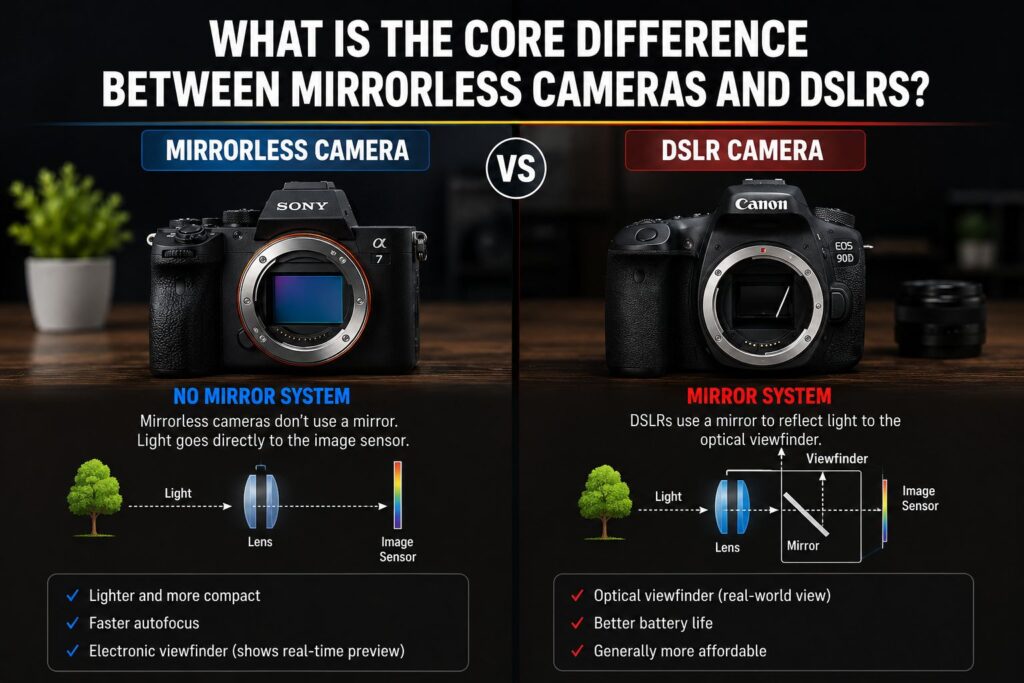
A DSLR (Digital Single-Lens Reflex) uses a physical mirror inside the camera body to reflect light up through an optical viewfinder. When you press the shutter, the mirror flips up, and light hits the sensor. A mirrorless camera removes that mirror entirely — light goes straight to the sensor at all times, and the viewfinder is an electronic display showing a live feed from the sensor.
This single mechanical difference drives most of the trade-offs between the two systems:
- No mirror = smaller, lighter body (mirrorless)
- No mirror = no optical viewfinder (mirrorless uses EVF or rear screen)
- Mirror mechanism = more moving parts, more wear (DSLR)
- Live sensor feed = better real-time exposure preview (mirrorless)
“The mirror is both the DSLR’s greatest strength and its greatest limitation—it delivers an optically pure view of the world, but it also adds weight, complexity, and mechanical constraints that mirrorless systems simply don’t have.”
Visit Amazon:
Mirrorless Camera: https://amzn.to/4tS4hGA
DSLR Camera: https://amzn.to/3Q1hjnk
How Does Image Quality Compare: Mirrorless Camera vs DSLR?
At equivalent sensor sizes and price points, image quality between mirrorless and DSLR cameras is effectively identical. Both systems use the same sensor technologies—full-frame, APS-C, or Micro Four Thirds—and the sensor primarily determines image quality, not the presence or absence of a mirror.
Where mirrorless pulls ahead on image quality:
- Real-time exposure preview in the EVF means fewer blown highlights or crushed shadows in tricky lighting.
- On-sensor phase-detect autofocus on mirrorless cameras is more precise for critical focus in portraits and macro work.
- In-body image stabilization (IBIS) is more common and more advanced in mirrorless systems, reducing motion blur in low light.
Where DSLRs hold their own:
- Optical viewfinders show the scene with zero lag and no digital noise, which some photographers prefer for composition.
- Proven, mature sensor technology in flagship DSLRs like the Nikon D850 still produces exceptional results.
Bottom line: Don’t choose between these systems based on image quality alone. The differences are minimal at the sensor level.
Which Has Better Autofocus: Mirrorless or DSLR?
Mirrorless cameras have a clear autofocus advantage in 2026. Because mirrorless systems use on-sensor phase-detect autofocus (PDAF) covering most or all of the frame, they track subjects faster and more accurately than the separate AF modules used in DSLRs.
Key autofocus advantages of mirrorless:
- Eye, face, and subject tracking are standard on most mid-range and flagship mirrorless bodies (Sony, Canon, Nikon).
- AF coverage often spans 90–100% of the frame vs. the center-weighted AF zones on most DSLRs.
- Continuous tracking for sports and wildlife is significantly more reliable on current mirrorless systems.
DSLRs use a dedicated phase-detect AF module that only activates in optical viewfinder mode. In live view (using the rear screen), DSLR autofocus slows dramatically because it switches to contrast-detect AF, a known weakness.
Choose mirrorless if autofocus speed and subject tracking matter for your work (sports, wildlife, events, video).
Choose a DSLR if you shoot primarily static subjects (landscapes, studio portraits) where AF speed is less critical.
Size, Weight, and Portability: Which Wins?
Mirrorless cameras win on size and weight, but the gap is smaller than many people expect once lenses are attached.
| Feature | Mirrorless | DSLR |
| Body weight (typical full-frame) | 450–650g | 700–900g |
| Body depth | Shallower (no mirror box) | Deeper |
| Lens size | Often larger (new optical designs) | Mature, compact primes available |
| Travel friendliness | Better | Bulkier |
| Grip ergonomics | Varies; some feel small | Generally excellent |
The mirrorless body is lighter, but native mirrorless lenses — especially fast primes and telephoto zooms — are sometimes larger than their DSLR equivalents because lens designers are compensating for the shorter flange distance with more complex optical formulas.
For travel photographers or street shooters, mirrorless is the clear winner. For studio or landscape photographers who always use a tripod, the weight difference matters less. If you’re looking for stable support regardless of camera type, a stable and portable tripod can make a real difference in your shooting setup.
Battery Life: A Real Weakness of Mirrorless Cameras
DSLRs last significantly longer per charge than most mirrorless cameras. The optical viewfinder in a DSLR uses no power — the sensor only activates when you shoot. Mirrorless cameras power the sensor and EVF continuously.
Typical battery performance (CIPA ratings, approximate):
- Entry-level DSLR: 600–1,000 shots per charge
- Mid-range DSLR: 800–1,500 shots per charge
- Mirrorless (APS-C): 300–500 shots per charge
- Mirrorless (full-frame, newer models): 350–600 shots per charge
Note: CIPA ratings are standardized lab estimates. Real-world performance varies based on EVF use, image review, and wireless features.
Practical workarounds for mirrorless battery life:
- Carry 2–3 spare batteries (they’re relatively inexpensive).
- Use a battery grip for extended shoots.
- Enable power-saving modes and reduce EVF brightness.
- Turn off Wi-Fi and Bluetooth when not needed.
For professional event photographers shooting all-day jobs, battery management is a real workflow consideration with mirrorless systems.
Video Capabilities: Mirrorless Camera vs DSLR
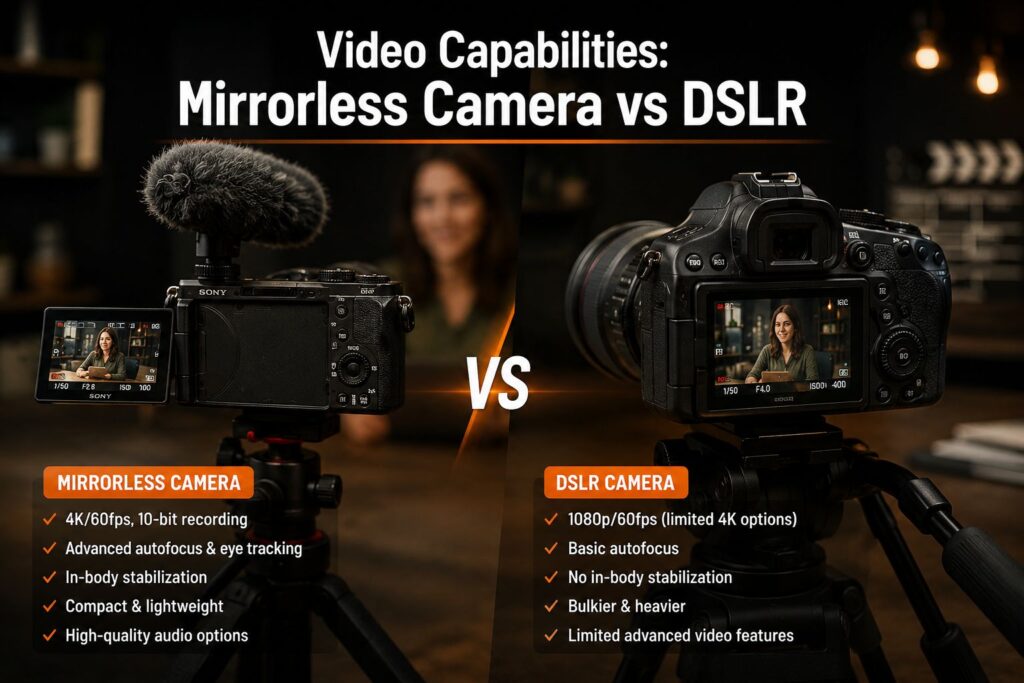
Mirrorless cameras are substantially better for video. This is one of the clearest advantages in the mirrorless camera vs. DSLR debate.
Why mirrorless dominates video:
- Continuous autofocus during video is fast and reliable (DSLR live-view AF is slow and often hunts).
- 4K and higher resolutions are standard across mirrorless lines; many DSLRs cap at 1080p or offer limited 4K.
- Log profiles and 10-bit color are more widely available on mirrorless bodies.
- Compact form factor pairs better with gimbals and rigs. For smooth handheld video, a stabilizer like the DJI Osmo Mobile 8 works well alongside a mirrorless body.
- Microphone and headphone jacks are standard on most mirrorless bodies.
DSLRs were never designed with video as a primary use case. While cameras like the Canon 5D Mark IV produce usable video, they can’t match what a Sony A7 IV or Canon R6 Mark II delivers out of the box.
Choose mirrorless if video is any part of your workflow—even occasional YouTube content or family videos.
Cost Comparison: Which Is More Affordable?
The answer depends on whether you’re buying new or used.
New camera market (2026):
- Entry-level mirrorless (APS-C): $600–$900
- Mid-range mirrorless (full-frame): $1,800–$2,800
- Entry-level DSLR: $400–$700 (limited new releases)
- Mid-range DSLR: $900–$1,500 (mostly older stock)
Used/refurbished market:
DSLRs offer excellent value used. A Nikon D750 or Canon 5D Mark III with a kit lens can be found for $500–$800 used, delivering full-frame image quality at a fraction of the mirrorless equivalent. For photographers on a strict budget who primarily shoot stills, the used DSLR market is genuinely compelling.
Lens ecosystem costs:
- DSLR lenses (Canon EF, Nikon F mount) have decades of third-party support, meaning sharp, affordable primes are widely available.
- Mirrorless native lenses are newer and often more expensive, though the gap is closing as third-party manufacturers like Sigma and Tamron expand their mirrorless lineups.
Who Should Buy a Mirrorless Camera in 2026?
Mirrorless is the right choice for most new buyers in 2026. Here’s a simple decision framework:
Buy mirrorless if you:
- Are you buying your first interchangeable-lens camera?
- Shoot video regularly or plan to.
- Want the best autofocus for moving subjects.
- Value a compact, travel-friendly system.
- Plan to grow your lens collection over time.
Stick with a DSLR (or buy a used DSLR) if you:
- Already own a large collection of DSLR lenses and aren’t ready to invest in adapters or new glass.
- Need maximum battery life for long fieldwork without charging access.
- You are on a very tight budget, and the used DSLR market fits your needs.
- Strongly prefer an optical viewfinder for sports or fast-action shooting.
For photographers who also want to understand how smartphone cameras compare to dedicated cameras, our Camera category covers a wide range of imaging devices and reviews.
What About Smartphone Cameras vs. Mirrorless and DSLR?
Modern smartphones have closed the gap significantly for casual photography, but dedicated cameras still lead in several areas. Phones like the Apple iPhone 18 Pro Max and Samsung Galaxy S26 Ultra produce impressive results in good light, but they can’t match the low-light performance, optical zoom range, or creative control of a dedicated mirrorless or DSLR system.
Where dedicated cameras still win:
- Large sensor low-light performance (less noise at high ISO)
- True optical zoom (not digital crop)
- Interchangeable lenses for creative flexibility
- RAW file quality and dynamic range
- Shallow depth of field for portrait work
Smartphones are ideal for everyday moments and social media. For professional work, portraiture, wildlife, or any situation requiring creative lens control, a dedicated camera system remains the better tool.
FAQ: Mirrorless Camera vs DSLR
Q: Is mirrorless better than a DSLR for beginners?
Yes, for most beginners in 2026. Mirrorless cameras offer better autofocus, more intuitive live-view shooting, and a system with a longer future roadmap. The learning curve is similar.
Q: Can I use my DSLR lenses on a mirrorless camera?
Yes, with an adapter. Canon, Nikon, and Sony all make official adapters that allow DSLR lenses to work on their mirrorless bodies, usually with full autofocus and image stabilization support.
Q: Are DSLRs being discontinued?
Not immediately, but major manufacturers have shifted primary development to mirrorless. Nikon announced no new DSLR development in 2022. Canon and Nikon continue to support existing DSLR lines with firmware, but new model releases are rare.
Q: Which is better for wildlife photography?
Mirrorless, in most cases. Modern mirrorless systems (Sony A9 III, Canon R3, and Nikon Z9) offer blackout-free shooting, superior subject tracking, and faster burst rates than any current DSLR.
Q: Do mirrorless cameras overheat during video recording?
Some do, particularly older or entry-level models. Most current flagship mirrorless cameras have addressed overheating with improved heat management. Check specific model reviews before buying for heavy video use.
Q: Is a DSLR still worth buying in 2026?
Yes, specifically on the used market. A used full-frame DSLR with quality glass is a cost-effective way to get professional image quality. For new purchases, mirrorless offers better long-term value.
Q: Which system has more lens choices?
Currently, DSLR mounts (Canon EF and Nikon F) have more total lenses available due to decades of production. However, mirrorless mounts are growing rapidly, and adapters bridge the gap effectively.
Q: What is an electronic viewfinder (EVF) disadvantage?
EVFs can show slight lag (though modern EVFs are near-imperceptible), look grainy in very low light, and consume battery. Some photographers also find them less natural than an optical viewfinder for panning shots.
Q: Which is better for portrait photography?
Both work well. Mirrorless cameras with eye-tracking autofocus make portrait shooting faster and more reliable, but a DSLR with a quality 85mm or 50mm prime lens produces equally beautiful portrait images.
Q: How long will DSLR support last?
Manufacturers have committed to continued lens and firmware support for existing DSLR systems for the foreseeable future. Practically, DSLRs will remain usable and supported for at least another decade.
Conclusion: Which Camera System Should You Choose?
The mirrorless camera vs. DSLR debate has a clear winner for most buyers in 2026: mirrorless. The technology has matured, prices have become competitive, and the autofocus, video, and portability advantages are real and meaningful.
That said, DSLRs aren’t obsolete. They remain excellent tools, especially for photographers buying used, those who already own DSLR glass, or anyone who values optical viewfinders and extended battery life.
Actionable next steps:
- Define your primary use case—stills only, video, sports, or travel—before looking at specific models.
- Set a realistic budget, including at least one quality lens, not just the body.
- Visit a camera store and hold both types before buying — ergonomics matter more than spec sheets.
- Consider used gear if budget is a constraint; a used full-frame DSLR often outperforms a new entry-level mirrorless for pure image quality.
- Check the lens roadmap for any system you’re considering—investing in a mount with an active future matters for long-term value.
For more in-depth camera and tech reviews, explore the full Camera section at TechnoItem to compare specific models and find the right fit for your photography goals.
References
- Camera & Imaging Products Association (CIPA). Digital Camera Statistics and Battery Performance Standards. CIPA, 2023. https://www.cipa.jp/
- Nikon Corporation. Nikon’s Future Direction on Imaging Products. Nikon Press Release, 2022.
- Sony Electronics. Alpha System Lens Roadmap. Sony, 2024. https://www.sony.com/en/articles/alpha-lens-lineup
- DPReview. Mirrorless vs DSLR: A Practical Comparison. DPReview, 2023. https://www.dpreview.com/