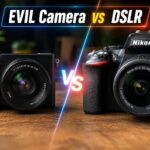
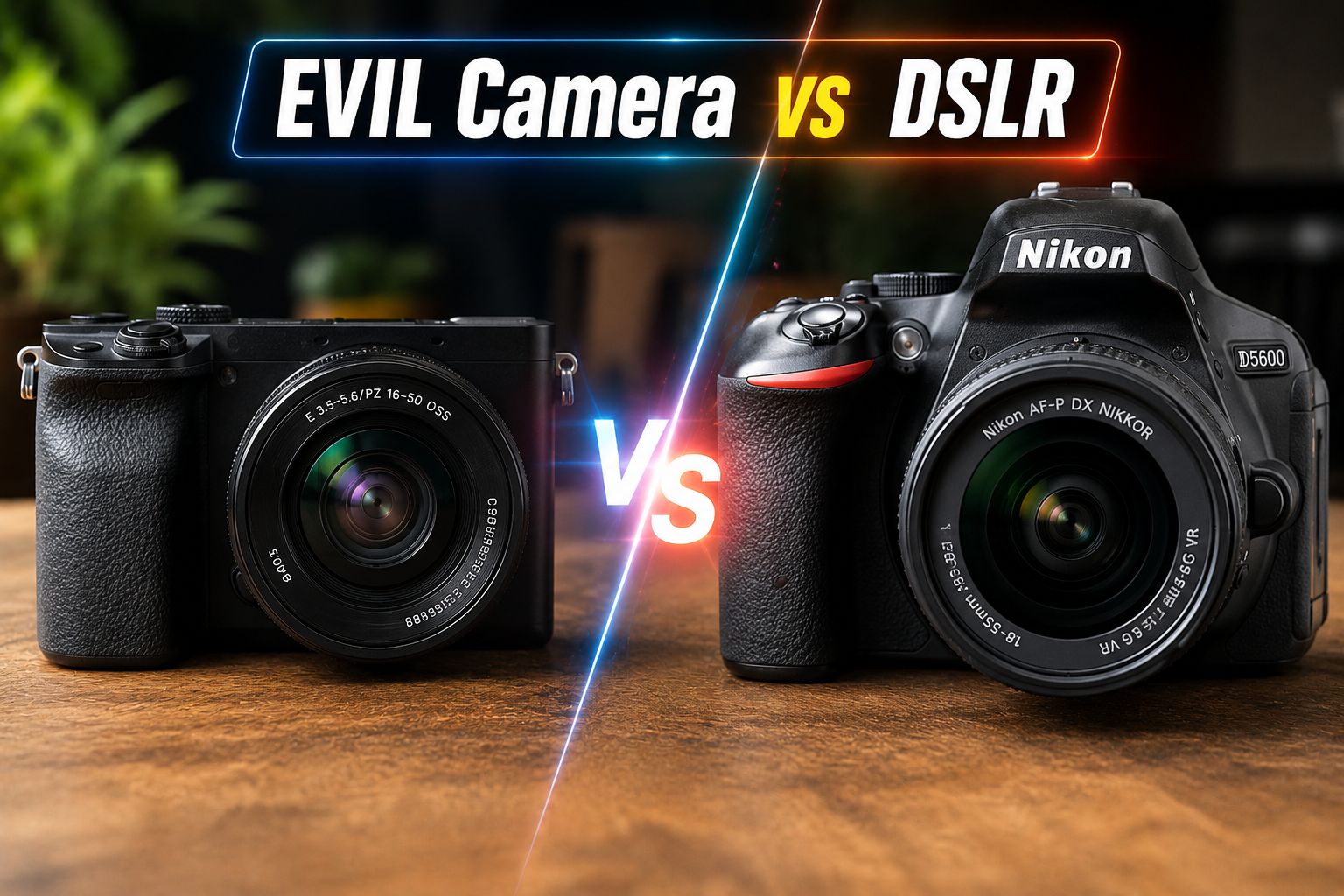
Quick Answer: An EVIL camera (Electronic Viewfinder, Interchangeable Lens)—also called a mirrorless camera—uses an electronic viewfinder and no mirror mechanism, making it lighter and more compact than a DSLR. DSLRs use an optical viewfinder and a reflex mirror, offering longer battery life and a wider selection of native lenses. For most new photographers in 2026, a mirrorless (EVIL) camera is the better long-term investment. DSLRs still make sense for shooters who already own glass or need maximum battery endurance in the field. (EVIL Camera vs DSLR)
Key Takeaways
- EVIL stands for “Electronic Viewfinder Interchangeable Lens”—it’s the technical term for mirrorless cameras.
- Mirrorless cameras are generally lighter, more compact, and better suited for video than DSLRs.
- DSLRs offer optical viewfinders, longer battery life per charge, and a massive back-catalog of affordable native lenses.
- Major manufacturers (Canon, Nikon, Sony) have shifted R&D focus almost entirely to mirrorless systems as of 2026.
- Image quality at equivalent sensor sizes is comparable between both systems — sensor size matters more than camera type.
- Budget matters: entry-level DSLRs can still undercut mirrorless cameras at the same image quality tier.
- Autofocus speed and subject tracking favor modern mirrorless cameras by a clear margin.
- Choosing between an evil camera and a DSLR ultimately comes down to your shooting style, budget, and existing gear.
What Is an EVIL Camera, and How Does It Differ from a DSLR?
An EVIL camera is a mirrorless interchangeable-lens camera that replaces the optical viewfinder and reflex mirror of a DSLR with an electronic viewfinder (EVF) and direct sensor readout. The result is a physically smaller body with fewer moving parts.
A DSLR (Digital Single-Lens Reflex) works by bouncing light from the lens up through a mirror into an optical viewfinder. When you press the shutter, the mirror flips up, the shutter opens, and light hits the sensor. This mechanism adds bulk but gives a true optical view of the scene.
Key structural differences at a glance:
| Feature | EVIL / Mirrorless | DSLR |
| Viewfinder type | Electronic (EVF) | Optical (OVF) |
| Mirror mechanism | None | Yes |
| Body size/weight | Smaller, lighter | Larger, heavier |
| Battery life (typical) | 300–500 shots/charge | 600–1,200 shots/charge |
| Video capability | Excellent | Good to moderate |
| AF speed (2026) | Very fast (phase + AI) | Fast (phase detect) |
| Native lens selection | Growing rapidly | Extensive (decades of glass) |
| New model releases | Active | Slowing significantly |
Visit Amazon:
Why the EVIL Camera vs DSLR Debate Still Matters in 2026
Some photographers assume this debate is settled — and in terms of manufacturer investment, it largely is. Canon released its last major DSLR body update in 2022, and Nikon has publicly committed its future to the Z-mount mirrorless system. Sony stopped producing new DSLR bodies years ago.
But the debate still matters for buyers because
- Millions of used DSLRs are available at steep discounts, making them compelling entry points.
- Existing lens ecosystems mean many working photographers have thousands of dollars in DSLR glass.
- Battery life and ruggedness remain genuine DSLR advantages in specific field conditions.
- Beginners searching for “evil camera vs. DSLR” are often choosing their first serious camera system—a decision that shapes their gear investment for years.
💡 The real question isn’t which technology is “better” — it’s which system fits your shooting habits, budget, and growth path.
Image Quality: Does the Camera Type Actually Matter?
For image quality, the camera type (mirrorless vs DSLR) is largely irrelevant. Sensor size and quality determine dynamic range, low-light performance, and resolution — not whether a mirror is present.
A full-frame mirrorless camera and a full-frame DSLR with the same generation sensor will produce nearly identical raw files. The meaningful comparisons are the following:
- Full-frame vs. APS-C vs. Micro Four Thirds—sensor size differences create real IQ gaps.
- Sensor generation — a newer APS-C mirrorless sensor can outperform an older full-frame DSLR sensor.
- Lens quality — a sharp prime on either system beats a mediocre zoom on either system.
Choose based on sensor size and lens quality, not mirror presence.
Autofocus: Where Mirrorless Cameras Pull Ahead
Modern mirrorless cameras have a clear autofocus advantage over DSLRs, particularly for moving subjects. This is one area where the evil camera vs. DSLR comparison has a definitive answer for most use cases.
DSLRs use a dedicated phase-detection AF module in the mirror box, which is fast but limited to the center of the frame. Mirrorless cameras embed phase-detection pixels across the entire sensor and layer AI subject recognition on top, enabling eye, face, animal, and vehicle tracking across the full frame.
Where this matters most:
- 📸 Sports and wildlife photography
- 👶 Children and unpredictable subjects
- 🎬 Video with continuous subject tracking
- 🐦 Birds in flight (a classic AF stress test)
For static subjects—landscapes, architecture, and studio portraits—DSLR autofocus is perfectly adequate.
Video Performance: A Clear Win for Mirrorless
If video is part of your workflow, mirrorless cameras are the stronger choice. DSLRs typically use sensor crop during video recording and often lack features like in-body image stabilization (IBIS), log profiles, and 4K at higher frame rates.
Mirrorless cameras in 2026 commonly offer:
- 4K at 60fps or higher
- 6K and 8K options on higher-end bodies
- In-body image stabilization (IBIS)
- Clean HDMI output for external recorders
- Log color profiles for post-production grading
For vloggers, filmmakers, or hybrid photo-video shooters, the mirrorless advantage here is significant. If you’re pairing your camera with a smartphone gimbal like the DJI Osmo Mobile 8 for run-and-gun shooting, a lighter mirrorless body also balances better on a gimbal.
Size, Weight, and Portability: The Practical Reality
EVIL cameras are generally smaller and lighter than DSLRs, but the gap narrows with larger lenses. A compact mirrorless body paired with a large telephoto lens is no lighter than a DSLR with an equivalent lens.
Where the size advantage is real:
- Street photography with a small prime lens
- Travel photography where bag space is limited
- Daily carry where you want a capable camera without a large bag
Where the size advantage shrinks:
- Wildlife or sports shooting with 400mm+ telephoto lenses
- Studio work where portability doesn’t matter
- Shooters who prefer a larger grip for ergonomic comfort
If portability is a priority and you’re also comparing your camera to a capable smartphone, it’s worth checking out the Samsung Galaxy S26 Ultra or the Google Pixel 10 Pro XL—flagship phones that can complement or even replace a dedicated camera for casual shooting.
Battery Life: The DSLR’s Lasting Advantage
DSLRs consistently outperform mirrorless cameras on battery life. The optical viewfinder uses no power, and the mirror mechanism only activates at the moment of capture. A mid-range DSLR can deliver 800–1,200 shots per charge. Most mirrorless cameras manage 300–500 shots under CIPA test conditions.
Practical workarounds for mirrorless shooters:
- Carry two or three spare batteries (they’re small and relatively inexpensive)
- Use a battery grip for extended shooting sessions
- Turn off the EVF when reviewing shots on the rear screen
- Use power-saving modes during idle periods
For travel photographers or photojournalists in remote locations without reliable charging access, this is a genuine consideration — not just a spec sheet footnote.
You can also pair your camera with a stable cell phone tripod to extend shooting sessions without holding the camera, which conserves battery on both mirrorless and DSLR bodies.
Cost Comparison: What Does Each System Actually Cost?
Entry-level pricing in 2026 (approximate USD):
| System | Entry Body | Mid-Range Body | Kit Lens (18-55mm equiv.) |
| DSLR (new) | $400–$600 | $900–$1,400 | $100–$200 |
| DSLR (used/refurbished) | $150–$350 | $400–$700 | $50–$150 |
| Mirrorless (new) | $600–$900 | $1,200–$2,000 | $200–$400 |
| Mirrorless (used) | $350–$600 | $700–$1,200 | $150–$300 |
The budget reality: A used DSLR kit can get a beginner shooting with excellent image quality for under $400. An equivalent mirrorless setup costs more, though prices have dropped as the market matures.
Choose a DSLR if: You’re on a tight budget, you’re buying used, or you already own compatible lenses.
Choose mirrorless if you’re investing in a long-term system, you shoot video, or you want the latest autofocus technology.
For a broader look at camera and electronics options, the Camera category at TechnoItem covers a range of imaging gear across budgets.
Who Should Choose an EVIL Camera vs. a DSLR?
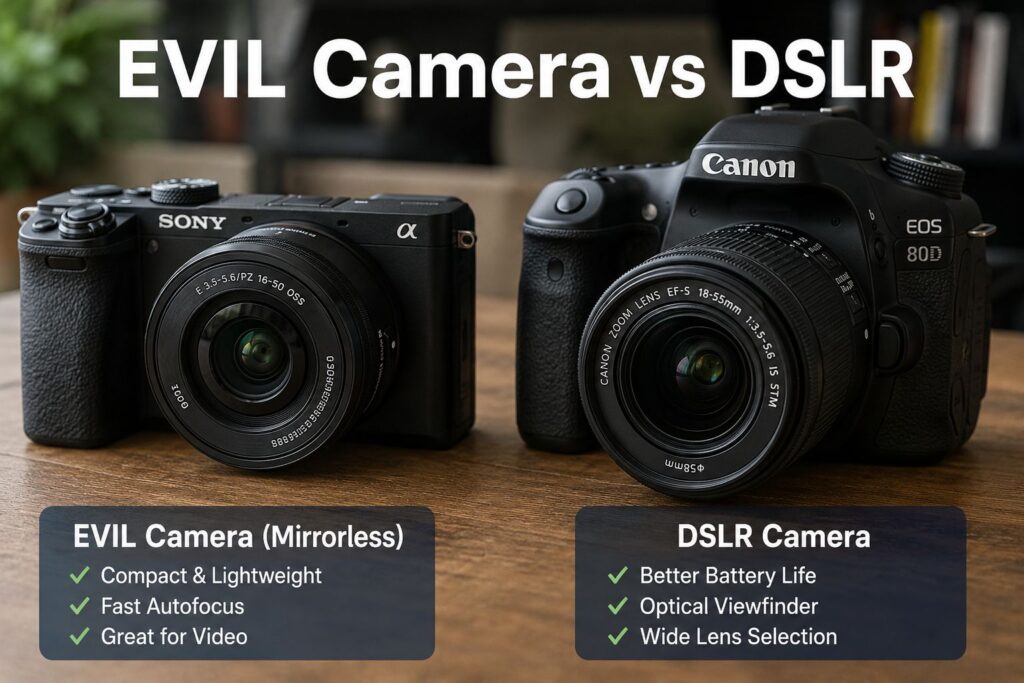
This is the most practical question in the entire evil camera vs. DSLR comparison. Here’s a direct decision framework:
Choose a mirrorless (EVIL) camera if you:
- Are you buying your first serious camera with no existing lens investment
- Shoot video regularly or plan to
- Want the best autofocus for fast-moving subjects
- Prioritize a compact, travel-friendly system
- Are investing for the next 5–10 years (manufacturer support favors mirrorless)
Choose a DSLR if you:
- Already own a collection of DSLR lenses (Canon EF, Nikon F, etc.)
- Need maximum battery life for extended field work
- Are on a tight budget and want the best image quality per dollar
- Prefer an optical viewfinder for its natural, lag-free view
- Are you buying used and want the widest selection of affordable bodies
Common mistake: Buying a mirrorless body and then adapting all your old DSLR lenses. Adapted lenses often lose autofocus speed advantages, which defeats a key reason to go mirrorless. If you’re switching systems, plan to gradually replace lenses with native mirrorless glass.
FAQ: Evil Camera vs DSLR
Q: Is “EVIL camera” just another name for mirrorless?
Yes. EVIL (Electronic Viewfinder, Interchangeable Lens) is the technical term for what most people call a mirrorless camera. The terms are interchangeable.
Q: Are DSLRs becoming obsolete?
Not immediately. DSLRs still produce excellent images and will continue to work indefinitely. However, manufacturers have largely stopped developing new DSLR models, so the technology is no longer advancing. Used DSLRs remain excellent value buys.
Q: Can I use my DSLR lenses on a mirrorless camera?
Usually, yes, with an adapter. Canon RF, Nikon Z, and Sony E-mount bodies all have manufacturer-made adapters for their legacy DSLR lenses. Autofocus performance varies by lens and adapter combination.
Q: Which is better for portrait photography?
Both systems produce excellent portraits. The mirrorless advantage in eye-tracking autofocus is genuinely useful for portraits, especially with moving subjects or children.
Q: Which is better for wildlife photography?
Modern mirrorless cameras have surpassed DSLRs for wildlife, particularly for bird-in-flight tracking. The Sony A9 series, Canon R3, and Nikon Z9 set a new standard that DSLR AF systems can’t match.
Q: Do mirrorless cameras have a shutter lag problem?
Early mirrorless cameras had noticeable EVF lag. Current-generation bodies (2023 onward) have EVF lag measured in milliseconds — imperceptible in normal shooting. This is no longer a meaningful concern.
Q: Is the electronic viewfinder (EVF) worse than an optical viewfinder?
It depends on preference. EVFs show exposure preview, focus peaking, and live histograms—genuinely useful information. Optical viewfinders offer a natural, lag-free view with no battery drain. Many photographers who switch to mirrorless prefer the EVF after a short adjustment period.
Q: What about weather sealing?
Both systems offer weather-sealed bodies at mid-to-high price points. Weather sealing is a feature of specific models, not an inherent advantage of either system.
Q: Is a mirrorless camera good for beginners?
Yes. Entry-level mirrorless cameras are no harder to use than DSLRs. The learning curve is the same; the technology is just different under the hood.
Q: Will DSLR lenses hold their value?
Canon EF and Nikon F lenses remain widely used and hold reasonable resale value, especially quality L-series and prime lenses. Demand is softening as more photographers move to mirrorless, but quality glass retains value better than bodies.
Conclusion: Making the Right Choice in 2026
The evil camera vs. DSLR debate has a practical answer for most photographers in 2026: mirrorless is the better long-term investment for anyone starting fresh or upgrading without a legacy lens collection. The autofocus advantages, video capabilities, and manufacturer support all point in the same direction.
That said, DSLRs aren’t dead — they’re just mature. A well-chosen used DSLR kit remains one of the best ways to get serious image quality on a limited budget, and existing DSLR users with quality lenses have no urgent reason to switch.
Actionable next steps:
- Audit your current gear. If you own quality DSLR lenses, calculate the cost of replacing them before switching systems.
- Define your primary use case. Video and fast-action shooting favor mirrorless. Budget-conscious stills shooting may still favor a used DSLR.
- Rent before you buy. Many camera rental services let you test a mirrorless body for a weekend—worth doing before a $1,000+ commitment.
- Buy the lens, not the body. Whichever system you choose, invest in quality glass. Bodies get upgraded; good lenses last decades.
- Check the used market. Both systems have strong market use. A one-generation-old mirrorless body at a 40% discount often beats buying new.
For more camera and tech gear coverage, explore the full Camera section at TechnoItem to compare options across categories and budgets.
References
- Canon Inc.—EOS R System product announcements and development roadmaps. canon.com
- Nikon Corporation — Z-mount system development statements. nikonusa.com
- Sony Electronics—Alpha mirrorless system product line documentation. sony.com
- CIPA (Camera & Imaging Products Association) — Battery life testing standards and shot count methodology. cipa.jp
- Digital Photography Review (DPReview) — Mirrorless vs DSLR autofocus comparisons, 2022–2024. dpreview.com