Quick Answer
Key Takeaways 📷
- The camera obscura (a light-projection device) was described as early as 1021 AD by the Arab scholar Ibn al-Haytham.
- The first permanent photograph was taken around 1826–1827 by Joseph Nicéphore Niépce using a device called a heliograph.
- Louis Daguerre introduced the daguerreotype in 1839, marking the birth of practical photography.
- William Henry Fox Talbot developed the calotype process in 1841, enabling multiple prints from one negative.
- The first portable, hand-held camera (the Kodak No. 1) was launched in 1888, making photography accessible to the public.
- Digital cameras emerged commercially in the 1990s, with the first consumer digital camera released by Apple in 1994.
- The question of when the camera was discovered depends on which milestone you count: optical projection, chemical capture, or digital imaging.
- Today’s smartphone cameras (see the Apple iPhone 17 Pro Max and Samsung Galaxy S26 Ultra) are the direct descendants of Niépce’s invention.
When was the camera discovered? Understanding the Question
The answer depends on what you mean by “camera.” Three distinct milestones define the camera’s origin:
| Milestone | Date | Key Figure |
| Camera obscura (optical projection) | ~1021 AD | Ibn al-Haytham |
| First permanent photograph | 1826–1827 | Joseph Nicéphore Niépce |
| First commercial photographic system | 1839 | Louis Daguerre |
| Flexible film camera | 1888 | George Eastman (Kodak) |
| First consumer digital camera | 1994 | Apple/Kodak |
Most historians point to 1826–1827 as the true birth year of the camera as a photographic device, because that’s when light was first captured and preserved as a permanent image.
What Was the Camera Obscura and Why Does It Matter?
The camera obscura was the direct ancestor of the modern camera. It was an optical device, not a photographic one, meaning it could project images but could not save them.
How it worked: Light passed through a small hole (or lens) into a darkened room or box, projecting an upside-down image of the outside world onto the opposite wall or surface. Artists used it as a drawing aid for centuries.
Key timeline of the camera obscura:
- 1021 AD: Arab polymath Ibn al-Haytham (Alhazen) described the principles of the camera obscura in his Book of Optics, making him the earliest documented source.
- 1490s: Leonardo da Vinci wrote detailed descriptions of the device in his notebooks.
- 1550: Gerolamo Cardano improved the design by adding a convex lens to sharpen the projected image.
- 1685: Johann Zahn designed a compact, portable camera obscura box, which closely resembled the shape of later photographic cameras.
Pull quote: “The camera obscura proved that light could form images automatically. The missing piece was chemistry—a way to make those images permanent.”
The camera obscura established the optical foundation. The next challenge was chemically fixing the image, and that took another 150 years to solve.
Who Really Invented the First Camera? Niépce vs. Daguerre
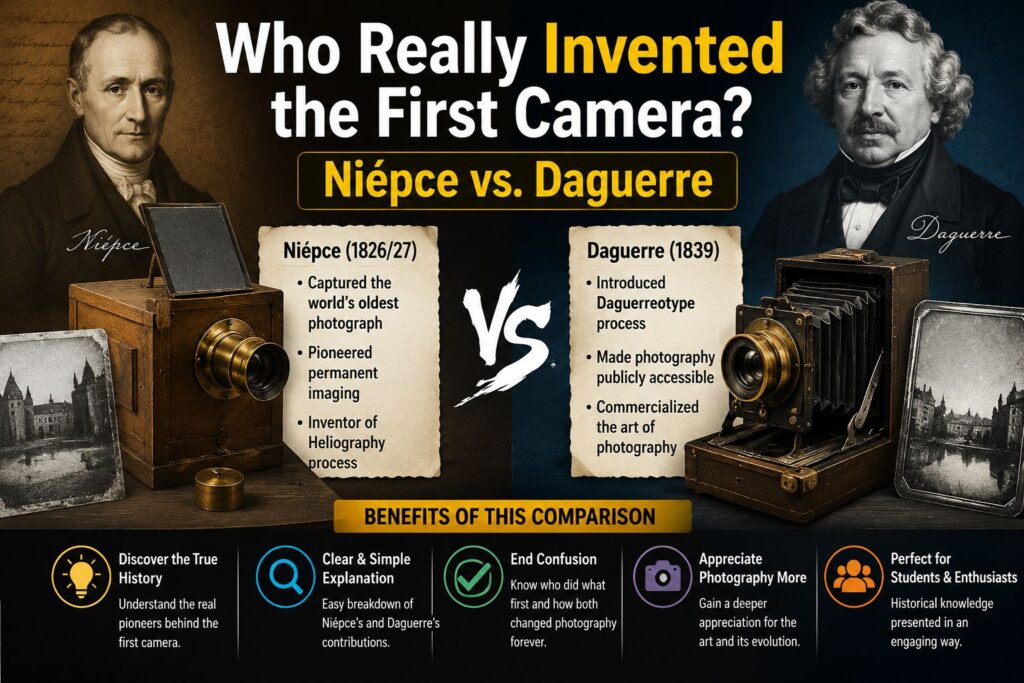
Joseph Nicéphore Niépce is credited with taking the world’s first permanent photograph around 1826–1827. He coated a pewter plate with bitumen of Judea (a light-sensitive substance) and exposed it inside a camera obscura for approximately 8 hours. The result was a blurry but permanent image of rooftops viewed from his upstairs window in Burgundy, France. This image, known as “View from the Window at Le Gras,” still exists and is held at the University of Texas at Austin.
Louis Daguerre later partnered with Niépce in 1829. After Niépce died in 1833, Daguerre continued the work and, in 1839, unveiled the daguerreotype process to the French Academy of Sciences. The daguerreotype produced sharp, detailed images on silver-coated copper plates and required only 15–30 minutes of exposure time, a massive improvement.
Key difference:
- Niépce = first permanent photograph (priority of discovery)
- Daguerre = first practical, widely adopted photographic process (priority of impact)
Both men deserve credit, but if you’re asking when the camera was discovered in a practical sense, 1839 is the most commonly cited answer in historical and academic sources.
How Did the Camera Evolve After 1839?
After Daguerre’s announcement in 1839, camera technology advanced rapidly across three major eras.
Era 1: Chemical Film Cameras (1839–1980s)
- 1841: William Henry Fox Talbot’s calotype process introduced paper negatives, allowing multiple prints from a single exposure.
- 1851: Frederick Scott Archer’s wet collodion process reduced exposure time to seconds.
- 1871: Richard Leach Maddox developed the dry gelatin plate, making cameras far more portable.
- 1888: George Eastman launched the Kodak No. 1, a simple box camera pre-loaded with film. The slogan “You press the button, we do the rest” democratized photography for the first time.
- 1900: The Brownie camera sold for just $1, putting cameras in the hands of everyday families.
- 1948: Polaroid introduced instant photography, producing a finished print in about 60 seconds.
Era 2: SLR and Compact Cameras (1950s–1990s)
- The 35mm SLR (Single Lens Reflex) camera became the professional standard, with brands like Nikon, Canon, and Leica leading development.
- Autofocus systems arrived in the 1970s, and fully automatic compact cameras became mass-market products by the 1980s.
Era 3: Digital Cameras (1990s–present)
- 1975: Kodak engineer Steven Sasson built the first digital camera prototype, which weighed 8 pounds and captured a 0.01-megapixel image.
- 1994: Apple released the QuickTake 100, widely considered the first consumer digital camera.
- 2000: Sharp released the J-SH04, the first mobile phone with a built-in camera.
- By 2010, smartphone cameras had surpassed point-and-shoot sales, a trend that has only accelerated since.
For a look at where camera technology stands in 2026, the Samsung Galaxy S26 Ultra and Google Pixel 10 Pro XL showcase just how far image capture has come from Niépce’s 8-hour exposure.
When was the camera discovered in the Digital Age?
The digital camera’s discovery is its own separate story. The core technology, the charge-coupled device (CCD) sensor, was invented in 1969 by Willard Boyle and George E. Smith at Bell Labs. This sensor converts light into digital signals, replacing chemical film entirely.
Key digital camera milestones:
- 1969: The CCD sensor was invented at Bell Labs (Boyle and Smith later won the Nobel Prize in Physics in 2009 for this work).
- 1975: First digital camera prototype built by Steven Sasson at Kodak.
- 1991: Kodak released the DCS 100, the first professional digital SLR, priced at around $13,000.
- 1994: Apple QuickTake 100 brought digital cameras to consumers at $749.
- 2000s: Megapixel counts climbed rapidly; 5MP cameras became standard by 2003.
- 2007: The iPhone’s camera (1.9MP) began shifting photography to smartphones permanently.
Today’s cameras are embedded in devices most people carry daily. Whether you’re stabilizing shots with a tripod for your cell phone camera or capturing 4K video on a flagship phone, the technology traces directly back to that 1969 Bell Labs breakthrough.
What Was the First Camera Used For?
Early cameras served very different purposes than today’s devices.
Primary uses of early cameras:
- Scientific documentation: Astronomers and naturalists used early daguerreotypes to record the moon, sun, and plant specimens.
- Portrait photography: By the 1840s, portrait studios replaced painted miniatures. A daguerreotype portrait took 15–30 minutes of sitting still.
- News and war documentation: Roger Fenton photographed the Crimean War in 1855, and Mathew Brady documented the American Civil War beginning in 1861.
- Art and exploration: Cameras documented expeditions to remote regions, giving people their first visual evidence of distant landscapes.
- Criminal identification: Police departments began using photographs for criminal records (“mugshots”) in the 1840s and 1850s.
The shift from scientific tool to everyday consumer device took roughly 60 years, from Daguerre’s 1839 announcement to Eastman’s Brownie in 1900.
When was the camera discovered for everyday use? The Kodak Revolution
The camera became a mass-market product in 1900 with the launch of the Brownie camera by Eastman Kodak. Priced at $1 (roughly $35 in 2026 dollars), it was affordable for middle-class families and required no technical knowledge.
Why the Kodak Brownie mattered:
- Sold over 150,000 units in its first year of production.
- Introduced the concept of the “snapshot,” casual, unposed, everyday photography.
- Created the photo album as a cultural artifact.
- Established Kodak as the dominant photography brand for most of the 20th century.
Before Kodak, cameras were expensive, heavy, and required chemical knowledge to operate. After Kodak, photography became a hobby, a family ritual, and eventually an art form accessible to anyone.
If you’re interested in how modern accessories extend your camera’s capabilities, check out resources on camera accessories and gear available today.
How Do Modern Cameras Compare to the First Camera?
The contrast between Niépce’s heliograph and a 2026 smartphone camera is almost impossible to overstate.
| Feature | Niépce’s Camera (1826) | Modern Smartphone (2026) |
| Exposure time | ~8 hours | 1/8000th of a second |
| Image resolution | Not measurable (single plate) | 200+ megapixels |
| Portability | Heavy, room-sized setup | Fits in a pocket |
| Color capability | None (monochrome) | Full color + HDR |
| Storage | Single pewter plate | Thousands of images (cloud) |
| Video | None | 8K video recording |
| Cost | Equivalent to thousands of dollars | Included in phone price |
The Apple iPhone 18 Pro Max and similar flagship devices now include computational photography, AI scene recognition, and multi-lens systems that would have seemed like science fiction even 20 years ago.
For photographers who want to stabilize their shots, a DJI Osmo Mobile 8 gimbal shows how camera accessories have evolved alongside the devices themselves.
FAQ: When was the camera discovered
Q: What year was the camera invented?
The first camera capable of capturing a permanent photograph was developed around 1826–1827 by Joseph Nicéphore Niépce. The first commercially practical camera system (the daguerreotype) launched in 1839.
Q: Who invented the camera first?
Joseph Nicéphore Niépce is credited with the first permanent photograph (~1826–1827). Louis Daguerre developed the first widely used photographic process in 1839. Both are considered co-founders of photography.
Q: What was the very first camera called?
Niépce’s device was called a heliograph (from the Greek for “sun writing”). Daguerre’s improved system was called the daguerreotype.
Q: Did Ibn al-Haytham invent the camera?
Ibn al-Haytham (Alhazen) described the camera obscura principle around 1021 AD, making him the earliest documented source of camera optics. However, his device projected images but could not photograph them. He is credited with foundational optics, not photography itself.
Q: When was the digital camera invented?
The digital camera was invented as a prototype in 1975 by Steven Sasson at Kodak. The first consumer digital camera, the Apple QuickTake 100, launched in 1994.
Q: When did cameras become common in everyday life?
Cameras became accessible to the general public in 1900 with the launch of the Kodak Brownie, priced at $1. Smartphone cameras made photography truly universal after 2007.
Q: What was the first photograph ever taken?
The first known permanent photograph is “View from the Window at Le Gras,” taken by Joseph Nicéphore Niépce around 1826–1827. It shows rooftops and a courtyard in Burgundy, France.
Q: How long did the first photograph take to expose?
Niépce’s first photograph required an exposure time of approximately 8 hours in direct sunlight. By comparison, modern cameras can expose in less than 1/8000th of a second.
Q: When was color photography invented?
The first color photograph was taken by physicist James Clerk Maxwell in 1861. Practical color film for consumers became available with Kodachrome in 1935.
Q: When did phone cameras become standard?
The first camera phone was the Sharp J-SH04, released in Japan in 2000. By 2010, most smartphones included cameras, and by 2015, smartphone cameras had largely replaced point-and-shoot cameras in the consumer market.
Conclusion: From Ancient Optics to Pocket Supercomputers
The story of when the camera was discovered spans more than a thousand years, from Ibn al-Haytham’s optical experiments in 1021 AD to Niépce’s breakthrough in 1826–1827, Daguerre’s commercial revolution in 1839, Eastman’s democratization in 1900, and the digital transformation that began in 1975 and accelerated through the smartphone era.
The most accurate answer: The camera as a photographic device was discovered in 1826–1827 and made practically useful in 1839. Everything since has been refinement, miniaturization, and digitization.
Actionable next steps for readers in 2026:
- If you’re curious about modern camera technology, explore current flagship phones like the Google Pixel 10 Pro XL to see where the technology stands today.
- If you shoot with a smartphone and want better stability, a quality cell phone tripod is a practical upgrade.
- For a broader look at cameras, lenses, and imaging gear, the Camera category at TechnoItem covers the latest reviews and buying guides.
- If you’re interested in videography on the go, the DJI Osmo Mobile 8 review covers one of 2026’s best stabilization tools.
The camera’s 200-year journey from an 8-hour exposure on a pewter plate to a pocket device that shoots 8K video is one of the most remarkable technological progressions in human history. Understanding that history makes the technology in your hand feel a lot more extraordinary.
References
- Gernsheim, H. (1982). The Origins of Photography. Thames and Hudson.
- Hannavy, J. (Ed.). (2008). Encyclopedia of Nineteenth-Century Photography. Routledge.
- Newhall, B. (1982). The History of Photography: From 1839 to the Present. Museum of Modern Art.
- Boyle, W. S., & Smith, G. E. (1970). Charge-coupled semiconductor devices. Bell System Technical Journal, 49(4), 587–593.
- The Harry Ransom Center, University of Texas at Austin. (n.d.). Niépce’s “View from the Window at Le Gras.” hrc.utexas.edu
- Nobel Prize Committee. (2009). Nobel Prize in Physics: Willard Boyle and George E. Smith. nobelprize.org