
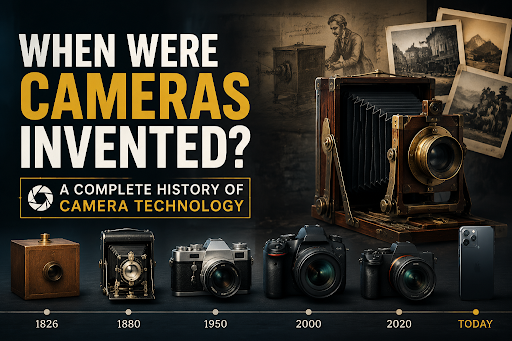
Quick Answer
Key Takeaways
- 📷 The concept of the camera obscura (a light-projecting box) dates back to the 11th century, but it could not record images
- 🖼️ The first permanent photograph was taken around 1826–1827 by Nicéphore Niépce
- 📅 The daguerreotype, the first practical camera system, was publicly announced in 1839
- 🎞️ Film cameras became widespread after George Eastman launched the Kodak camera in 1888
- 💡 The first digital camera was built by Kodak engineer Steven Sasson in 1975
- 📱 Smartphone cameras entered the mainstream with the Nokia 7650 in 2002 and exploded with the iPhone in 2007
- 🔬 Camera technology has evolved from hours-long exposures to instant, AI-enhanced images in under 200 years
- 🌍 As of 2026, an estimated 1.8 trillion photos are taken each year (Visual Capitalist, 2023 estimate)
- 🏆 Understanding this history helps explain why modern cameras—from DSLRs to smartphone sensors—work the way they do
When Were Cameras Invented? The Origins Explained
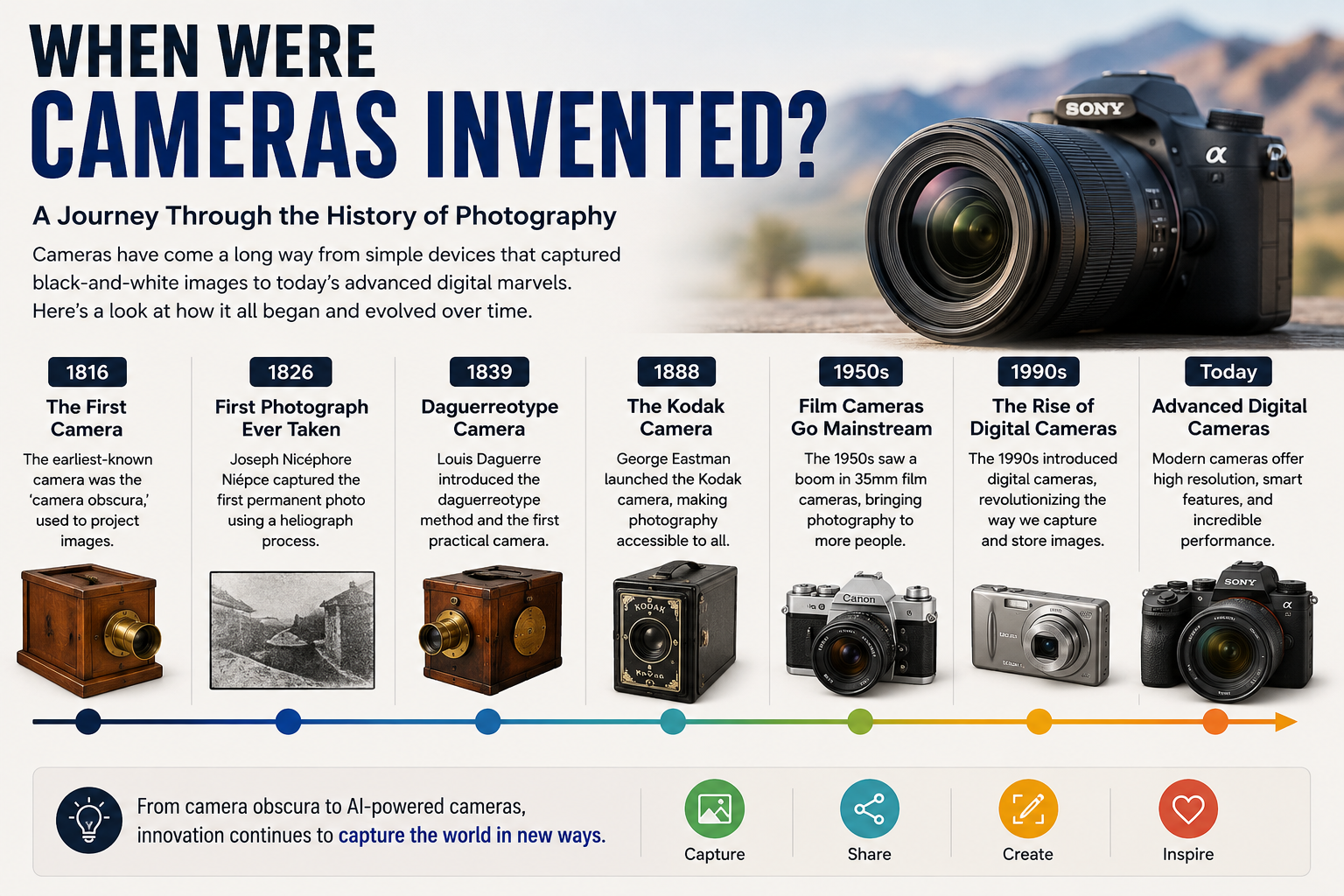
The question of when cameras were invented depends on how you define “camera.” If the definition includes any device that projects light to form an image, the answer reaches back over a thousand years. If the definition requires capturing and preserving that image, the answer is the early 19th century.
The camera obscura—Latin for “dark room”—was described by Arab scholar Ibn al-Haytham (Alhazen) around 1021 CE. It worked by allowing light through a small hole into a darkened space, projecting an inverted image of the outside world onto the opposite wall. Artists used it for centuries as a drawing aid, but it could not save images.
The leap from projection to preservation happened when chemistry caught up with optics.
The Camera Obscura: The Ancient Ancestor of Photography
The camera obscura is the direct ancestor of every camera in existence today. It is not an exaggeration to say that without it, modern photography — and by extension, the camera technology in today’s smartphones — would not exist.
How it worked:
- Light enters through a tiny aperture (hole) in a darkened enclosure
- The light rays cross and project an inverted, full-colour image on the opposite surface
- The image is real and accurate, but disappears the moment light is blocked
By the 16th and 17th centuries, portable camera obscura boxes were common tools among European artists and scientists. The challenge everyone recognized: how do you make the image stay?
“The camera obscura gave artists a perfect image. Chemistry gave that image a permanent home.”
Who Took the First Photograph, and When?
The first known permanent photograph was taken by Nicéphore Niépce in 1826 or 1827 (historians debate the exact year). Niépce coated a pewter plate with bitumen of Judea, a naturally light-sensitive substance, and placed it inside a camera obscura pointed out of his upstairs window in Burgundy, France. The exposure took approximately 8 hours.
The result, known as “View from the Window at Le Gras,” is blurry by any modern standard, but it is the oldest surviving photograph in the world.
Key milestones in early photography:
| Year | Inventor | Achievement |
| 1826/27 | Nicéphore Niépce | First permanent photograph |
| 1839 | Louis Daguerre | The daguerreotype process was announced publicly |
| 1841 | William Henry Fox Talbot | The calotype (paper negative) process was patented |
| 1851 | Frederick Scott Archer | Wet collodion process — sharper, faster |
| 1871 | Richard Leach Maddox | Dry gelatin plates—no more wet chemistry in the field |
Niépce and Daguerre later partnered, but Niépce died in 1833 before their work was complete. Daguerre refined the process, and on January 7, 1839, the French Academy of Sciences announced the daguerreotype to the world. France effectively gave the invention as a “gift to the world” by making the process available.
When Were Cameras Invented for Everyday Use? The Film Era
The daguerreotype was remarkable but impractical for most people. Each image was unique and fragile and required a trained operator. The shift toward cameras for everyday use came in the late 19th century.
George Eastman changed everything. In 1888, his company (later known as Kodak) released a simple box camera preloaded with enough film for 100 exposures. The tagline was direct: “You press the button, we do the rest.” Users mailed the entire camera back to Kodak, which developed the film and returned the camera reloaded.
This was the moment cameras became a consumer product rather than a professional tool.
The film era timeline:
- 1888 — Kodak No. 1 box camera; roll film for consumers
- 1900 — Kodak Brownie: cameras cost just $1, making photography accessible to children
- 1925 — Leica I introduced the 35mm film format for still cameras
- 1936 — Exakta released one of the first single-lens reflex (SLR) cameras
- 1948 — Polaroid Model 95; instant photography arrives
- 1959 — Nikon F, the professional SLR that defined photojournalism for decades
The 35mm SLR camera became the gold standard for serious photographers and remained dominant for over 50 years.
When Was the Digital Camera Invented?
The digital camera was invented in 1975 by Steven Sasson, an engineer at Eastman Kodak. His prototype weighed 3.6 kg (about 8 pounds), captured black-and-white images at a resolution of 0.01 megapixels (10,000 pixels), and took 23 seconds to record a single image to a cassette tape. Viewing the image required connecting the device to a television set.
Kodak held back commercial development for years, partly to protect its profitable film business—a decision widely cited as one of the most costly strategic mistakes in corporate history.
Digital camera milestones:
- 1975 — Sasson’s prototype at Kodak (internal only)
- 1981 — Sony Mavica; first commercial electronic still camera (stored images on floppy disk)
- 1990 — Dycam Model 1; first fully digital consumer camera sold in the US
- 1994 — Apple QuickTake 100; one of the first mass-market digital cameras
- 1999 — Nikon D1; first affordable professional digital SLR
- 2000s — Megapixel counts climbed rapidly; film cameras declined sharply
By the mid-2000s, digital had largely replaced film for consumer photography.
How Smartphone Cameras Changed Everything
Smartphone cameras represent the most recent and most disruptive chapter in the history of cameras. The Nokia 7650 (2002) was among the first phones with a built-in camera, but the quality was minimal. The Apple iPhone (2007) popularized the idea of a capable camera always in your pocket.
Today, the cameras built into flagship smartphones rival dedicated cameras for most everyday uses. Computational photography — using software and AI to enhance images — has become as important as the physical lens and sensor.
For a look at what modern smartphone cameras can do, the Apple iPhone 17 Pro Max and Samsung Galaxy S26 Ultra represent the current state of the art in 2026. The Google Pixel 10 Pro XL is another strong example of how AI-driven camera processing has reshaped what’s possible from a pocket-sized device.
What makes modern smartphone cameras different:
- Multiple lenses (wide, ultrawide, telephoto) in a single device
- AI scene detection and automatic optimization
- Computational HDR and night mode
- 8K video recording in some flagship models
- Real-time object and face recognition
When Were Cameras Invented Compared to Other Key Technologies?
Putting camera history in context helps show how rapidly the technology evolved once it started.
| Technology | Year Invented | Years After Camera Obscura Concept |
| Camera obscura (concept) | ~1021 CE | — |
| First permanent photograph | 1826 | ~805 years |
| First practical camera (daguerreotype) | 1839 | ~818 years |
| Consumer roll-film camera | 1888 | ~867 years |
| First digital camera prototype | 1975 | ~954 years |
| First smartphone camera | 2002 | ~981 years |
| AI-enhanced computational photography | ~2016 | ~995 years |
The gap between the camera obscura and the first photograph spans eight centuries. The gap between the first photograph and the digital camera spans less than 150 years. The acceleration is striking.
How Did Camera Technology Evolve So Quickly?
Three forces drove the rapid evolution of cameras after 1839: chemistry, mechanics, and electronics.
Chemistry made faster exposures possible. Early daguerreotypes required minutes of exposure time. By the 1870s, dry gelatin plates could capture a moving subject in a fraction of a second.
Mechanics made cameras smaller and more reliable. The development of precision optics, shutter mechanisms, and film transport systems turned cameras from fragile studio equipment into portable tools.
Electronics eliminated film and introduced computational processing. Once image sensors (CCDs and later CMOS chips) could convert light directly into digital data, the pace of improvement accelerated dramatically.
Today, pairing a quality camera with the right accessories — like a tripod for your phone camera — can produce results that would have seemed impossible even 20 years ago. Specialty cameras, such as the VIMTAG 5G Pet Camera with 360° rotation, show how far the technology has branched into niche applications.
FAQ: When Were Cameras Invented?
Q: What year was the camera officially invented?
A: There is no single official year. The first permanent photograph was taken around 1826–1827. The first publicly available camera system, the daguerreotype, launched in 1839. Most historians use 1839 as the birth year of practical photography.
Q: Who invented the first camera?
A: Nicéphore Niépce created the first permanent photograph around 1826. Louis Daguerre developed the first practical, commercially usable camera process, announced in 1839. Both men are credited as founding figures of photography.
Q: What was the first camera called?
A: The device Niépce used was a modified camera obscura. Daguerre’s commercial system was called the daguerreotype. The word “camera” itself derives from “camera obscura.”
Q: When was the first digital camera invented?
A: Steven Sasson at Kodak built the first digital camera prototype in 1975. The first consumer digital camera sold commercially in the US was the Dycam Model 1 in 1990.
Q: When did cameras become affordable for regular people?
A: The Kodak Brownie in 1900 sold for $1 and made cameras genuinely affordable for ordinary families. Before that, photography was largely limited to professionals and the wealthy.
Q: How long did early photographs take to expose?
A: Niépce’s first photograph required roughly 8 hours of exposure. By the 1840s, daguerreotypes needed only a few minutes. By the 1870s, exposures dropped to fractions of a second.
Q: When did film cameras become obsolete?
A: Film cameras declined sharply after 2000 as digital cameras became affordable. Kodak filed for bankruptcy in 2012. Film is still used by enthusiasts and some professional photographers in 2026, but it is no longer the mainstream format.
Q: What is computational photography?
A: Computational photography uses software algorithms — increasingly AI-based — to process and enhance images beyond what the physical lens and sensor capture alone. It became mainstream in smartphone cameras around 2016–2018.
Q: What was the camera obscura?
A: The camera obscura was a darkened box or room with a small hole that projected an inverted image of the outside world onto the opposite surface. It could not capture or save images, but it was the optical foundation for all cameras that followed.
Q: Is the iPhone considered a camera?
A: Yes. Modern smartphones are fully functional cameras with multiple lenses, large sensors, and advanced image processing. For most users in 2026, a smartphone camera handles all everyday photography needs.
Conclusion: From a Dark Room to Your Pocket
The history of cameras spans roughly 1,000 years if the camera obscura is included, or about 200 years if the starting point is the first preserved photograph. Either way, the trajectory is clear: each generation of inventors solved the problem left by the last one, moving from projection to preservation, from silver plates to film rolls, from film to digital sensors, and from dedicated devices to the computational cameras built into every modern smartphone.
Actionable next steps for camera enthusiasts in 2026:
- Explore camera history firsthand—many science museums hold original daguerreotypes and early Kodak cameras
- Understand your current camera’s heritage—the sensor in your smartphone is a direct descendant of Sasson’s 1975 prototype
- Upgrade thoughtfully—if you’re evaluating modern cameras, check out our reviews of the Samsung Galaxy S26 Ultra and the Google Pixel 10 Pro XL to see how far the technology has come
- Invest in accessories—even the best camera benefits from stable support; a quality cell phone tripod can meaningfully improve your results
- Browse the full camera category at TechnoItem’s camera hub for current reviews and buying guides
The camera was never invented just once. It has been reinvented, again and again, by people who believed the last version wasn’t good enough.
References
- Gernsheim, H. (1982). The Origins of Photography. Thames and Hudson.
- Rosenblum, N. (1997). A World History of Photography (3rd ed.). Abbeville Press.
- Sasson, S. (2007). “We Had No Idea.” Plugged In (Kodak blog). [Archived source]
- Visual Capitalist. (2023). “How Many Photos Will Be Taken in 2023?” visualcapitalist.com
- The George Eastman Museum (2020). Photography and the Invention of the Camera. eastman.org
- British Journal (2020). “Nokia 7650: The Camera Phone Arrives.” BJP archive (2002).
- Ibn al-Haytham (Alhazen). (c. 1021 CE). Book of Optics (Kitab al-Manazir)—historical text.