
Key Takeaways
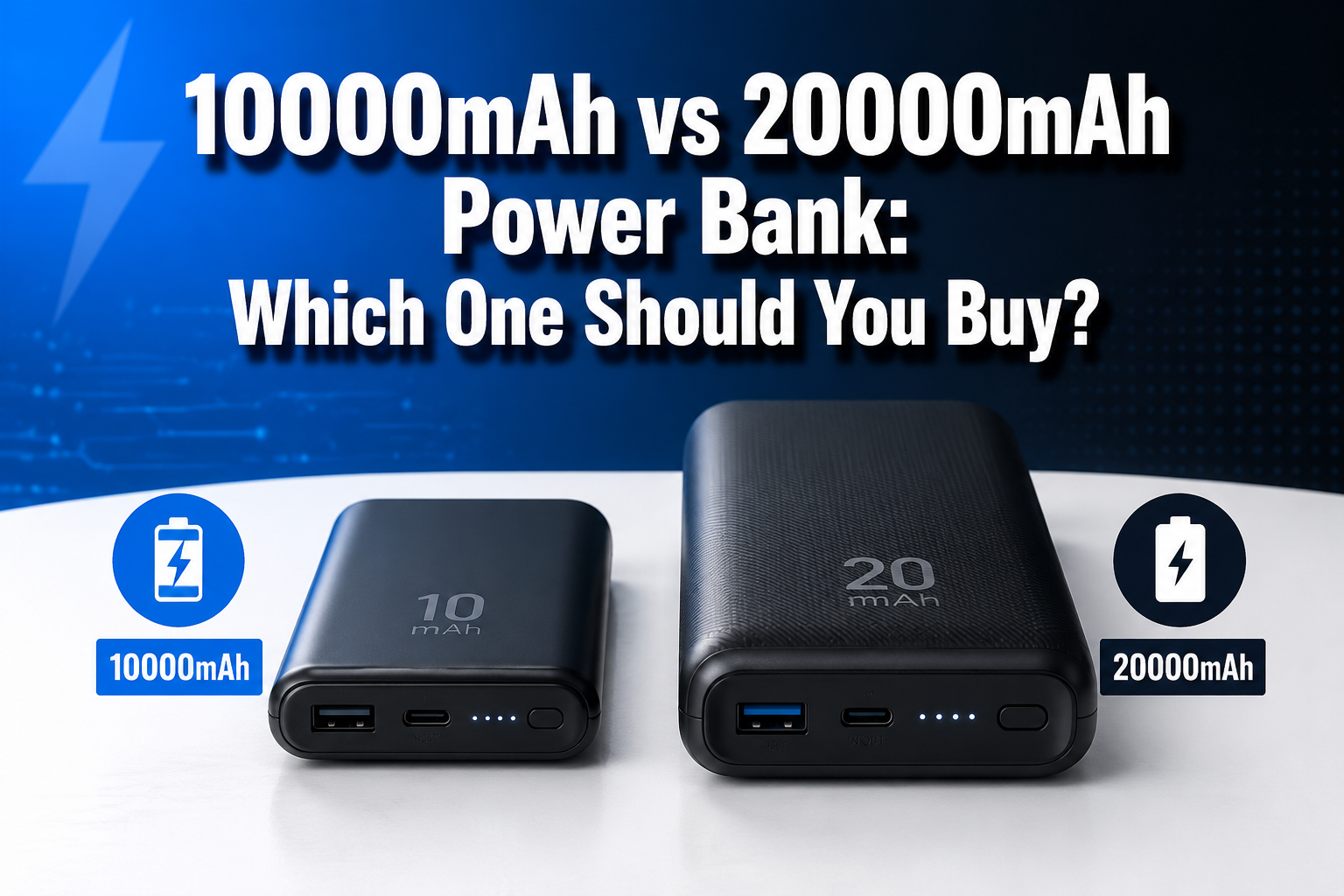
- A 10000mAh power bank typically weighs 180–220g and fits in a jacket pocket; a 20000mAh unit usually weighs 350–450g and needs a bag.
- A 10000mAh bank can fully charge most modern smartphones (4000–5000mAh batteries) roughly 1.5–2 times; a 20000mAh bank can do it 3–4 times.
- Real-world usable capacity is about 70–80% of the rated mAh due to conversion losses.
- Most airlines allow power banks up to 100Wh (roughly 27000mAh at 3.7V) in carry-on luggage — both sizes are generally permitted.
- 20000mAh banks cost more and charge more slowly (longer recharge time for the bank itself).
- For single-device, daily commuters: choose 10000mAh.
- For multi-day trips, multiple devices, or tablet/laptop charging: choose 20000 mAh.
- Fast-charging support (PD 45W, 65W) matters more than raw capacity for many users in 2026.
- Visit Amazon: https://amzn.to/3RKV9Gn
What Do 10000mAh and 20000mAh Actually Mean?
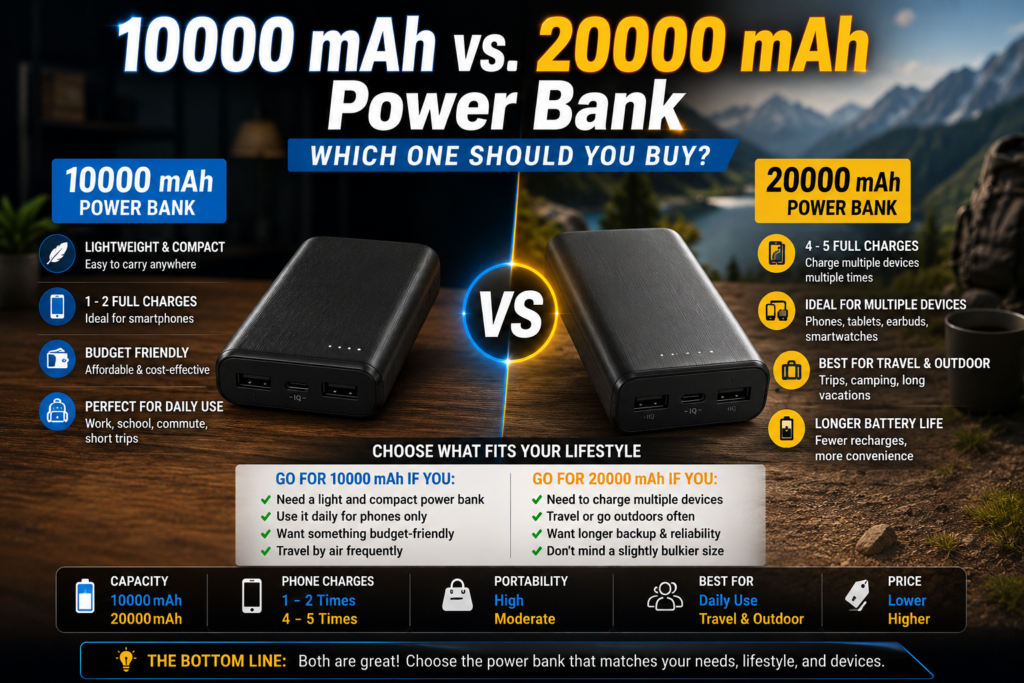
“mAh” stands for “milliampere-hour”; it measures how much electrical charge a battery can store. A higher number means more stored energy, which translates to more charges for your devices.
Here’s the practical breakdown:
| Spec | 10000mAh Power Bank | 20000mAh Power Bank |
| Typical weight | 180–220g | 350–450g |
| Typical size | Pocket-sized | Palm-to-fist-sized |
| Smartphone charges (5000mAh phone) | ~1.5–2x | ~3–4x |
| Tablet charges (8000mAh tablet) | ~0.8–1x | ~1.5–2x |
| Recharge time (via 18W) | ~3–4 hours | ~6–8 hours |
| Average price range (2026) | $20–$45 | $35–$70 |
Important caveat: No power bank delivers 100% of its rated capacity. Energy is lost during the conversion from battery voltage (3.7V) to output voltage (5V or higher). Expect roughly 70–80% usable efficiency. So a 10000mAh bank delivers about 7000–8000mAh of actual charging power to your device.
How Many Charges Does Each Size Actually Provide?
The number of charges you get depends on your device’s battery size, not just the power bank’s capacity. Use the 70–80% efficiency rule as your baseline.
Here are realistic estimates for popular devices in 2026:
10000mAh Power Bank (usable ~7500mAh):
- iPhone 18 Pro Max (~4685mAh battery): ~1.5 full charges
- Samsung Galaxy S26 Ultra (~5000mAh battery): ~1.5 full charges — see our Samsung Galaxy S26 Ultra review for battery details
- Google Pixel 10 Pro XL (~5000mAh battery): ~1.5 full charges — check the Google Pixel 10 Pro XL review for real-world battery performance
- iPad Pro (~10758mAh): ~0.7 partial charge
20000mAh Power Bank (usable ~15000mAh):
- iPhone 18 Pro Max: ~3 full charges
- Samsung Galaxy S26 Ultra: ~3 full charges
- iPad Pro: ~1.4 full charges
- Small laptop (45Wh battery): ~1 full charge (with 65W PD output)
Decision rule: If you charge one phone per day and return home each evening, 10000mAh is more than enough. If you’re away for 2+ days or carry multiple devices, the 20000mAh bank pays for the extra weight.
10000 mAh vs. 20000 mAh Power Bank: Which One Should You Buy for Travel?
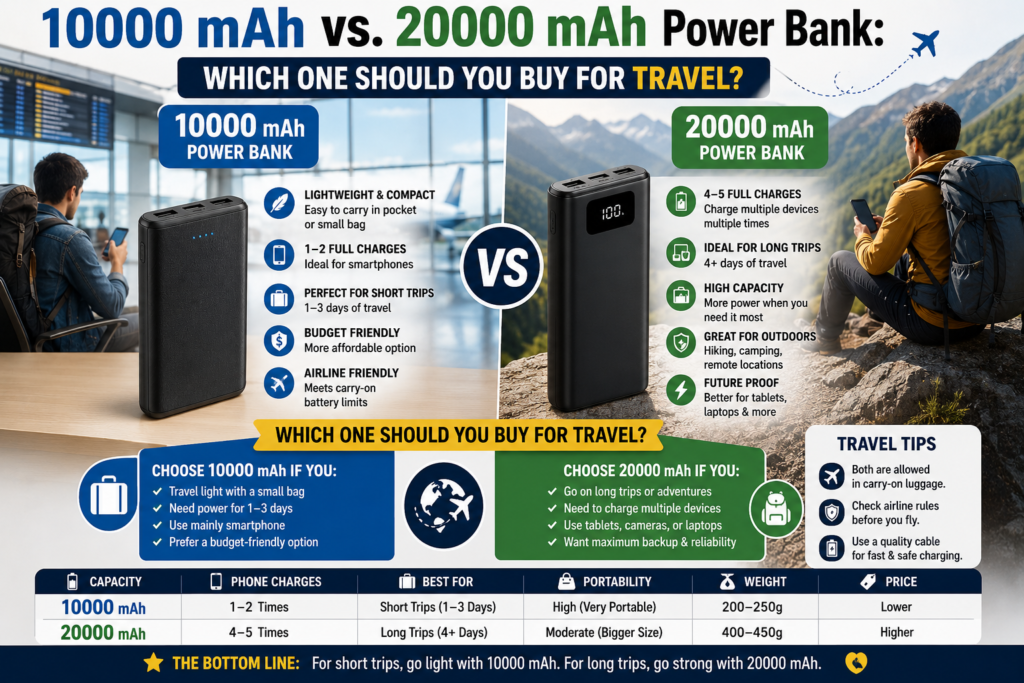
For air travel, both sizes are allowed on most airlines as carry-on items. The key limit is 100Wh (watt-hours), which equals roughly 27,000mAh at 3.7V—so both 10,000mAh and 20,000mAh banks fall well within limits. Always check your specific airline’s policy before flying.
For daily commuting or short trips:
- A 10000 mAh bank slips into a jacket pocket or small bag
- It adds minimal weight to your daily carry
- It handles one full emergency charge with capacity to spare
For international travel or multi-day trips:
- A 20000 mAh bank covers 3–4 days of moderate phone use without finding an outlet
- It can charge a phone and wireless earbuds simultaneously
- The extra 200–250g weight is a fair trade for peace of mind
“The best power bank is the one you actually bring with you. A 20000 mAh bank left at home because it’s too heavy helps nobody.”
Common mistake: Buying the largest capacity available “just in case.” Most users overestimate how much backup power they need. A 20000mAh bank that takes 8 hours to recharge itself becomes inconvenient on a fast-paced trip.
For users who travel with flagship phones like the Apple iPhone 16 Pro Max or the Xiaomi 13T Pro 5G, a 10000mAh bank covers most day-trip scenarios comfortably.
Does the Size Affect Charging Speed?
Capacity and charging speed are separate specs — a larger bank doesn’t automatically charge your device faster. What matters is the output wattage (measured in watts, W) and whether the bank supports fast-charging protocols like USB Power Delivery (PD) or Qualcomm Quick Charge (QC).
Key charging speed facts:
- Standard output: 5W–10W (slow, works on any device)
- Quick Charge 3.0/4.0: 18W–27W (fast for Android phones)
- USB-C PD 45W/65W: Fast for phones and tablets; required for most laptops
- Both 10000mAh and 20000mAh banks are available with 65W PD output in 2026
Using a quality USB-C to USB-C cable rated for the correct wattage is just as important as the power bank’s output spec. A 65W bank paired with a 5W cable will only charge at 5W.
Edge case: Some ultra-compact 10000mAh banks cap output at 12W–18W to keep the form factor small. If fast charging is a priority, check the spec sheet before buying — don’t assume a higher price means faster output.
10000 mAh vs. 20000 mAh Power Bank: Which One Should You Buy for Specific Use Cases?
The answer changes depending on who you are and how you use your devices. Here’s a direct breakdown:
Choose 10000mAh if you:
- Charge one smartphone per day
- Commute to work or school and return home daily
- Prioritize a lightweight bag or minimalist carry
- Travel on short weekend trips (1–2 nights)
- Use your power bank as an emergency backup, not a primary source
Choose 20000mAh if you:
- Carry two or more devices (phone + tablet, phone + earbuds + smartwatch)
- Travel for 3+ days without reliable outlet access
- Use a power-hungry device like a foldable phone (see the Samsung Galaxy Z Fold7 for battery demands)
- Work remotely and need to charge a small laptop in a pinch
- Camp, hike, or work in locations with no power access
For budget-conscious buyers: The price difference between a good 10000mAh and a good 20000mAh bank is typically $15–$25. That’s a small premium for double the capacity—but only worth it if you’ll actually use the extra power.
What Are the Pros and Cons of Each Size?
10000mAh Power Bank
Pros:
- Lightweight and pocket-friendly
- Faster to recharge itself (3–4 hours)
- Lower price point
- Easier to carry every day, so you’re more likely to have it when needed
- Passes through security and airline checks without any concern
Cons:
- Limited to 1.5–2 smartphone charges
- Not practical for tablets or laptops
- May not last a full multi-day trip
20000mAh Power Bank
Pros:
- 3–4 smartphone charges per cycle
- Can handle tablets, earbuds, and small laptops
- Ideal for long trips and remote work
- Better value per mAh at most price points
Cons:
- Heavier (350–450g) — noticeable in a bag
- Takes 6–8 hours to fully recharge
- Bulkier form factor; won’t fit in a pocket
- Slight overkill for everyday single-device users
Are there better alternatives to consider?
In some cases, neither size is the best answer. Here are three scenarios where an alternative makes more sense:
- You only need a top-up, not a full charge: A 5000mAh “slim” power bank (credit card size, ~100g) is enough for a 30–50% emergency charge and fits in a wallet case.
- You need laptop-level power regularly: Look at 25000–30000mAh banks with 100W PD output. These are heavier but purpose-built for laptops.
- You’re at a desk all day: A compact GaN charger with a short cable at your desk is lighter, cheaper, and more practical than carrying a power bank daily.
For users pairing a power bank with a rugged phone like the Samsung Galaxy XCover7 Pro, the phone’s own large battery may reduce how often you need the power bank at all.
What Should You Look for Beyond Capacity?
Capacity is just one spec. These features often matter more in daily use:
- Number of ports: At least one USB-C and one USB-A covers most devices
- Simultaneous charging: Can it charge two devices at full speed at the same time?
- Pass-through charging: Can it charge your devices while itself being recharged?
- LED indicator: Shows the remaining battery level clearly
- Brand reliability: Established brands (Anker, Baseus, Belkin, RAVPower) publish verified capacity specs; off-brand banks often overstate capacity
- Warranty: Look for at least an 18-month warranty
Quick checklist before buying:
- Check the output wattage matches your device’s fast-charge spec
- Confirm airline compliance (under 100Wh) if you fly
- Verify the number of output ports
- Read verified reviews for real-world capacity tests
- Check the recharge input wattage (higher = faster to top up the bank itself)
FAQ: 10000 mAh vs. 20000 mAh Power Bank
Q: Is a 20000mAh power bank allowed on planes?
A: Yes, in most cases. Most 20000mAh banks at 3.7V equal about 74Wh, which is under the standard 100Wh airline carry-on limit. Always verify with your specific airline before travel.
Q: How long does it take to charge a 20000mAh power bank?
A: Using an 18W charger, expect 6–8 hours. With a 65W PD charger and a compatible input port, some banks can recharge in 3–4 hours. Check the bank’s maximum input wattage.
Q: Can a 10000mAh power bank charge a laptop?
A: Only if the bank has a USB-C PD output of at least 45W and the laptop accepts USB-C charging. Most 10000 mAh banks with PD can provide a partial charge to thin laptops, but it’s not ideal for sustained use.
Q: Why does my power bank show less charge than the rated capacity?
A: Conversion losses during the step-up from 3.7V (battery) to 5V+ (output) consume 20–30% of stored energy. This is normal and applies to all power banks regardless of brand.
Q: Which is better for camping — 10000mAh or 20000mAh?
A: For camping trips of 2+ days without power access, a 20000mAh bank is strongly recommended. It can keep a phone charged for 3–4 days with moderate use.
Q: Does a higher mAh rating mean the power bank charges devices faster?
A: No. Charging speed depends on output wattage, not capacity. A 10000mAh bank with 45W PD charges a phone faster than a 20000mAh bank with only 10W output.
Q: What’s the best brand for power banks in 2026?
A: Anker, Baseus, Belkin, and RAVPower consistently receive high marks for accuracy of rated capacity and build quality. Always buy from brands that publish third-party test results.
Q: Can I bring two power banks on a plane?
A: Most airlines allow multiple power banks as long as each is under 100Wh and the total doesn’t exceed two units. Some airlines cap at two bags per passenger. Check your carrier’s policy.
Conclusion: Making the Right Choice in 2026
The 10000 mAh vs 20000 mAh power bank debate comes down to one honest question: how long are you away from an outlet, and how many devices do you carry?
For most people—daily commuters, students, and casual travelers—a 10000 mAh power bank is the smarter buy. It’s lighter, cheaper, faster to recharge, and provides enough backup for a full day with one smartphone.
For road warriors, remote workers, multi-device users, and anyone on trips of 3+ days, the 20000mAh bank is worth every extra gram. The capacity advantage is real, and the price difference is modest.
Actionable next steps:
- Count the devices you charge on a typical day away from home.
- Add up their battery capacities and multiply by 1.3 (to account for efficiency losses).
- If that number is under 8000mAh, buy a 10000mAh bank. If it’s over, go with 20000mAh.
- Prioritize fast-charging output (45W PD minimum) over raw capacity if you need quick top-ups.
- Stick to reputable brands and verify the spec sheet before purchasing.
The right power bank is the one that matches your actual routine — not the one with the biggest number on the box.
References
- Anker official product specifications and capacity testing documentation. https://www.anker.com
- IATA (International Air Transport Association). Lithium Battery Guidance Document. 2023. https://www.iata.org/en/programs/cargo/dgr/lithium-batteries/
- Baseus product engineering specs and output efficiency data. https://www.baseus.com
- FAA (Federal Aviation Administration). Pack Safe — Lithium Batteries. 2024. https://www.faa.gov/hazmat/packsafe