By TechnoItem Expert Team | Last Updated: July 24, 2026
Quick Answer
The top inexpensive digital cameras in 2026 sit in the $100–$350 price range and deliver genuinely good image quality for everyday photography, travel, and content creation. Brands like Canon, Sony, Nikon, and Kodak all offer solid budget options with features that would have cost twice as much five years ago. For most casual photographers, a budget point-and-shoot or entry-level mirrorless camera is all they’ll ever need.
Key Takeaways
- Budget digital cameras ($100–$350) now offer 20MP+ sensors, optical zoom, and 4K video in many cases.
- Canon PowerShot, Sony Cyber-shot, and Nikon Coolpix are the most reliable budget camera lines in 2026.
- A dedicated camera still outperforms most smartphones in optical zoom, low-light performance, and battery life for long shooting sessions.
- Point-and-shoot cameras are best for beginners and travelers; entry-level DSLRs and mirrorless cameras suit those who want to grow their skills.
- Always check sensor size, optical zoom range, and battery life before buying—these three specs matter most at the budget level.
- Memory cards, cases, and a stable tripod add value without breaking the budget.
- Refurbished cameras from certified sellers can cut costs by 30–50% with minimal risk.
- Smartphone cameras (like those on the Google Pixel 10 Pro XL) are a legitimate alternative but lack optical zoom depth and manual controls.
What Makes a Digital Camera “Inexpensive” in 2026?
A digital camera is generally considered inexpensive when it costs under $350. At this price point, buyers can find capable point-and-shoot cameras, entry-level mirrorless models, and older DSLR bodies that still perform well.
The $100–$200 range covers basic compact cameras ideal for casual use. The $200–$350 range unlocks better sensors, faster autofocus, and more manual control. Anything above $350 starts entering mid-range territory, where features like interchangeable lenses and larger sensors become standard.
Budget doesn’t mean bad. Many professional photographers keep a compact budget camera as a backup or travel body precisely because modern inexpensive cameras punch well above their price tag.
Key price tiers to know:
| Price Range | What You Get |
| Under $100 | Basic point-and-shoot, fixed lens, 720p–1080p video |
| $100–$200 | 20MP+, optical zoom, 1080p–4K video, Wi-Fi connectivity |
| $200–$350 | Larger sensors, faster AF, manual modes, better low-light |
| $350+ (mid-range) | Interchangeable lenses, APS-C sensors, and advanced controls |
Visit Amazon:https://amzn.to/4fnYYvh
Who Are the Top Inexpensive Digital Cameras Actually For?
Budget cameras are the right choice for specific types of users. They’re not for everyone, and knowing whether you fit the profile saves time and money.
Choose a budget digital camera if you are
- A beginner photographer learning composition and exposure basics
- A traveler who wants a lightweight, durable camera without worrying about theft or damage
- A parent or family photographer capturing everyday moments without complex settings
- A content creator who needs a dedicated camera for YouTube vlogs or social media
- A student studying photography or visual media on a tight budget
A budget camera may not be enough if you:
- Shoot professional events, weddings, or commercial work
- Need fast burst shooting for sports or wildlife
- Require interchangeable lenses for creative flexibility
- Work in very low-light conditions regularly
If you fall into that second group, consider stretching the budget to $500+ or exploring a used mid-range body. For smartphone comparisons, the Samsung Galaxy A16 with its 50MP camera is worth a look as a hybrid option.
Top Inexpensive Digital Cameras Worth Buying in 2026
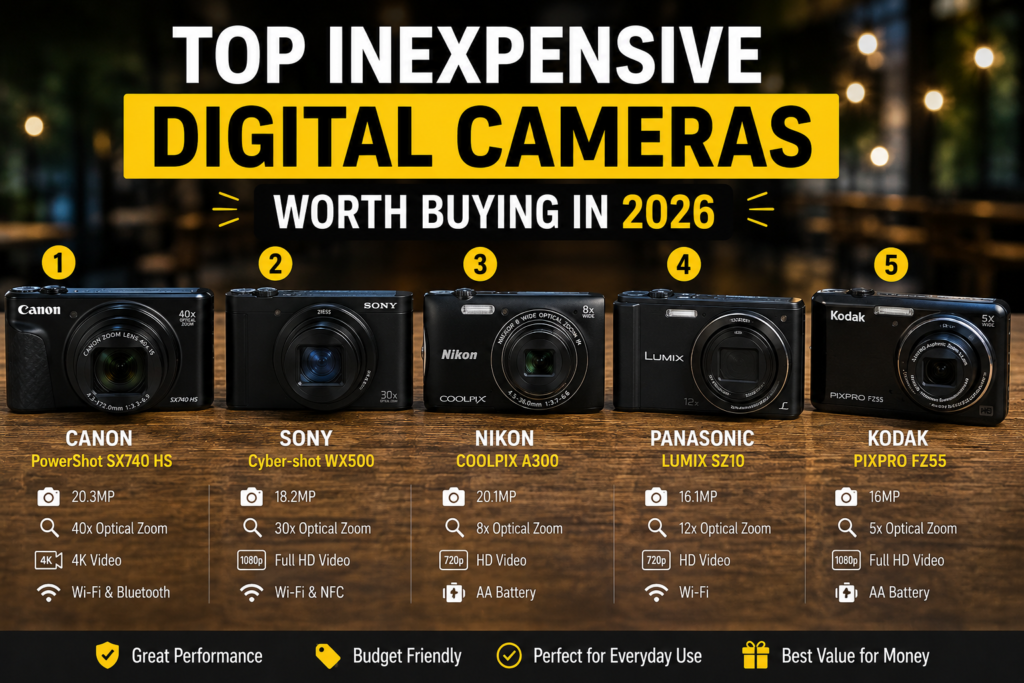
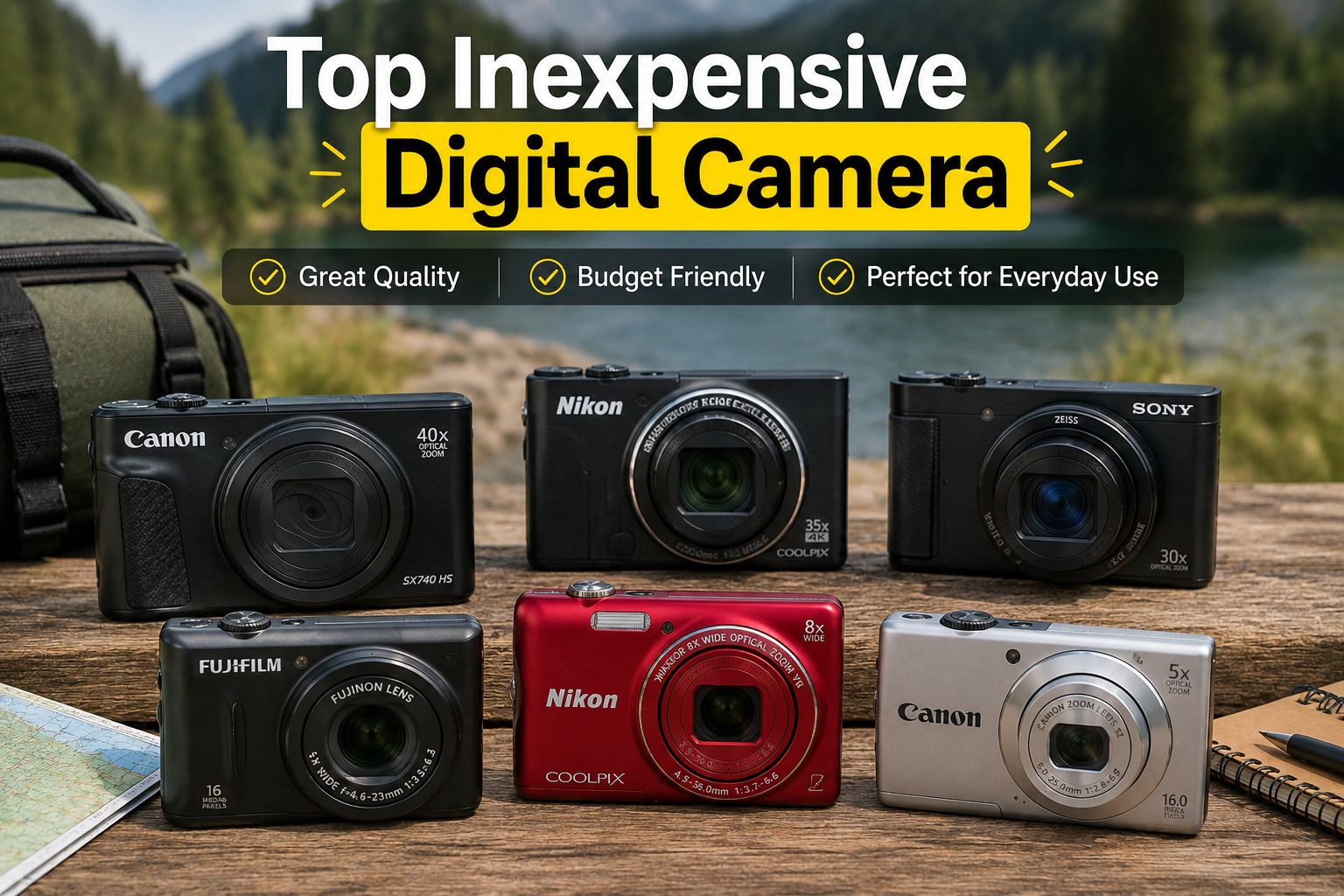
These are the most consistently recommended budget cameras across photography communities, retailer reviews, and hands-on testing in 2026. Prices reflect approximate retail at the time of publication.
🏆 Best Overall: Canon PowerShot ELPH 360 HS (~$150)
- 12x optical zoom, 20.2MP sensor
- Wi-Fi and NFC for easy sharing
- Slim, pocket-friendly design
- Great for travel and everyday shooting
📸 Best for Video: Sony Cyber-shot DSC-W800 (~$100)
- 20.1 MP, 5x optical zoom
- Simple controls, excellent color accuracy
- Ideal for beginners who want reliable stills and 720p video
- Lightweight at under 120g
🎥 Best for Vloggers: Canon PowerShot G7 X Mark II (~$320)
- 1-inch sensor (significantly larger than most budget cameras)
- 4.2x optical zoom, flip-up screen for selfies
- 1080p video at 60fps
- Popular with YouTube creators for a reason
🔍 Best Zoom: Nikon Coolpix B500 (~$200)
- 40x optical zoom—best in class at this price
- 16MP, Bluetooth, built-in Wi-Fi
- Excellent for wildlife, sports, and events where you can’t get close
💰 Best Under $100: Kodak PIXPRO FZ45 (~$75)
- 16MP, 4x optical zoom
- Simple interface, good for kids or casual users
- AA battery compatible — no proprietary charger needed
🔄 Best Refurbished Value: Sony Cyber-shot DSC-RX100 (Refurbished, ~$200)
- Originally a $700+ camera, now available certified refurbished
- 1-inch sensor, 10x optical zoom, exceptional image quality
- Best image-per-dollar ratio in 2026 for budget shoppers
How Do Budget Cameras Compare to Smartphone Cameras?
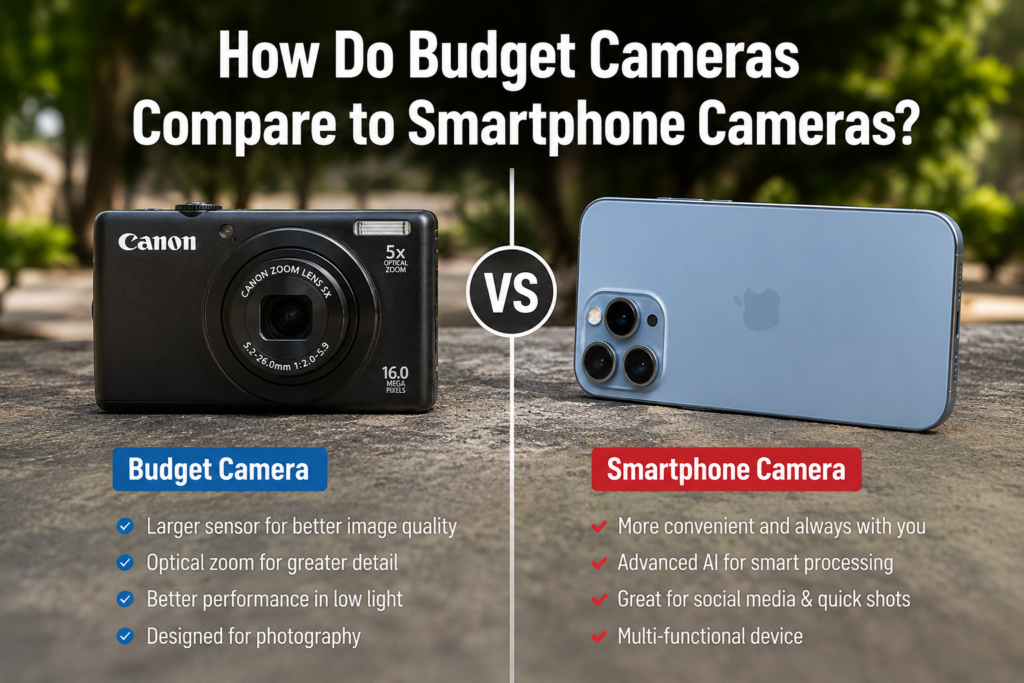
Budget digital cameras beat smartphones in three specific areas: optical zoom, battery endurance, and physical controls. Smartphones win on convenience, software processing, and connectivity.
| Feature | Budget Camera | Mid-Range Smartphone |
| Optical Zoom | 5x–40x | 3x–10x (most models) |
| Low-Light | Moderate | Good (AI-enhanced) |
| Battery Life | 200–350 shots | All-day (multi-use) |
| Manual Controls | Full | Limited |
| Portability | Good | Excellent |
| Sharing Speed | Moderate (Wi-Fi) | Instant |
For most casual users, a smartphone like the Google Pixel 9a handles daily photography well. But for travel photography, wildlife, or situations where you want a dedicated device, a budget camera still makes sense.
What Specs Matter Most When Buying an Inexpensive Digital Camera?
Three specs separate a good budget camera from a frustrating one: sensor size, optical zoom, and battery life. Everything else is secondary.
- Sensor Size
Larger sensors capture more light and produce better images, especially indoors or at dusk. A 1/2.3-inch sensor is standard at the budget level. A 1-inch sensor (found in the Sony RX100 line) is noticeably better and worth paying for if available. - Optical Zoom (not digital zoom)
Digital zoom is just cropping — it degrades image quality. Optical zoom uses actual glass elements and preserves sharpness. Look for at least 5x optical zoom for versatility. - Battery Life
Budget cameras often use small batteries. Check the CIPA rating (shots per charge). Anything under 180 shots per charge will frustrate you on a full day of shooting. Carry a spare battery if possible.
Other specs worth checking:
- Image stabilization (OIS beats digital stabilization)
- Video resolution (1080p minimum; 4K is a bonus)
- Wi-Fi or Bluetooth for easy transfers
- Weight and build quality for travel durability
For accessories that extend your shooting capability, a portable tripod pairs well with any budget camera for stable shots and long exposures.
Where to Buy Top Inexpensive Digital Cameras for the Best Price
The best prices on budget cameras come from a mix of sources, and knowing where to look saves real money.
Best places to buy in 2026:
- Amazon — Competitive pricing, easy returns, frequent deals on Canon and Sony models
- B&H Photo—Reliable for camera-specific purchases, often has open-box deals
- Best Buy — Good for in-store testing before buying; price-match guarantee
- eBay (certified refurbished) — Strong option for getting premium cameras at budget prices
- Manufacturer websites — Canon, Sony, and Nikon all run periodic direct sales
Common mistake: Buying from unknown third-party sellers without checking return policies. Always confirm the seller’s rating and return window before purchasing a camera online.
For more tech buying guides and reviews, the Camera category at TechnoItem covers a wide range of options across price points.
What Accessories Should You Buy With a Budget Camera?
A budget camera performs better with a few low-cost accessories. None of these is required, but each one solves a real problem.
- Extra battery (~$15–$25): Most budget cameras ship with one battery. A spare eliminates the fear of running out mid-shoot.
- Class 10 or UHS-I SD card (~$10–$20): Slow cards cause lag between shots. A fast card fixes this immediately.
- Camera case or bag (~$15–$30): Protects the investment and makes carrying easier.
- Tripod or mini tripod (~$20–$40): Essential for low-light shots, group photos, and video. See options at TechnoItem’s tripod guide.
- Screen protector (~$5–$10): Budget cameras often have plastic LCD screens that scratch easily.
Total accessory budget: $65–$125 covers everything needed to shoot confidently from day one.
Are Refurbished Budget Cameras Worth Buying?
Certified refurbished cameras from reputable sellers are worth buying in most cases. They typically cost 30–50% less than new, come with a warranty, and have been tested and repaired to manufacturer standards.
Choose refurbished if:
- The camera is certified by the manufacturer or a verified retailer (not just “seller refurbished”)
- It includes at least a 90-day warranty
- You’re targeting a premium model (like Sony RX100) that’s outside your new-camera budget
Avoid refurbished if:
- There’s no return policy or warranty
- The listing doesn’t specify what was repaired or tested
- The price is only 10–15% less than new—the risk isn’t worth the small saving
FAQ: Top Inexpensive Digital Cameras
Q: What is the best budget digital camera under $150 in 2026?
The Canon PowerShot ELPH 360 HS ($150) and Sony Cyber-shot DSC-W800 ($100) are the top picks. Both offer reliable image quality, optical zoom, and easy controls for beginners.
Q: Is a $100 camera worth buying, or should I just use my phone?
A $100 camera is worth buying if you need optical zoom, a dedicated shooting device, or longer battery life. For casual daily photos, a modern smartphone is equally capable or better.
Q: What’s the difference between optical zoom and digital zoom?
Optical zoom uses physical lens movement to magnify the subject without losing quality. Digital zoom simply crops the image, which reduces sharpness. Always prioritize optical zoom when comparing cameras.
Q: How many megapixels do I actually need?
For most uses, including 8×10 prints and social media, 16–20MP is more than enough. Megapixel count matters less than sensor size and lens quality at the budget level.
Q: Can budget cameras shoot good video?
Yes. Most cameras in the $150–$350 range shoot 1080p at 30fps or higher. Some, like the Canon G7 X Mark II, shoot 1080p at 60fps. True 4K is rare under $200 but available in some models.
Q: Do budget cameras work well in low light?
Budget cameras with small sensors (1/2.3-inch) struggle in low light compared to smartphones with AI processing. Cameras with 1-inch sensors (like the Sony RX100 series) perform noticeably better indoors and at night.
Q: What brand makes the most reliable budget cameras?
Canon and Sony consistently receive the highest reliability ratings in the budget camera segment. Nikon is also strong, particularly for zoom-range options.
Q: Should I buy a point-and-shoot or a used DSLR on a budget?
A point-and-shoot is better for portability and simplicity. A used DSLR gives more creative control and better image quality but is bulkier and requires learning more settings. Choose based on how serious you are about photography.
Q: Is Wi-Fi important in a budget camera?
Wi-Fi makes transferring photos to a phone or laptop much faster and easier. It’s a useful feature, especially for content creators. Most cameras above $150 now include it.
Q: What memory card should I buy for a budget camera?
A SanDisk or Lexar Class 10 or UHS-I SD card with at least 32GB storage is the standard recommendation. It ensures fast write speeds and enough space for a full day of shooting.
Conclusion: How to Choose the Right Budget Camera
The top inexpensive digital cameras in 2026 offer real value for photographers at every skill level. The decision comes down to three questions: How much do you want to spend? How important is zoom range? And will you grow into manual controls?
Actionable next steps:
- Set a firm budget before browsing—$100, $200, or $350 each unlocks a different tier of quality.
- Prioritize optical zoom and sensor size over megapixel count when comparing models.
- Check battery life ratings (CIPA standard) and budget for a spare battery.
- Consider certified refurbished if you want a premium model at a budget price.
- Add a fast SD card and a basic tripod to your order — these two accessories make an immediate difference in usability.
- Compare with smartphone options if portability is your top priority — devices like the Motorola Moto G 2026 offer strong cameras at competitive prices.
For more camera reviews, comparisons, and tech buying guides, browse the full Camera section at TechnoItem.
References
- Canon USA. (2023). PowerShot ELPH 360 HS product specifications. https://www.usa.canon.com
- Sony Electronics. (2022). Cyber-shot DSC-W800 product overview. https://www.sony.com
- Nikon Inc. (2022). Coolpix B500 specifications. https://www.nikonusa.com
- CIPA (Camera & Imaging Products Association). (2023). Battery life testing standard for digital cameras. https://www.cipa.jp