Quick Answer
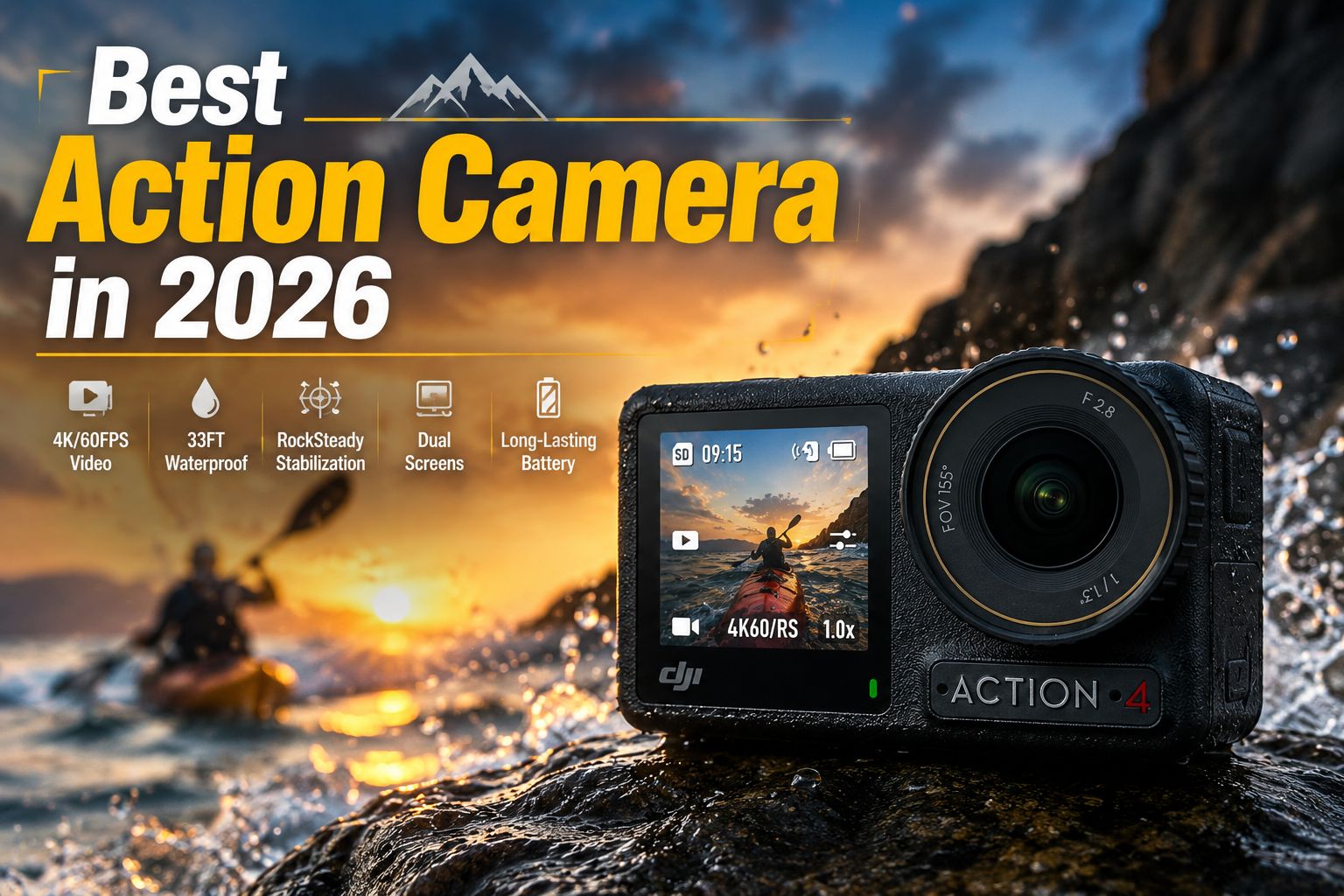
The GoPro Hero 13 Black and DJI Osmo Action 5 Pro are the top picks for most people looking for the best action camera in 2026. Both shoot 4K at 120fps, offer strong image stabilization, and handle water without a separate case. Your best choice depends on your budget, ecosystem preference, and whether you prioritize battery life or low-light performance.
Key Takeaways
- GoPro Hero 13 Black remains the benchmark for video quality and accessory compatibility in 2026.
- DJI Osmo Action 5 Pro leads in battery life and dual-screen usability.
- Insta360 Ace Pro 2 is the best pick for solo creators who need AI-powered auto-framing.
- Waterproofing depth, stabilization quality, and battery life are the three most important specs to compare.
- Budget action cameras (under $150) have improved significantly but still lag in low light and stabilization.
- Most action cameras now support voice control, making hands-free operation practical for extreme sports.
- Accessories like mounts and gimbals dramatically extend what an action camera can do—check our Camera category for compatible gear.
- 4K/60fps is the current sweet spot; 4K/120fps is available on premium models for smooth slow-motion.
- Subscription costs (GoPro’s Quik app, cloud storage) add to the total ownership cost.
- Always check the camera’s companion app quality before buying — editing on mobile is now a core feature.
What Makes the Best Action Camera in 2026?
The best action camera balances video resolution, stabilization, durability, and battery life in a compact body. No single spec wins the category on its own.
Here are the core criteria that separate a great action camera from a mediocre one:
- Video resolution and frame rate: 4K/60fps is standard; 4K/120fps is the premium tier.
- Image stabilization: Look for electronic stabilization (EIS) with horizon leveling. GoPro calls theirs HyperSmooth; DJI uses RockSteady.
- Waterproofing: Most top cameras are waterproof to 10–20 meters without a case.
- Battery life: Budget cameras often get 60–80 minutes; premium models push 150+ minutes at 4K.
- Low-light performance: Sensor size matters here. Larger sensors (1/1.7″ and above) handle dim conditions better.
- Companion app and editing: A strong mobile app reduces post-production time significantly.
- Accessory ecosystem: GoPro’s mount system is the industry standard, but DJI and Insta360 have caught up.
Decision rule: Choose GoPro if you already own GoPro mounts and want the widest accessory selection. Choose DJI Osmo Action if battery life and dual-screen convenience matter more. Choose Insta360 if you shoot solo content and want AI auto-editing features.
Visit Amazon:https://amzn.to/3RnAiZF
How Do the Top Action Cameras Compare?
| Camera | Max Resolution | Stabilization | Waterproof Depth | Battery Life (4K) | Price (Est. 2026) |
| GoPro Hero 13 Black | 5.3K/60fps | HyperSmooth 6.0 | 10m | ~90 min | ~$399 |
| DJI Osmo Action 5 Pro | 4K/120fps | RockSteady 4.0 | 20m | ~160 min | ~$329 |
| Insta360 Ace Pro 2 | 4K/120fps | FlowState | 10m | ~110 min | ~$349 |
| Akaso Brave 8 | 4K/60fps | EIS | 10m | ~75 min | ~$129 |
| Sony RX0 II | 4K/30fps | None (optical) | 10m | ~60 min | ~$699 |
Prices are market estimates as of mid-2026. Always verify current pricing before purchasing.
Common mistake: Many buyers focus only on maximum resolution. A camera that shoots 5K but has poor stabilization will produce shaky, unusable footage in real-world conditions. Prioritize stabilization quality over peak resolution.
Which Best Action Camera Is Right for Your Activity?
Different sports and use cases demand different strengths. Here’s a quick breakdown:
🏄 Surfing and water sports
- Prioritize waterproofing depth (20m+ preferred) and corrosion-resistant housing.
- Best pick: DJI Osmo Action 5 Pro (20 m rating without a case).
🚵 Mountain biking and motorsports
- Stabilization is critical. Helmet and handlebar vibrations destroy footage without strong EIS.
- Best pick: GoPro Hero 13 Black with HyperSmooth 6.0.
🧗 Hiking and travel vlogging
- Battery life and compact size matter most. Dual screens help with self-filming.
- Best pick: DJI Osmo Action 5 Pro or Insta360 Ace Pro 2.
🎿 Skiing and snowboarding
- Cold weather kills batteries fast. Look for cameras with cold-weather battery performance data.
- Best pick: GoPro Hero 13 Black (tested in sub-zero conditions by multiple reviewers).
🎮 Gaming content and desk setups
- Action cameras aren’t the right tool here. A webcam or mirrorless camera serves better.
For vloggers who also want a capable smartphone, see the Apple iPhone 18 Pro Max review for a comparison of mobile camera capabilities.
What Resolution and Frame Rate Do You Actually Need?
4K/60fps is the practical sweet spot for most users in 2026. Higher specs exist but come with trade-offs.
Here’s how to think about it:
- 1080p/60fps: Sufficient for social media clips and casual use. Smaller file sizes.
- 4K/30fps: Standard for YouTube and streaming. Looks sharp on most screens.
- 4K/60fps: Smooth motion, good for fast-moving subjects. The current mainstream standard.
- 4K/120fps: Allows 4x slow motion in post. Requires strong lighting and large storage cards.
- 5.3K/60fps (GoPro): Gives extra cropping room in editing without losing 4K output quality.
Edge case: If you plan to display footage on a large 8K TV or use it for professional film production, resolution matters more. For Instagram Reels and TikTok, 1080p is often sufficient and saves storage space.
Storage tip: 4K/60fps footage typically uses 2–4GB per minute, depending on bitrate. A 256GB microSD card is the practical minimum for a full day of shooting.
How Important Is Image Stabilization in an Action Camera?
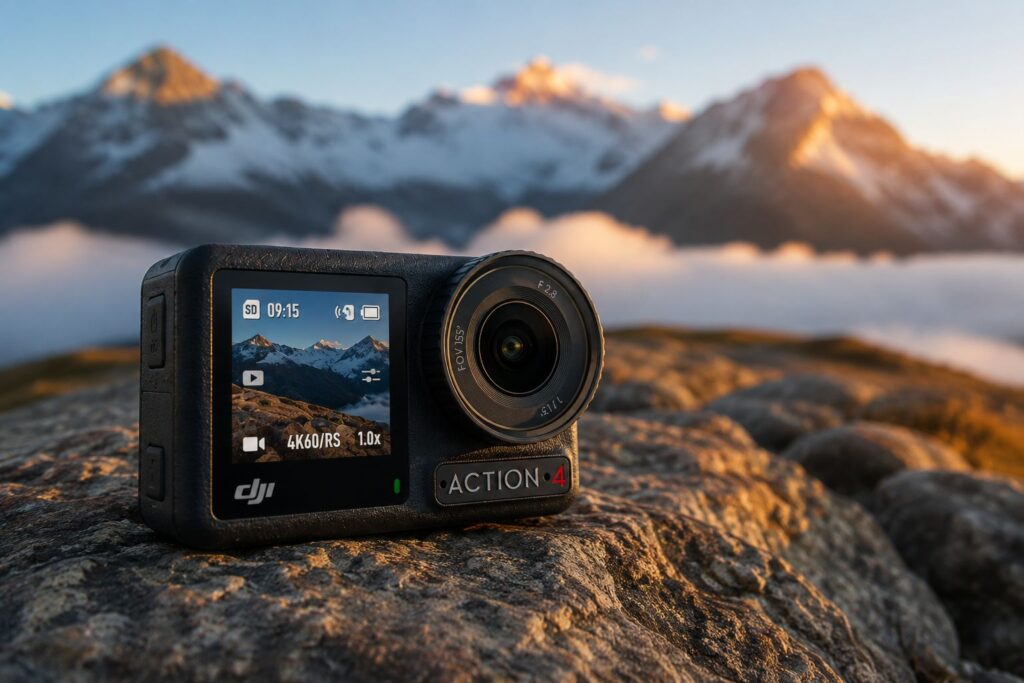
Image stabilization is arguably the single most important feature in an action camera. Shaky footage is unwatchable, regardless of resolution.
There are two types to know:
- Electronic Image Stabilization (EIS): Software crops the frame slightly and compensates for movement digitally. GoPro’s HyperSmooth and DJI’s RockSteady are the industry leaders.
- Optical Image Stabilization (OIS): Physical lens movement compensates for shake. Rare action cameras due to size constraints.
Horizon leveling is a sub-feature worth checking. It keeps the horizon straight even when the camera tilts up to 45–60 degrees, which is critical for surfing and skiing footage.
For users who want even smoother results, pairing an action camera with a gimbal is an option. The DJI Osmo Mobile 8 is a popular smartphone gimbal, and similar stabilization principles apply to action camera gimbals.
What Are the Hidden Costs of Owning an Action Camera?
The sticker price is only part of the total cost. Budget for these additional expenses:
- Extra batteries: Most cameras ship with one battery. A full day of shooting requires 2–3 batteries. Each costs $20–$50.
- MicroSD cards: Fast cards (V30 or V60 rated) are required for 4K recording. A 256GB card costs $30–$60.
- Mounts and accessories: Chest mounts, helmet mounts, and suction cups add $15–$80 each.
- Subscription services: GoPro’s Quik subscription (for cloud backup and editing tools) costs approximately $50/year as of 2026.
- Protective cases: Some activities require additional housing beyond the built-in waterproofing.
- Charging hubs: Multi-battery chargers cost $30–$60 but save significant time.
Total first-year cost estimate: Add $100–$200 to the camera’s retail price for a realistic budget.
If you’re mounting your camera to a vehicle or fixed surface, a stable mounting solution is essential. Our guide to the best tripod for cell phone cameras covers mounting principles that apply to action cameras as well.
Are budget action cameras worth buying in 2026?
Budget action cameras (under $150) are worth buying for casual users, beginners, and specific low-risk activities. They are not suitable for professional use or demanding conditions.
What budget cameras do well:
- Decent 4K/30fps or 4K/60fps video in good lighting
- Basic waterproofing (usually 10m)
- Compact and lightweight bodies
- Low financial risk if the camera is lost or damaged
Where they fall short:
- Stabilization is noticeably weaker than GoPro’s or DJI’s
- Low-light performance degrades quickly
- Companion apps are often poorly designed
- Build quality may not survive repeated impacts
Best budget pick in 2026: The Akaso Brave 8 offers 4K/60fps, 10m waterproofing, and decent EIS for around $129. It’s a reasonable starting point before committing to a premium model.
Decision rule: Buy a budget camera if you’re testing whether action camera footage fits your content style. Upgrade to GoPro or DJI once you know you’ll use it regularly.
How Does an Action Camera Compare to a Smartphone Camera?
For most casual users, a flagship smartphone now rivals or beats entry-level action cameras in video quality. But action cameras still win in specific scenarios.
Action cameras win when:
- You need hands-free, wearable footage (helmet, chest, surfboard)
- You’re in water deeper than 1–2 meters
- You need wide-angle footage without a clip-on lens
- Your activity would destroy a phone (motocross, whitewater kayaking)
Smartphones win when:
- You want the best low-light video quality (flagship phones now have exceptional night modes)
- You need cellular connectivity and instant sharing
- You want one device for photos, video, and communication
For reference, see how top smartphones handle video in our Google Pixel 10 Pro XL review and the Apple iPhone 17 Pro Max review. Both demonstrate how close smartphone video has come to dedicated cameras.
If you want a wireless microphone to pair with either device, the Mini Mic Pro Wireless is a practical addition for vloggers.
FAQ: Best Action Camera Questions Answered
Q: What is the best action camera for beginners in 2026?
The DJI Osmo Action 5 Pro is the best beginner pick because of its long battery life, dual screens for self-filming, and intuitive app. The GoPro Hero 13 Black is also excellent but costs more and has a steeper learning curve.
Q: Is GoPro still the best action camera brand?
GoPro remains the benchmark for video quality and accessory compatibility, but DJI and Insta360 have closed the gap significantly. GoPro is no longer the automatic choice for every user.
Q: What microSD card should I use with an action camera?
Use a card rated V30 or higher for 4K recording. For 4K/120fps or 5K, a V60 or V90 card is recommended. Brands like SanDisk Extreme Pro and Lexar Professional are reliable choices.
Q: How long do action camera batteries last?
At 4K/60fps, most premium cameras last 80–160 minutes per charge. Cold weather, high frame rates, and Wi-Fi use reduce battery life. Always carry at least one spare battery.
Q: Can action cameras be used as webcams?
Yes. The GoPro Hero 13 Black and the DJI Osmo Action 5 Pro both support webcam mode via USB-C. Video quality is excellent, making them a strong alternative to dedicated webcams.
Q: Are action cameras waterproof without a case?
Most premium action cameras are waterproof to 10–20 meters without a case. Budget cameras typically offer 10m protection. Always check the specific depth rating before diving.
Q: What is the best action camera for low-light filming?
The Insta360 Ace Pro 2 and GoPro Hero 13 Black perform best in low light due to their larger sensors (1/1.7″ and 1/1.9″, respectively). Low-light performance drops sharply on budget models.
Q: Do action cameras shoot vertical video for social media?
Yes. Most 2026 action cameras support vertical (9:16) shooting modes or allow vertical cropping in their companion apps, making them suitable for TikTok and Instagram Reels.
Q: What accessories are essential for an action camera?
At minimum: one extra battery, a 256GB V30+ microSD card, a helmet or chest mount, and a protective carry case. A floating handgrip is essential for water activities.
Q: How do I stabilize action camera footage in editing?
Most companion apps (GoPro Quik, DJI Mimo) apply additional stabilization in post-production. Adobe Premiere Pro and DaVinci Resolve also offer Warp Stabilizer tools for further smoothing.
Conclusion: Choosing the Best Action Camera for Your Needs
The best action camera in 2026 is not a single model — it’s the one that matches your specific activity, budget, and content goals.
Here’s a simple decision framework:
- Under $150: Start with the Akaso Brave 8 to test whether action-camera content fits your workflow.
- $300–$400, water sports focus: Choose the DJI Osmo Action 5 Pro for its 20 m of waterproofing and long battery life.
- $300–$400, general adventure: The GoPro Hero 13 Black offers the best stabilization and the widest accessory ecosystem.
- Solo content creators: The Insta360 Ace Pro 2 with AI auto-framing saves significant editing time.
- Professional or cinematic use: Consider the Sony RX0 II for its optical quality, accepting its limitations in stabilization.
Actionable next steps:
- Decide on your primary activity and budget before browsing.
- Read hands-on reviews from creators who film the same type of content you want to produce.
- Factor in the total cost of ownership, including batteries, storage, and mounts.
- Test the companion app before committing — a poor app experience undermines even the best camera hardware.
For more camera and tech buying guides, browse the full Camera category at TechnoItem.
References
- GoPro. (2024). GoPro Hero 13 Black Product Specifications. GoPro.com.
- DJI. (2024). Osmo Action 5 Pro Official Specs and Features. DJI.com.
- Insta360. (2024). Ace Pro 2 Product Overview. Insta360.com.
- Akaso. (2024). Brave 8 Action Camera Specifications. Akasotech.com.
- Sony. (2023). RX0 II Compact Camera Specifications. Sony.com.